
When you purchase gear through links on our site, we may earn a small commission. Here’s why you can trust our tests and our affiliate partner.
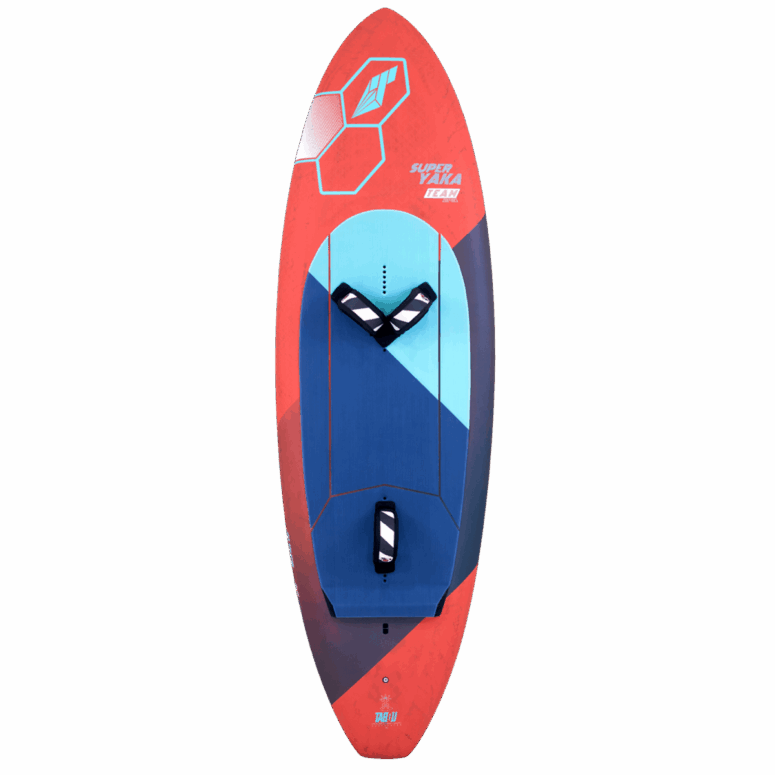
When the delivery driver called asking for help carrying everything into the garden, we immediately knew something more than just a few wings and foils had arrived. Judging by the size of the box, there had to be a seriously big board inside. And we weren’t wrong… although, considering the new Tabou Super Yaka is available in eight sizes ranging from 66L all the way up to 136L, ours could actually have been even bigger as we received the 86L.
Unpacking boards like this is always a bit of a mission. They’re wrapped layer after layer like an onion, with plenty of protection to ensure they arrive in perfect condition. After a few minutes of peeling everything away, we finally had the Super Yaka in our hands and the very first thing that caught our attention was its weight. For a board with this much volume and these dimensions, it felt quite light. That’s when we realized we had received the Team edition, built with a full carbon shell and premium reinforcements to keep the weight down without compromising strength. We spent a few minutes admiring the details and everywhere we looked the design seemed to serve a clear purpose. The long, narrow outline, the pronounced double-V bottom, and the clean, highly refined shape all hinted at a board designed to get flying as early and as efficiently as possible. We mounted the footstraps and, normally, this is the part where we’d say we headed straight to the water. Not this time. Instead, the Super Yaka Team went straight into storage, where it sat for well over a month while we patiently waited for the conditions we really wanted to test it in: proper marginal wind. After all, a board designed around early takeoffs deserves to be tested when every knot counts.
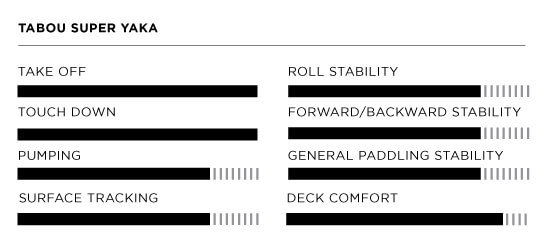
Our first session took place in fading onshore winds combined with brutally choppy water, exactly the kind of conditions that usually make you question why you even rigged your gear. The first challenge wasn’t getting on foil, but simply making it far enough from shore to have room for a proper waterstart while fighting against the elements. The board’s first major highlight came before we even made our first waterstart: paddling the Super Yaka into position was almost effortless. Despite its size, the board slices through the water with remarkably little resistance, making the paddle out far easier than we had anticipated. For reference, the 86L sits around 20 liters above our body weight, so flotation was never going to be an issue.
What we were really curious about was how stable such a long, narrow board would feel during the waterstart. As it turned out, we barely had time to think about it. The whole takeoff process felt incredibly natural. We settled into position, sheeted in with both hands on the boom, and the board immediately started accelerating. Within moments it released from the water and lifted onto the foil with almost no effort. There was virtually no pumping required in around 10-12 knots using a 4.5m wing. Watching such a large board get up and flying so easily in marginal conditions was genuinely impressive.
Once airborne, the biggest compliment we can give the Super Yaka is that it simply disappears beneath your feet. Despite riding a board with more than twice the volume we’re normally used to, it never felt bulky or cumbersome. It behaves much more like a smaller board than its dimensions would suggest. The real magic, however, happens during touchdowns. Whether you come off the foil after a mistake or make a less-than-perfect maneuver, the board accelerates so efficiently across the surface that getting back onto the foil feels almost effortless. Its hydrodynamic shape really comes into its own here, turning what would normally be frustrating recoveries into smooth, almost automatic takeoffs. These are exactly the kind of conditions in which we would normally leave the wing gear at home. Instead, we ended the session with a smile on our faces, wondering just how many marginal days this board could turn into fun sessions.
After that session, the Super Yaka went back into storage for a few more weeks until another proper light-wind day came along. This time, we decided to push it even further, pairing it with a 4m wing in just 8-10 knots to see how far we could stretch its limits. Once again, the board impressed us. The way it builds speed is simply remarkable. We had to pump a few times to get going every time, as expected in such marginal conditions, but thanks to its clever volume distribution and efficient hull shape, every pump translated into forward speed. It never felt like we were fighting the board, it was working with us every step of the way.
The Super Yaka Team is, without a doubt, a true light-wind machine. More importantly, it delivers that performance in a way that is accessible. Despite its long and narrow outline, it never feels overly technical or demanding. Riders with limited experience in this style of board should have no trouble adapting to it and taking full advantage of those marginal days that would otherwise go unridden. Although Tabou doesn’t specifically market it as a parawing board, we couldn’t help but think it would be a very suitable platform for that discipline as well. Its effortless glide, efficient takeoffs and forgiving nature seem like an excellent match for the low-power characteristics of a parawing. If your local spot is often blessed with light winds, or if you simply want to maximize your time on the water, the Super Yaka Team deserves a serious look. It transforms sessions that would normally be written off into enjoyable rides, whether you’re cruising, linking endless downwind runs or sneaking in a few waves along the way. It’s one of those boards that genuinely expands your riding window and that’s perhaps the biggest compliment we can give it.