
When you purchase gear through links on our site, we may earn a small commission. Here’s why you can trust our tests and our affiliate partner.
Starboard’s legacy in SUP and windsurfing are useful tools in the arsenal when it comes to designing modern foil boards and we’ve seen some interesting shapes from them over recent times, with the latest Above model being presented as a discipline-spanning midlength outline. There’s a comprehensive 10 size range from 34l to 155l. In fact, we can’t think of another board model range on the market with this span of volumes. Couple this with the fact you can choose from three different construction levels, with smaller boards up to 45l available in Blue Carbon, then for the mid sizes you also choose Blue Carbon or Limited Series. The largest 155l has an ASAP option which is a center spec build, and every conceivable option is available to you.
Our test board sat more or less in the middle of the range at 101l and 6’10” x 21” and was in Limited Series fiberglass construction. For a 90kg colossus of a rider, this was the perfect board for some wingfoil and parawing crossover action, which is increasingly the theme of our current wind sports routine.
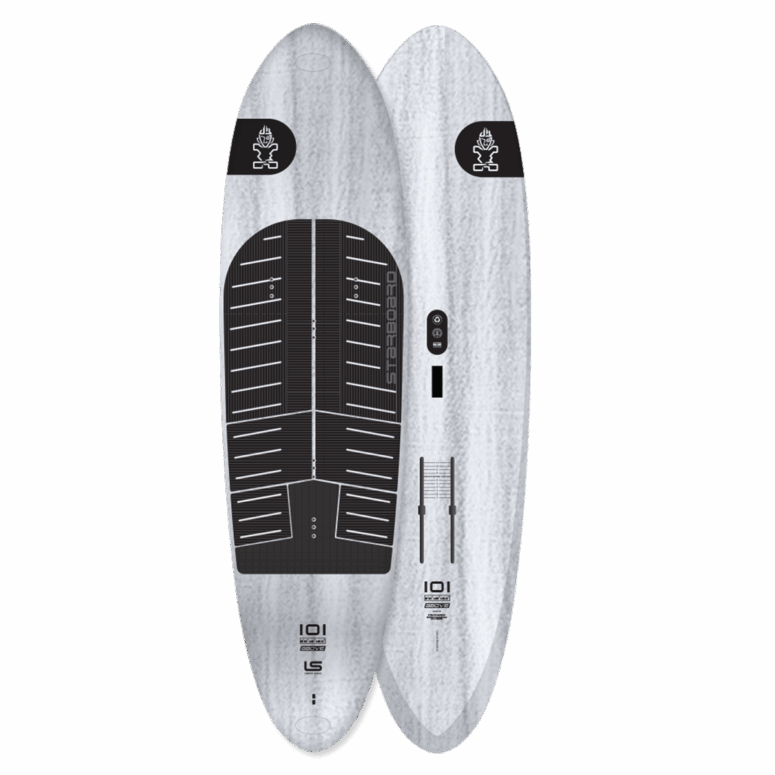
Aesthetically, considering Limited Series is quite competitively priced, the Above is on point. You’d be hard pressed to tell it apart from some full carbon boards as the sanded back finish feels premium. Shape-wise, it’s like some sort of futuristic warship. The Starboard legacy of SUP and windsurf influence is plain to see, almost a fusion between features from each discipline and there’s plenty of detail to discuss here. The nose is a rounded and domed affair retaining plenty of volume and avoiding nose diving with bad foot placement. The standing area is largely flat with a slight concave, and with the nose and tail sections domed, it sits recessed in comparison to the top line of the board. The footpad is a high-quality EVA and feels like a high-end SUP to stand on. They’ve textured the area over the foil box with a squared pattern so you can feel and locate where your back foot is without looking down.
Underneath, the hull shape rails are parallel and boxy to promote stability and have gently rounded edges, leaving plenty of flat efficient planing surface on the underside. Rocker is forced into the middle section of the board under the standing area, with an elongated foil box relatively forward placed. The nose section has quite a deep V which batters its way through chop like a speedboat and the tail is fettled back to a point, much like a race SUP. The outline is like an elongated teardrop.
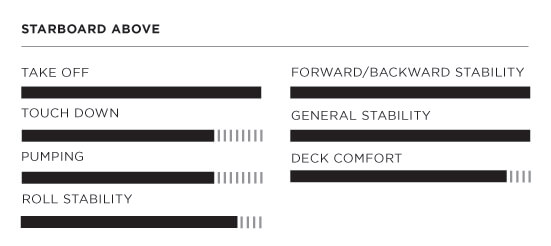
Once you hop on, the immediate feeling is how stable the board is – considering the width, it has exceptional static balance. The concave deck, volume distribution and squared rail combine to provide an extremely stable platform. Forward placed volume means it’s difficult to nosedive and great to bounce out for parawing. Considering this is a fiberglass board, not carbon, it has an impressive level of foil feedback for a relatively thick board and weight is impressive; it at no point felt cumbersome.
When it comes to board shapes, Starboard aren’t afraid to shun market trends and go their own well-founded path, and in this instance it’s paid dividends producing a highly practical and accessible platform that spans disciplines like a mighty grey aircraft carrier. It made our sometimes fumbly lower wind parawing adventures a simpler excursion. Winging in light wind is an absolute doddle, and anyone just over beginner level upwards with a bit of balance could hop on one of these of an appropriate volume and foil much more easily than with a wider board. It’s a testament to the midlength shape in general that it can be scaled so far both up and down in volume and still be such a successful and easy shape.