When you purchase gear through links on our site, we may earn a small commission. Here’s why you can trust our tests and our affiliate partner.
The PPC Orbit is a very impressive first iteration of the brand’s parawing, and rather than starting with a simple single-skin design, they’ve gone straight for upwind angle, speed, range and power management with a full dual-skin. The idea is pretty simple: combine the speed, stability and upwind efficiency of a dual skin with something practical enough to stash, relaunch and use for everyday downwind sessions.
The big talking point is PPC’s PAL, or Power Assist Line. It essentially works like adding flaps to the back of the wing. Pull it on and you add more grunt and low-end pull for getting onto foil, release it once moving and the profile cleans up, accelerates and flies farther forward in the window. It addresses the biggest weaknesses of previous dual-skin parawings: plenty of efficiency once moving, but not always enough immediate low-end power.
Developed alongside NOVA Paragliders, the Orbit uses lightweight 26gsm silicone-coated material across both skins, with Kevlar lines and a lightweight ergonomic carbon bar. Despite having more material than a single skin, the lightweight canopy and short line setup keep the overall package surprisingly compact.
Most of my testing was around Namotu in Fiji using only an Orbit 2.7m, Kaohi Parawing Belt + Harness line, and an Armstrong Midlength MkII 65L with a KT Solus 650. Fiji is often under 20mph, but I also had sessions in the 18-22mph range and some properly powered 25-30mph conditions, giving me a good spread for testing both the low and top end, along with repeated foot launches, water relaunches and long upwind runs toward Cloudbreak.
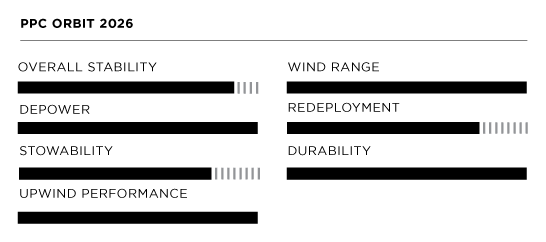
The first thing that really stood out to me was the upwind performance. The Orbit just wants to keep driving forward. Instead of loading up harder and harder as the wind increases, it accelerates and sits farther forward in the window. You can keep squeezing more angle out of it without feeling like you’re simply loading the foil sideways. On my third or fourth session, I made a dry run from Namotu toward Cloudbreak incredibly quickly, in three tacks and looking back at the GPS angles afterwards confirmed what I was feeling on the water. It absolutely trucks upwind, with a smoothly fast VMG.
The wind range is equally impressive. With the PAL pulled on, there’s a surprising amount of low-end grunt for a dual skin. With slight finesse, it gives you something solid to pump against and helps get the board moving. Once on foil, easing the PAL back out completely changes the character of the wing. It becomes light in the hands, efficient and ridiculously comfortable as the wind picks up.
That top end handling is one of the Orbit’s next biggest advantages over a normal single skin. Gusts translate more into speed than arm load, and long upwind legs are noticeably less physically taxing. The depower is impressive too because you’re not simply dumping power the wing accelerates farther forward in the window and becomes more efficient. Water relaunching also surprised me. Even after getting the Orbit properly wet, releasing the PAL, lifting the leading edge and giving it a moment to drain allowed it to refill and come out of the water without much drama.
When sitting overhead or resting with minimal input, it feels very stable as long as there’s enough wind keeping the cells pressurized. In lighter or inconsistent wind, it requires a little more attention than a forgiving single skin.
There is definitely a learning curve though. I wouldn’t call this a beginner parawing. Coming from a single skin, the temptation is to over-handle it. The Orbit likes small, controlled inputs and consistent line tension. Too much rear bar pressure, or too much PAL pulled in, and you can push it into a pretty aggressive backstall. Once you understand that, it becomes intuitive.
Tacking is a standout. It carries speed through the top of the window really well and comes onto the new side cleanly without yanking you downwind. Jibing takes a little more timing and you need to be a bit more deliberate about keeping the canopy flying through the transition. That said, coming from a beginner level in traditional kitefoiling, the Orbit is also much easier to manage than a kite. For anyone sailing upwind before turning around and surfing back, that efficiency genuinely means more time doing the fun part.
Stowing is better than I expected from a dual skin. There’s obviously more fabric to deal with, but the light canopy and short lines help a lot. Once the technique is dialed, it packs away quickly enough that the dual-skin construction doesn’t really take away from the downwind experience.
Compared with a standard inflatable wing, you give up some rigid structure and instant power delivery, but gain a completely different level of freedom once it’s time to stash and surf. Compared with a single-skin parawing, the Orbit asks a little more from the rider but rewards you with more speed, better angles and a huge usable range.
Overall, the Orbit feels like a true high-performance parawing that has finally made the benefits of a dual skin practical. It’s fast, ridiculously efficient, has a massive usable range and keeps rewarding you more as you understand how to fly it.