When you purchase gear through links on our site, we may earn a small commission. Here’s why you can trust our tests and our affiliate partner.
The North Midi Pro is a board we’ve seen plenty of as it’s the board of choice for several wing buddies of ours, so we were thrilled to finally get our hands on the 2027 iteration for testing. Actually, getting hold of it proved to be its own challenge: our test unit happened to be the distributor’s personal favorite, and he kept pushing back the delivery date. After some persistent nudging, we finally secured the 70-liter version. The Midi Pro comes in seven different sizes, from 50L to 110L, making it adaptable to virtually any rider.
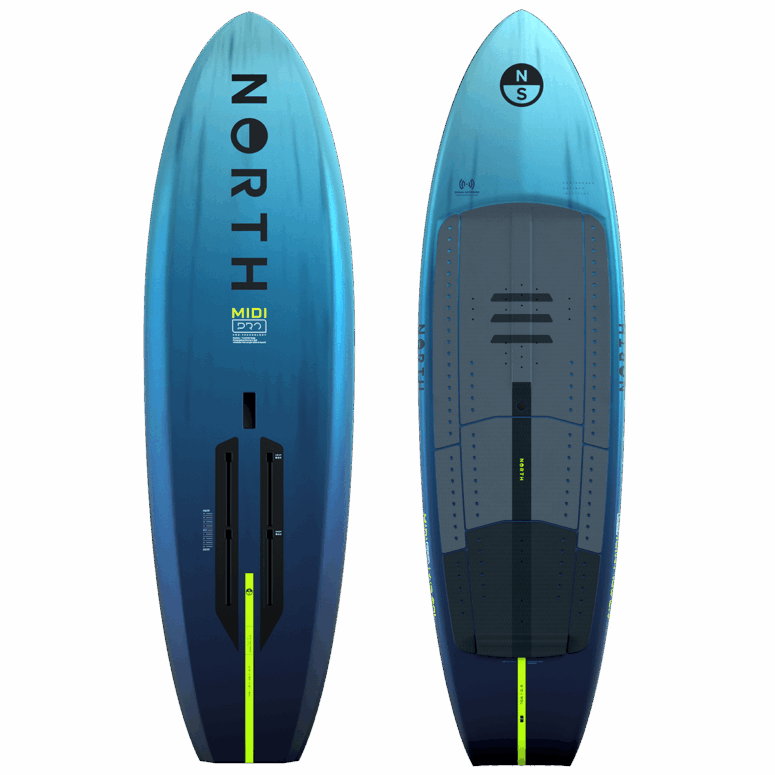
As you probably know, boards are particularly vulnerable to scratches and we always try to keep our test units in the best possible condition, so we brought our own board bag when we went to pick it up. It turns out we didn’t need it: all Pro versions in the North range come with their own board bag. And it is a pretty nice one too. Once out of the bag, we could take a closer look at the Midi Pro. It is a slim, mid-length board with a V-shaped hull, a distinctive low-entry rocker and rounded rails. Construction is a full carbon PVC wrap, which results in a relatively light board. Despite the low weight, North has included a handle, making transportation much easier once the board is fully rigged. Our test board already had the straps mounted, but the Midi Pro offers plenty of insert positions, making it easy to find the right stance and footstrap positioning.
Another interesting feature is the board’s versatility across different foil disciplines. The Midi Pro is designed to work with everything from wingfoil to other foil disciplines, and it also features North’s E-Glass 2.6GHz signal window, making it compatible with foil-drive-assist systems.
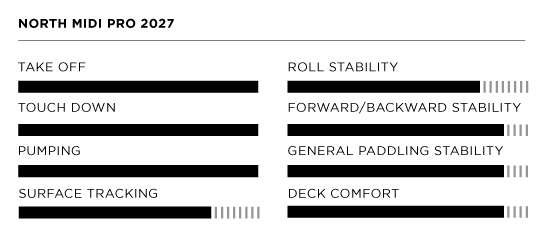
For our first session, we had a solid wind blowing, so we paired the board with a 670 foil and a 4m wing. At 70 liters, this gives us roughly a 1-liter-to-1-kilogram ratio. The waterstart is typically the trickiest part of riding this style of board, and from the outside, this one looked like it might be no exception, but that impression couldn’t have been further from reality for anyone with a bit of experience. The board stays remarkably stable while you’re positioning for the waterstart, and the real magic kicks in the moment you apply a touch of power to the wing. It genuinely slices through the water and builds speed impressively fast, making the transition from waterstart to flying quick and effortless. If there’s one word that defines this board, it’s efficiency, something we’d come to appreciate even more the following day. Given the conditions, we leaned into a racing-style session, chasing top speed. We assumed the board’s length might work against us in the air, but honestly, once up on the foil, the board essentially disappears beneath you – it’s only on touchdown that you’re reminded of its presence, and even then, in a good way: thanks to its shape and volume distribution, it holds speed beautifully and gets you back up on the foil almost instantly.
For our next session, we set out to properly test the low-end performance, suspecting this could be a genuine light-wind machine, and we weren’t wrong. This time we paired an 800 foil with a 4.5m wing in light wind, and that’s exactly where the Midi Pro truly shone. Once again, the low-end performance impressed us. We had to pump hard, both board and wing, to get going, but the way it builds speed from there is remarkable, leaving us with the sense that this board could be a genuine session-saver for anyone based somewhere with consistently light wind. With some nice swell rolling in a bit further out, we made the most of the conditions and headed that way. Linking swells and carving felt genuinely fun as the board is agile, quick and rides noticeably smaller than its actual dimensions suggest. But once again, what really stood out, especially in those marginal conditions, was how effortlessly it got back up on the foil whenever we lost speed and needed to re-pump. As we said: efficiency is the name of the game here.
The distributor wanted his board back ahead of a promising forecast, so that wrapped up our time with the Midi Pro. We can say with confidence that this board makes for an excellent crossover platform across disciplines, a genuinely compelling option for any waterman or waterwoman who likes to mix winging, parawinging, downwinding, and even SUP paddle-ups.
Is it suitable for everyone? Probably not. The board has a fairly clear target rider in mind. First are the riders who like mixing disciplines. Its combination of stability, efficiency, speed and relatively compact feeling makes it a very interesting option for anyone who wants one board that can cover several different foil disciplines. If we focus specifically on wingfoil, which is where we spent our time testing it, the Midi Pro should appeal particularly to freeriders and wave riders. Despite its mid-length outline, it feels agile and lively once on the foil, while the extra length and volume distribution provide a huge advantage when getting going and recovering from touchdowns.
And if light wind is a major part of your riding conditions, the North Midi Pro could be a genuine session saver. It may look like a specialized board at first glance, but its ability to build and retain speed makes it a surprisingly versatile and efficient platform.