































When you purchase gear through links on our site, we may earn a small commission. Here’s why you can trust our tests and our affiliate partner.
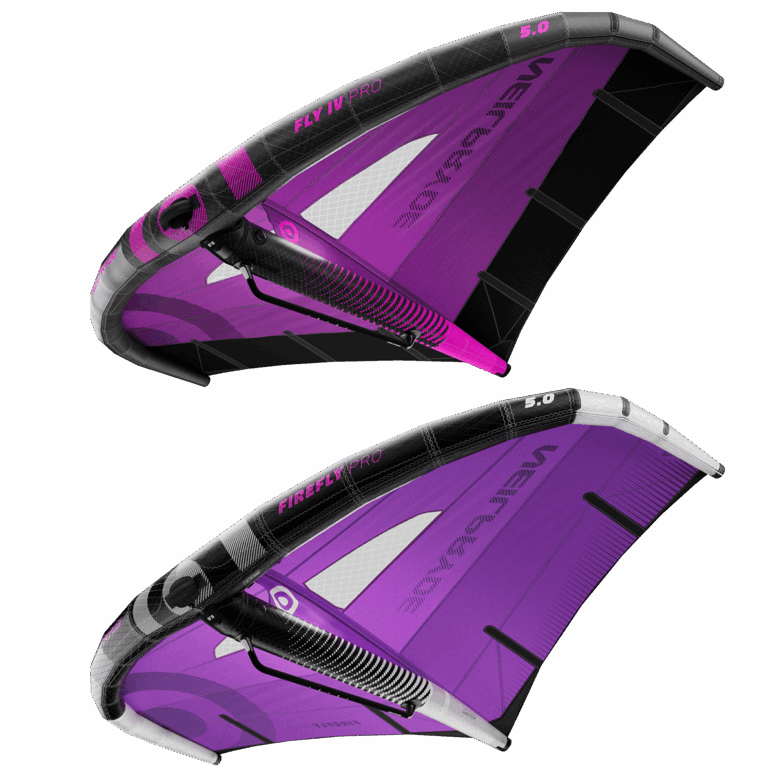
From a distance, they might look like twins, sharing similar color palettes, same boom system and a familiar silhouette. However, the closer you get, the differences between the all-new NeilPryde Fly Pro IV and the Firefly Pro quickly become clear. We’ve had the opportunity to spend an extended period riding and testing both wings, and here’s what we found.
Let’s start with the most obvious point: their shapes. The Fly Pro IV features a slightly higher aspect ratio, giving it a more elongated outline compared to the Firefly Pro. The biggest differences, however, go beyond the outline and lie in the materials used for the leading edge and strut. The Firefly Pro relies primarily on Aerotex, a high-tech composite made from woven UHMWPE (Ultra High Molecular Weight Polyethylene) with a distinctive black finish. It’s further enhanced with a protective film on one side and reinforced with Aramid X-Ply in the core. At the tips, NeilPryde uses Aerotex Light, around 10% lighter than the standard version, to strike a better balance between weight and stiffness. The Fly Pro IV, on the other hand, is built with Aluula Aeris X, a premium material that’s roughly 50% lighter than traditional fabrics, significantly stronger, highly tear-resistant and especially, super stiff. Its wingtips use Aeris, which maintains many of the same benefits while offering slightly more flex and less weight.
As you can see, the most meaningful differences between these wings come down to frame shape and material choices for the frame. Beyond that, they share a lot in common. Both feature a highly durable 5×5 yarn ripstop canopy at the front, paired with an even tougher 6×6 ripstop in the trailing sections. They also come equipped with individual SUP valves, a comfortable boom and a high level of attention to detail throughout.
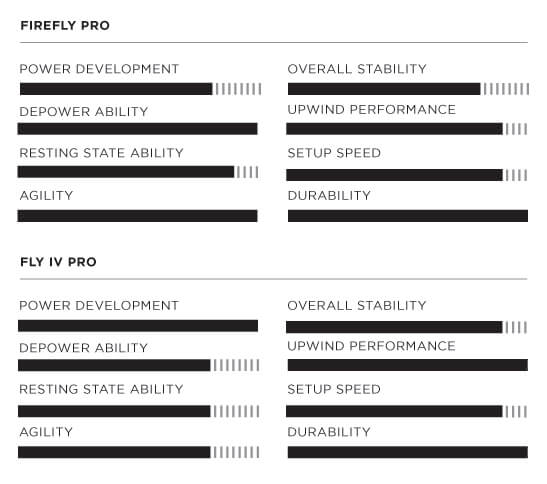
Luck was on our side for our first session: a classic mix of gusty wind paired with unusually clean, surfable waves. After pumping both wings for a side-by-side comparison, we headed out first with the Firefly Pro. Right away, it felt agile and comfortable, with excellent maneuverability. After just a few waves, it was clear this wing thrives in surf conditions. It drifted beautifully and sat in a perfectly neutral position when flagged out, yet delivered immediate power the moment we needed to accelerate back out of the wave zone. That same character carried over into freestyle. The lift felt explosive, not just upward, but with a strong forward pull that naturally set you up for more advanced moves, practically begging for inverted flips and advanced rotations. It all came together with impressive hangtime and a high level of control during jumps. After 30–40 minutes, we came in to swap wings and headed back out with the Fly Pro IV. From the very first waterstart, the difference was noticeable. The wing felt significantly stiffer, which translated into better low-end power. On the first tack, we were already riding faster and pointing higher upwind. In the waves, it remained composed and predictable in most situations… on the way in, during the ride, and heading back out. However, during tighter bottom turns, it occasionally felt a bit less at home, sometimes getting slightly in the way or brushing the water. That’s likely a trade-off of the higher aspect ratio and possibly, just a matter of adapting to the wing rather than a true limitation. In freestyle, the contrast became clearer. The lift is still solid, but more vertical, with less forward drive. It’s certainly capable of a fun session, but lacks the razor-sharp, trick-oriented edge that makes the Firefly Pro a true freestyle weapon.
After that first session, we logged several more on both wings and started to see a clear pattern emerge. The Fly Pro IV really came into its own on days without proper waves but with some rolling swell. Its added speed made it easier to link bumps and glide from one section to the next, turning otherwise average conditions into genuinely fun sessions. It also consistently delivered better low-end power and improved upwind performance, just as we noticed from the start, making it the go-to for maximizing time on the water or whenever we were in the mood to push our racing pace.
The Firefly Pro, on the other hand, shined when the wind picked up or became gustier. Its slightly softer, more forgiving feel made it more comfortable to handle in those conditions. Where it truly stood out, though, was in waves and freestyle. On the surf, it felt intuitive and playful, and in the air, it really came alive, unlocking new moves and combinations thanks to its lift, control and quick rotation speed, proving itself as the more creative, high-performance choice for technical riders.
At first glance, it’s easy to mistake them for the same wing. The similar color schemes and overall layout give them a very close visual identity. Even on the water, they share an important trait: both make it surprisingly easy to unlock performance without needing a pro-level skill set. But which one to choose?
Both wings perform well across multiple disciplines and neither feels demanding. That said, they each have a clear sweet spot. The Fly Pro IV is an exceptional choice for beginners due to its effortless low-end and upwind drive, but it’s a powerhouse for advanced riders in light-wind environments like inland lakes, open-ocean downwinders where connecting swells is the goal and for speed-run seekers. The Firefly Pro, however, is a different animal altogether. It’s the ultimate pick for the rider seeking a versatile, high-fun factor wing that delivers pro-level freestyle and wave performance in a manageable, intuitive package.