

When you purchase gear through links on our site, we may earn a small commission. Here’s why you can trust our tests and our affiliate partner.
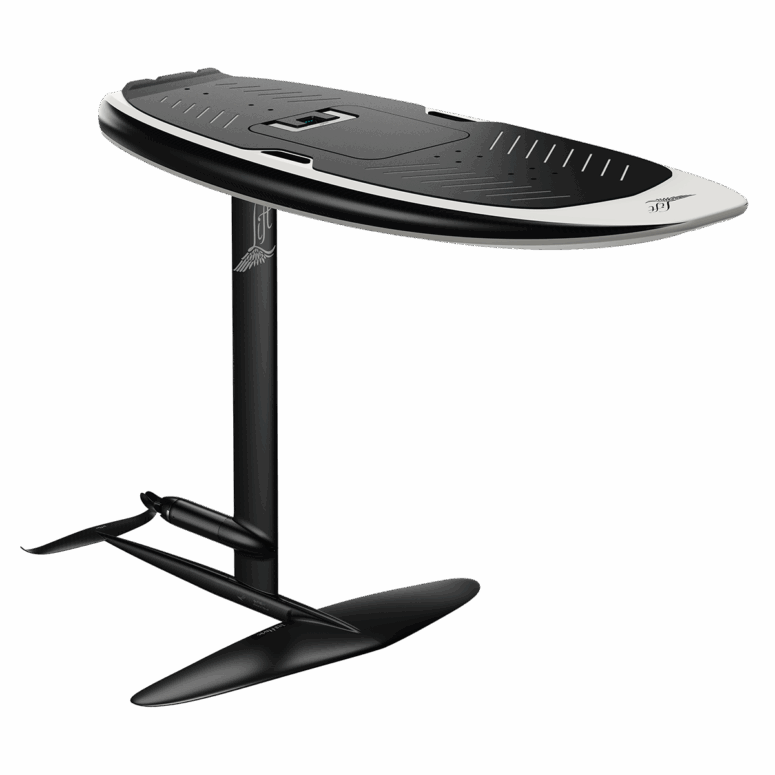
Lift has been one of the leaders in the eFoil industry pretty much since the conception. What started as an extremely oversized, and very heavy eFoil system, has been iterated and engineered into the current LiftX. The design concept of the LiftX, offering smaller board sizes, lighter battery choices, and seamless component integration, is blurring the lines between powered eFoiling, and a non-powered surf experience.
The board comes with a high-end board bag with Velcro access slits allowing for the board to be protected and transported when fully assembled. This board has thoughtfully integrated handles into the deck side rails which helps for carrying and transport after assembly. The most noticeable point of engineering here is the board/mast connection. Lift has completely redesigned this mast receiver, thus eliminating the need for any tools, nuts, bolts, tape, or other electrical connections – the mast has fixturing pins that securely clip into the board with a single lever. It takes approximately five seconds to attach the mast to the board and surprisingly feels incredibly stiff and strong with practically zero play.
The 32” length mast we tested was configured in the “Low Mount Propulsion” eFoil style setup with the motor pod at the base of the mast near the foil. Lift does offer two other mounts, an Ultra high for the highest performance surf experience, and a High mount blending ease of motoring with surf performance. These motors are fully integrated into the mast and cannot be removed or adjusted; changing the position of the motor pod will require a complete separate mast purchase. The motors themselves are a fair bit longer than other eFoil or assist systems on the market, but are small in diameter which makes them feel a bit more slippery through the water than you would expect. The mast itself is a high quality mast in line with other current masts from Lift. These masts are not compatible with other boards as they have the proprietary single point latch and electrical pins at the top, so they must be used with the LiftX board. This mast and other accessories come in a very high-end, semi-rigid carrying case with sufficient room for other misc. parts and pieces.
The foil connection is new for the LiftX system; the new foils feature a single point latch on the bottom allowing for a fully toolless connection – simply lifting up on the latch, pushing the foil down onto the mast, and clipping the latch down secures the foil to the mast. The LiftX masts also features screw holes so the mast is backwards compatible with prior generation Lift foils that do not have the toolless locking feature. The fuse/tail connection is identical to the existing Lift foils products, using two M6 bolts to secure the tail block to the front wing. This is the only part that requires a tool to assemble.
Finally, getting to the batteries and other accessories. Lift offers two batteries, the LiftX and LiftX Light. The standard LiftX battery provides approximately 45 minutes of ride time, where the LiftX Light battery is about 4lb lighter, at the tradeoff of roughly 25 minutes of ride time. Riders who are looking for more performance, and want to leverage ocean waves or downwind bumps as their main propulsion, relying on the battery for short bursts of energy, will appreciate the lighter weight of the Light battery. Those who want to spend more time under power, and have as much powered time on the water will be better suited using the full-size LiftX battery. The batteries have an integrated deck pad surface, and connect flush to the deck of the board. The carry handle doubles as the latching mechanism and when installed, has an almost seamless feel across the deck.
As mentioned earlier, the LiftX does seem like a lot to handle as you’re setting it up and figuring it out, but after the first assembly it’s a very slick system. Complete assembly with every component broken down (board, battery, mast, foil), the whole LiftX system can be assembled to ride in about 30 seconds with three latch points – battery, mast and foil. The handles integrated into the deck of the board mean carrying the assembled foil is not too bad even though it is substantially heavier than a non-motorized foil system.
The LiftX was tested primarily in flat water with occasional 2-3’ surf. In the water, the first impression is how much power is generated by the motor. It is difficult to quantify exactly how much effective thrust is generated under different conditions, but there is always a consistent feeling of constant and sufficient power. The 4’8 board had plenty of volume and length and getting on plane was easy and only took about 60% throttle. Getting up on foil was a breeze with the 150 Havoc front wing, and when cruising in flat water it was easy to back off to around 30% throttle. The most noticeable feeling was having a motor pushing from the bottom of the mast – it was a different sensation and required a different balance than more assist-style eFoil mounting positions. This is simply a feeling difference that riders will adjust to after just a few minutes of flying around.
Since the battery is mounted to the deck of the board, roughly in line vertically over the front wing, the weight is somewhat noticeable, but not that much different than any other board-mounted battery system. Once you get the feel for how the swing is a bit different, you can begin to leverage that extra momentum and anticipate the extra rolling moment to give some pretty fun and extreme turns.
Adding a bit of weight to the board can make a larger, slower foil feel a lot livelier and more fun. In the tested, eFoil-style configuration, the motor pod did have a moderate impact on the glide and surf performance when not under power. Testing both the LiftX battery and the LiftX Light, the provided battery durations were pretty accurate. There is a wide margin of battery life depending on how you ride, and how much throttle you are using, but making no effort to conserve or manage battery life provided close to the stated ride time on each battery.
Overall, the LiftX system is a very slick, albeit mildly over-engineered eFoil system. Every part of the product, from the board bags and carrying cases to the connections, accessories and controllers, has an extremely high-end premium/luxury feel. It would be remiss to not acknowledge this all comes at a premium price, with retail on the base system starting at $14,000, spare batteries costing $3,200 each, and mast choices at $2,800 – it is very easy to spend a significant amount of money per hour on the water. That being said, there really isn’t another eFoil system like the LiftX. If you want the functionality, ease of use, quick 30 second assembly, and ultra-premium product, this is the hands-down winner.