































When you purchase gear through links on our site, we may earn a small commission. Here’s why you can trust our tests and our affiliate partner.
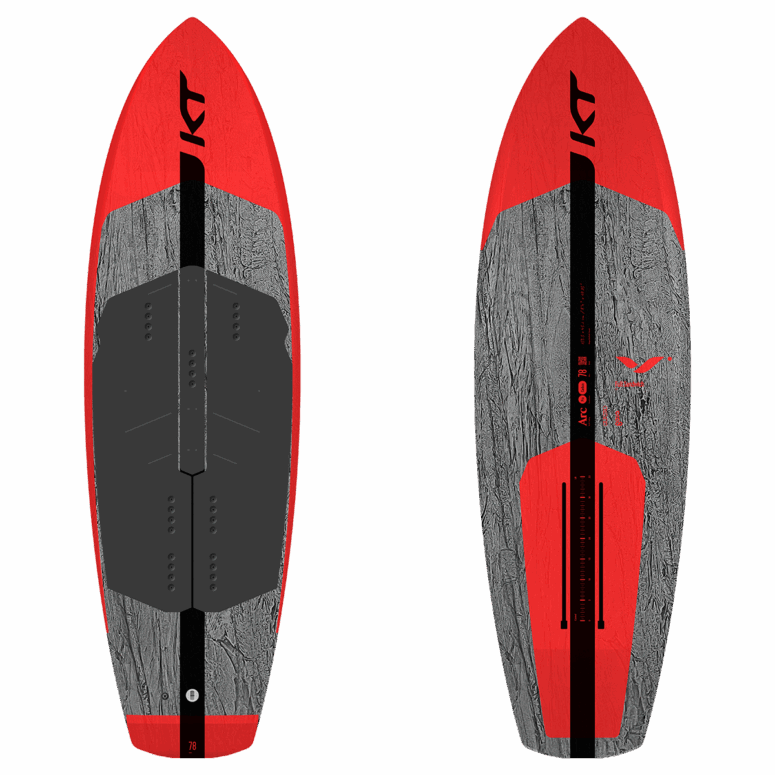
When the call comes to test a new addition to a lineup, it is hard to pass up even on a tight schedule, so we jumped at the chance to test the all-new KT Arc, a surf-style board designed for parawing, wing, prone and foil-assist riding. The board comes in six sizes, ranging from 48L to 98L. For this test, we chose the 68L, which puts us right around a 1kg-to-1L ratio.
Its carbon construction is an immediate eye-catcher, featuring a unique layup that creates a striking, high-tech aesthetic, complemented by a fiberglass window specifically integrated to support foil-assist hardware. What really impressed us, though, was the sheer versatility in strap configuration. “Versatility” is the word that best defines this board, with a wide range of strap placement options. You can go for a centered setup or shift towards a more heel-side position, particularly appealing for wingers. KT also includes multiple strap options: a V front strap as well as a single front strap, allowing riders to fine-tune their setup to match their style. For those who prefer to go strapless, the board can be ordered without inserts, shaving 400 grams on what is already a lightweight build. Every element of the board’s shape serves a clear purpose and has been meticulously thought out, highlights include the flat, streamlined double concave tri-plane hull, along with carefully tuned nose and tail angles. Now let’s get into the part that really matters: the performance.
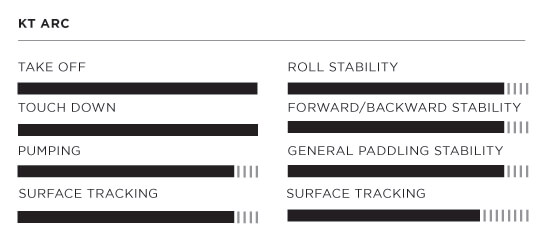
Typically, when testing new gear, we prefer to pair it with familiar hardware to ensure our focus remains entirely on the new component. However, given our packed testing schedule lately – just look at how many reviews we’ve been putting together – and the tight window for these last-minute additions forced us to combine this board with a brand-new wing. We headed out, and within five minutes of riding, something clicked: we hadn’t thought about the board at all. Not once. That realization made us stop in the middle of the ocean. The whole experience had been so smooth and effortless that the board simply disappeared beneath us and from our minds, which, in many ways, is the highest praise you can give. Yeah, it’s that good. With that in mind, we reset and approached our first conscious waterstart, paying close attention to every detail about the board. That’s when it all made sense. Despite its relatively narrow, mid-length shape, and let’s not forget our choppy conditions, finding balance is incredibly easy. Getting into position felt natural and intuitive and acceleration happened without any drama, gaining speed almost autonomously, and with minimal input. Even combined with a “lifty” foil, the Arc’s nose is already eager to rise clear of the water. Once in flight, the KT Arc becomes a true “flying carpet”, an extension of the rider that requires no conscious management. Every aspect of the construction and shape works together to deliver a very smooth and forgiving experience, both during waterstarts and while riding. After heading upwind to our usual spot, we managed to catch a few waves and that’s where the board truly shines. It delivers direct feedback, responds quickly and allows for tight, controlled turns. What stood out most, though, was its ability to recover: even when we lost speed or made a mistake, the moment the board touched down, it regained speed almost instantly, allowing for a seamless transition back onto the foil.
We managed one more session before writing this review, this time with a parawing in very light wind. Going in, we were confident and the board didn’t disappoint. Despite being a mid-length design, it maintained the same agility and balance we experienced earlier on the wing. Quick takeoffs and impressive stability, even in choppy conditions, really stood out as its key strengths.
So, who is this board for? Thanks to its near-infinite footstrap configurations and effortless speed, the KT Arc is a perfect match for any intermediate to advanced rider who likes to mix disciplines and wants a single board that delivers strong performance across all of them. We didn’t test the larger sizes, but it’s fair to say they could also be a solid option for beginners stepping into parawing, offering extra volume and stability to ease the learning curve.