When you purchase gear through links on our site, we may earn a small commission. Here’s why you can trust our tests and our affiliate partner.
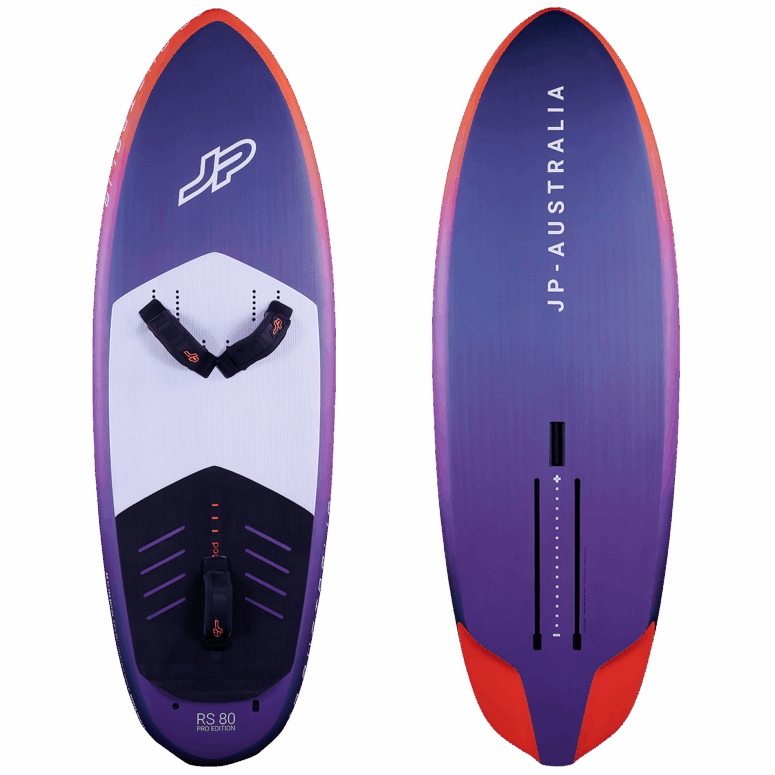
When the delivery guy calls ahead, we know something big, or a lot of gear, is about to land on our doorstep. This time, it was both. A handful of boxes arrived, one of them unmistakably large, and from the JP badge we knew a board was inside, the only question was which one from their sprawling catalog. After digging through layers of cardboard and padding, we uncovered a JP RS Pro. Our test unit was the 65L, though an 80L and 95L are also available.
The RS Pro follows the current trend toward an extended length with a narrow outline, featuring tail cutouts and clever shaping to fine-tune volume distribution. It’s built with a full high-density PVC sandwich construction, and in the hands, the weight sits somewhere in the middle of the scale, but thanks to the integrated handle, it is very easy to carry around. Mounting the footstraps was a breeze, with multiple inserts making it simple to dial in the right stance. The straps themselves are comfortable, secured with thick, sturdy screws, and a comfortable EVA pad underfoot. Once assembled, the board has the unmistakable look of something built for low-wind performance and the attention to detail is evident everywhere you look.
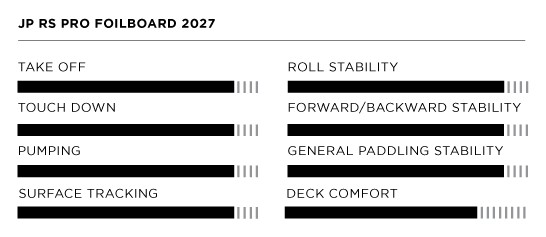
Our first session came in fading wind, the perfect scenario to put the board’s low-end capability to the test. We paired it with a 1000 foil and a 4m wing and got to it. At 65L, the board gives us roughly a 1L-to-1kg ratio, and from the very first waterstart, it proved remarkably stable while positioning and getting set, even in the choppy water we typically deal with. Thanks to its shape, and a bit of what can only be called witchcraft, building speed and popping up onto the foil felt completely natural, almost thoughtless. Once airborne, though, the character shifts: this is a fast, reactive board with a natural tendency to track upwind. It took a few minutes to adjust to that reactivity, but it quickly proved to be an asset. Following our usual wingfoil testing routine, we pushed a long upwind leg into stronger wind, then came back down using the small waves along the way. Through transitions, the board feels agile and nimble, and carving comes naturally.
On touchdowns, the board holds its speed well and gets back up on the foil with ease, and when it comes to pumping in light wind, energy transfer is direct and building speed feels simple and quick. It’s a board that offers minimal resistance against the water, and that quality seems to make everything else feel easier too. We ended the session convinced the board had more to give, so for round two, we planned a proper downwind session to hunt some waves.
A few days later, the conditions we’d been hoping for arrived, and we lined up a 10km downwind, again pairing the board with a 4m wing but this time on an 800 foil. This was the session where we really understood what the RS Pro is all about. Effortless take-offs, razor-quick turns, easy recoveries and overall agility made for a session for the books. We linked swell after swell with ease, and even when our own riding wasn’t perfect, the board consistently helped us pop back up onto the foil quickly and efficiently. After that session, we logged a few more, and found ourselves reaching for this board every time a downwind or freeride session was on the cards.
Is this board for everyone? Not really, as beginners will find a more suitable board for their level, and riders looking to mix in some freestyle will find better-suited boards in JP’s catalog. Where the RS Pro truly excels is freeriding, and particularly downwind and wave-riding. We didn’t get the chance to test it parawinging or prone foiling, but we’d bet it performs just as beautifully there. For the rider who likes to roam across conditions and disciplines while keeping the same board underfoot, the JP RS Pro is a serious weapon.