
When you purchase gear through links on our site, we may earn a small commission. Here’s why you can trust our tests and our affiliate partner.
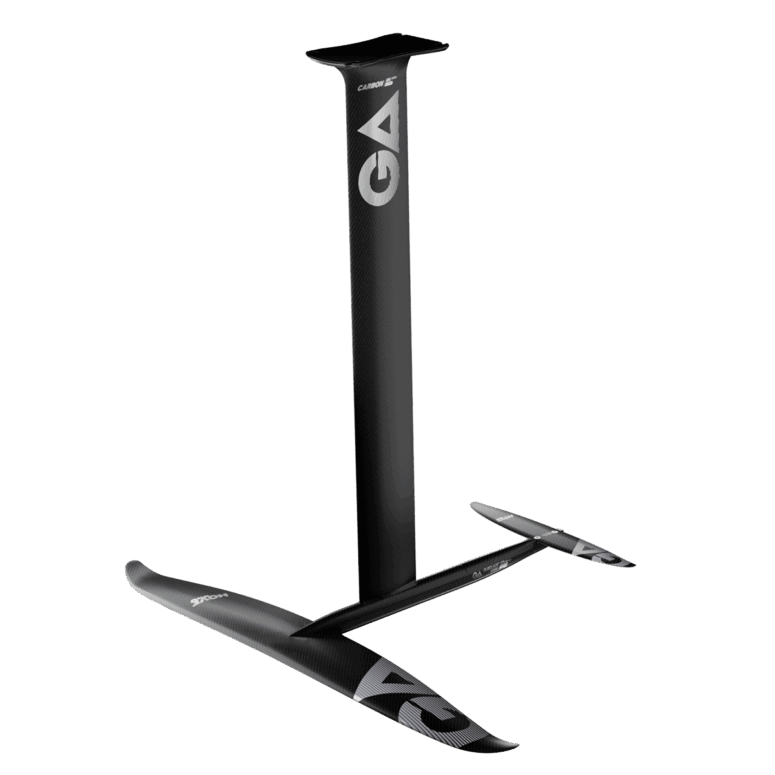
We knew our friends at Gaastra were sending over their latest front wings, the Move, but we had no idea they’d go all out and spoil us with three different sizes, plus multiple fuselages and tail options. The oversized box should have been a clue! When we opened it, the first thing to emerge was their brand-new mast, the Carbon Team UHM. Then came a lineup of tails, a range of fuselage lengths and finally the crown jewels: three Move front wings in 1000, 800 and 600.
The Carbon Team UHM (Ultra High Modulus) mast is a completely new addition to the range, designed specifically to pair with these wings. Straight out of its cover, it feels impressively light and remarkably thin, yet undeniably stiff thanks to its full carbon-fiber construction. It comes in an 85cm length with a strikingly slim 1.5cm profile. The front wings, like the fuselage and tails, are also built entirely from carbon fiber. The setup is thoughtfully engineered: the front wing attaches to the mast with three screws, the fuselage connects directly into the front wing with two screws, and the tail wing is secured with another two. This modular system makes swapping components quick and straightforward. With an aspect ratio of 9.2, the Move sits in the mid-to-high aspect-ratio bracket, looking sleek and streamlined, while its rounded tips make it feel far less intimidating on the water than others.
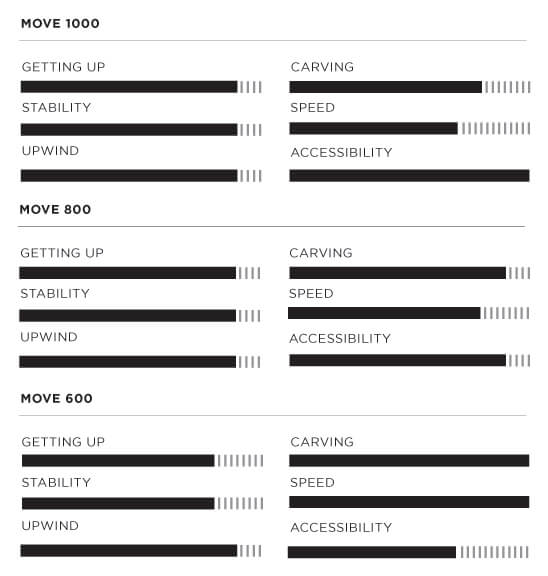
For our first session, the light wind dictated our choice: the Move 1000 paired with the largest fuselage and tail. Assembly was a breeze; the mast features a slotted base, allowing it to slide onto the board bolts without removing them entirely. After tightening a few screws here and there, the entire setup felt rock-solid yet impressively lightweight. On the water, the 1000 immediately proved its strength in marginal conditions. It delivered early, effortless lift, making it an excellent choice for those lighter wind days. Once up and riding, it felt noticeably more playful than many competitors in the same category. It didn’t feel draggy but very efficient, especially while pumping. The standout characteristic, though (and something that carried across the rest of the range), was its glide. It maintained speed beautifully through turns, giving a smooth, flowing ride that felt both controlled and lively. Though we only had one session on the 1000 wingfoiling, it left a strong impression and definitely had us eager to step down to the smaller sizes in stronger winds and more dynamic conditions.
The 800 was next to hit the water a few days later, this time with stronger wind. It carries over the same ease of use and efficiency as its bigger sibling, but adds a noticeable boost in speed, both in a straight line and through turns. If one word defines this size, it’s balance. It really feels like the best of both worlds: early, forgiving lift at low speeds, excellent glide and efficient pumping, all combined with a more agile, playful character and higher top-end speed. The result is a foil that adapts effortlessly to different styles. We found the 800 to be incredibly fun across a range of sessions, whether in waves, cruising or even freestyle. That said, because of its unique combination of glide and manageable speed, it quickly became our go-to setup for downwinders. It simply finds the perfect rhythm between speed and control.
That brings us to the smallest in the range, the 600. Jumping on it straight after the 800 feels like a significant step up. This front wing is noticeably more reactive and sensitive in every aspect, so it takes a short adjustment period to get fully dialed in. However, the 600 still offers surprisingly easy lift, even without much horizontal speed, and remains efficient when pumping. It’s extremely playful, and, unsurprisingly, carries the same DNA as the 800, just with everything turned up: quicker response, sharper turns and higher speeds. In freestyle, it does the job, but landings become more technical. It takes some time to dial in the right foil positioning and adjust trick speed to consistently ride away cleanly. While it holds its own in freestyle, it truly shines during downwinders or when surfing powerful waves. In stronger conditions, it delivers great speed and glide, but what really impressed us is how effectively it taps into the wave’s energy and converts it into forward drive, even while turning.
So, who is the Move series really for? While these wings are very versatile, they are best suited for riders seeking high-performance characteristics in a truly accessible and forgiving package. The 1000 is a powerhouse for lightwind days, offering beginners an easy entry point while providing experienced riders with the endless glide needed to connect swells in marginal conditions. The 800 stands out as the most balanced of the three and likely the crowd favorite. It hits a sweet spot that will suit a wide range of intermediate riders and all-around water users. Whether it’s winging, parawinging, or even light kite foiling, it delivers across the board. With its blend of speed, glide, maneuverability and ease of use, it’s easily the most versatile size in the lineup. The 600, on the other hand, is geared toward more advanced riders. It’s fast, efficient and highly responsive, with sharp turning capabilities that really come alive in stronger conditions. If you’re chasing speed, precision and maximum performance, especially in powered sessions or solid waves, this is where the 600 truly shines.
Across the entire range, Gaastra has managed to blend elite speed and agility with a user-friendly feel that keeps the fun factor high, regardless of the conditions.