


When you purchase gear through links on our site, we may earn a small commission. Here’s why you can trust our tests and our affiliate partner.
With Foil Drive essentially a hybrid of both a water sports and technology company, upgrades and progress are naturally going to be fairly regular, particularly as battery technology improves and the discipline finds its feet. Since the launch of the Gen 2 system, now a couple of years ago, probably the most significant upgrades we’ve seen in the system are High Power batteries and motors and the relevant software upgrades to support them. Foil manufacturers have fed in with integrated masts and trench boards, but the core of the system, the base unit, has remained the same, that is until now.
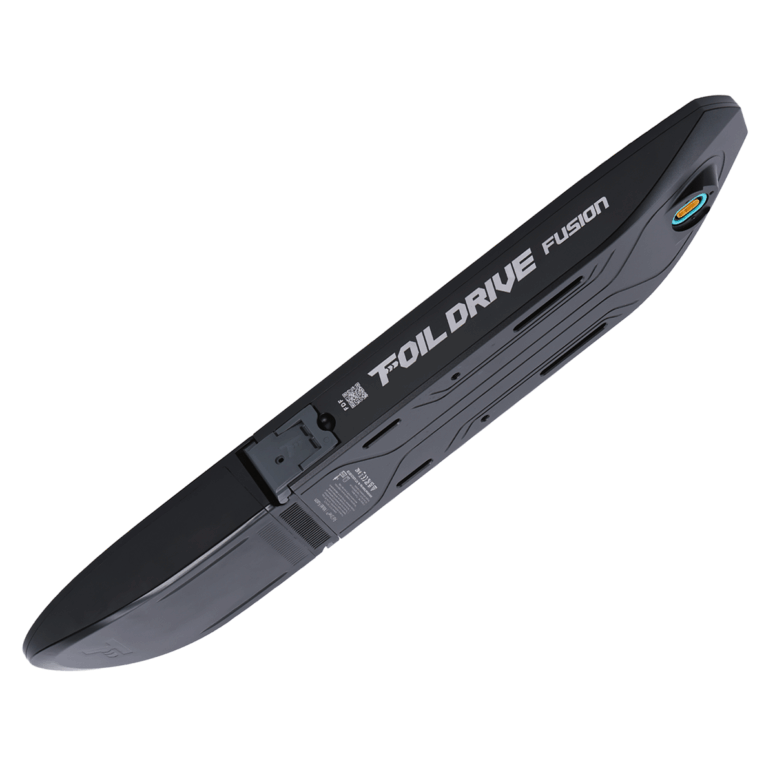
The Fusion has been released as the Gen 2.5 system, to complement rather than replace the Gen 2. The basic architecture of the unit with the front loading battery remains familiar but the form factor has slightly changed. The unit housing the electronics has increased in size, and is larger at the rear of the system where the cable plugs in; it also has subtle channels CNC’ed into the casing to aid cooling. When loaded up with the battery, it’s two kilos heavier (give or take a few grams) than the Gen 2. M7 bolts are provided to attach the unit to the board to allow for more space inside the unit to accommodate electronic components and more cells. Due to the mast position being further forward in relation to the motor cable socket than previously, a nifty barnacle attachment has been designed to shift that forward for non-integrated mast users. Whilst on that subject, anyone with an integrated mast moving from Gen 2 to Fusion can simply extend their cable by opening up the base of the mast and moving the cable forward to keep an ultra-clean, drag-free setup, something we failed to realize for a bit! The nose cone is now permanently attached to the battery and clips in with familiar side mounted clips as per the Gen 2.
A neatly designed carry handle for the Fusion unit houses the M7 split bolts when not in use. A brilliant new addition is the smart battery caddy. This has an inbuilt screen which shows state of charge, and both USB A and C ports on the side to let it charge anything you like as a battery bank. It talks to the batteries BMS to allow you to show accurate state of charge, and potential charging times, and you can charge the 860 battery whilst in the caddy, with a XT connector. Another genius feature it its ability to discharge the battery from full to storage state via a heatsink, although topping up your controller, phone or laptop is less wasteful. Good news for Gen2 users is that you can also use this caddy to discharge (not charge) your MAX, MAX HP or travel batteries. The caddy can detect the 40v which you then confirm via the menu.
So with the extra size and weight, what sort of performance figures do you expect? The battery capacity is more or less twice that of the original at 864 w/h. It also runs on a more punchy 43v architecture so has an all-new waterproof charger, which also has a nifty storage mode, to charge your batteries from empty to storage levels automatically if you don’t plan to use the system for a while. This is operated by a simple push button. A tilt sensor has been built into the Fusion unit as a very effective safety feature and this can be set up in the App. It cuts power to the motor as soon as it detects a certain amount of pitch or roll and thinks the board is out of control.
The V3 controller is a massive upgrade – it’s slightly larger, sports an all-new removable throttle guard, and has a larger and much brighter and clearer data-rich screen. Far more tech is quietly baked in here with a GPS chip for tracking data, which will eventually be integrated into the Foil Drive App – prepare yourself for an online leaderboard. A new Bluetooth chip talks to the BMS on the battery and gives accurate real-time battery readings, even with the throttle depressed. A nod towards learners and Efoil usage is a gears system which holds the throttle at a certain percentage and allows you to bump it up and down in increments rather than the linear throttle. The V3 controller is backwards compatible with the Gen 2 system, and is flashable so firmware can be updated, futureproofing the unit. It charges wirelessly with an induction pad as previously.
So in practical terms what does this plethora of new and updated tech achieve? If you back-to-back test the Fusion with the Gen 2 system you can obviously feel a slight weight increase but due to the way it’s balanced it doesn’t feel like much of an encumbrance, and for the vast majority of riders the technical benefits outweigh the negatives.
Your choice as a consumer between the available systems should depend on your intended outcome and usage case. If you want to make the most radical, snappy turns possible, without worrying about runtime obviously stick to the Gen 2 or if you’re super lightweight, even the Slim. However, if you want to use the smallest foil possible and are happy making wider, faster snowboard style turns the Fusion could be for you, particularly if your spot is inaccessible and requires a longer motor out. I’d also say that bodyweight factors heavily on this decision making, as if you’re 90kg plus, you’ll still be able to throw the Fusion around adequately, which makes sense when you think how a lighter rider would experience the Gen 2 system proportionally.
For an advanced rider in larger wave conditions, for me, this is where the Fusion’s attributes shine. The extra power and punch meant at 90kg I could take a 680cm2 foil with an inset board comfortably from flat water, and didn’t feel overpowered once on the more punchy wave. The weight in the system enables it to stabilize at speed and tackle more turbulent water. The extra grunt also meant I could power my way through white water more successfully. As a rhino chasing tow tool, the Fusion could definitely prompt jet ski owners to start to ask themselves a few awkward questions. The extra runtime is extremely useful if you need to motor a bit to your break, and will provide an extra level of safety to any more exposed downwind runs.
It’s easy to get fixated with the surf performance of the Fusion, but with its extra thrust and runtime, the system now edges well into eFoil territory. Mount the motor pod on a longer cable, and you’ve now got an extremely capable comparatively lightweight system with over an hour’s runtime, and best of all, it’s on a foil of your choice that you can tune to your preference, rather than something that’s dictated to you by a closed system. The V3 controller’s gear system also lends itself to super controlled throttling up for complete novices. Add a prop guard into the mix, the tilt sensor cut out, and you have something very safe as well.
It’s extremely impressive to see how many brands have got onboard with FD-specific products and their reactivity to evolve as the system does. The same is already true for the Fusion, with board manufacturers extending trenches and balancing out their boards as necessary.
The Foil Drive Fusion is a significant step up from the Gen 2: more powerful, more refined, and far more convenient to use with more baked-in safety features. With inset boards and integrated masts now widely available, it no longer feels like an add-on or retrofit system, but rather a fully integrated ecosystem. For many foilers, it’s no longer just a supplementary tool; it has become the primary setup and one that continues to evolve and improve with each iteration. The Fusion widens the scope of use even further.