

When you purchase gear through links on our site, we may earn a small commission. Here’s why you can trust our tests and our affiliate partner.
It’s fair to say that the Boards & More group have been a dominant force across wind sports industries for decades, and with their more recent ventures into wing and foil, it was inevitable that they had scope to build a ground-up foil assist product into the range. Cyril Coste heads up the design team, it’s not his first rodeo with a legacy, previously working with Takuma at the dawn of surf foil.
Rather than copy what’s already on the market, they’ve gone on their own path conceptually. With most existing systems the battery placement is in or surface mounted to the board, under the feet. With the all-important lithium battery being the heaviest part of the system, this is normally the most significant performance compromise in comparison to a traditional non-powered foil board, increasing the swing weight.
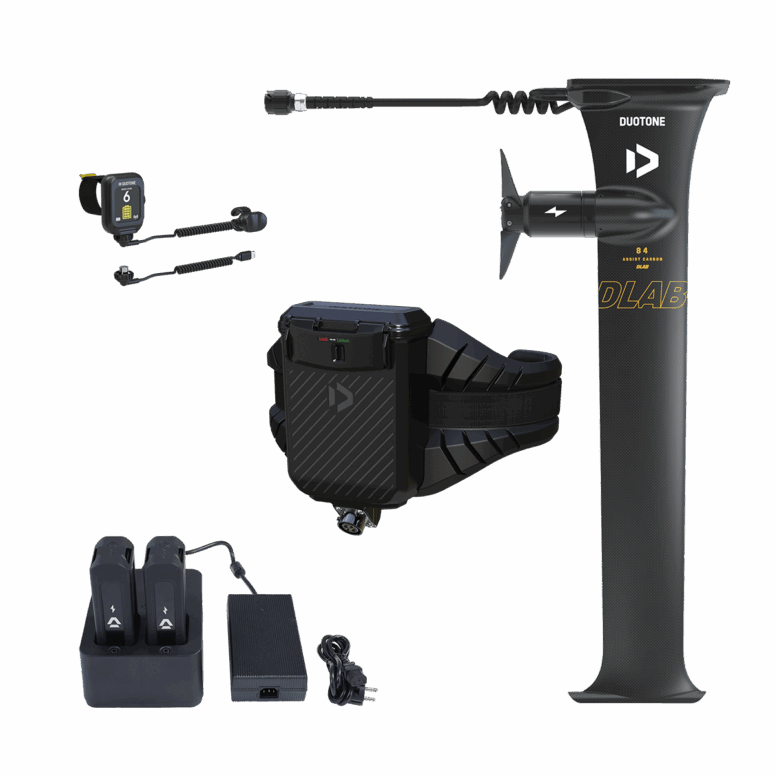
The critical difference is that Duotone have placed two lithium batteries in a neat waist belt leaving the board unweighted. The waist belt doesn’t look too dissimilar to a small wind sports waist harness, with a comfortable EVA interior and elegant magnetic set-and-forget belt closure system. It’s a modernistic fusion of a waterproof Peli case and a bum bag. Tucking the pouch containing the batteries into the small of your back seemed to make the weight disappear; you’re barely conscious of it walking around, not much different to the January weight gain after an overindulgent Christmas.
Batteries are twin 7ah on a 43v architecture and critically fall within current flight safe guidelines for easy air travel and have neat LED status indicators. Our test rig at 92kg was a 65l efficient mid length, the D/Lab integrated mast with a two blade prop. Foils wise we alternated between the Crest 800 and 1050 depending on wave height, which worked great in mixed northern Atlantic surf conditions. We achieved runtimes of around 35 minutes on batteries with constant motoring between waves. Using it as a pure wave assist and pumping between sets rather than motoring extended this to around an hour with a well-timed take off. Duotone advise two sets of batteries for the average rider, giving well over an hour of runtime, and down the line there will undoubtedly be uprated batteries for the more demanding rider. There’s two propellor options: the black standard two blade, and a torquier golden three blade system, which gives more thrust at lower RPM, and slightly less top end which we would recommend for heavier riders. On the black prop, the inner part of the folding prop is geared which means it extends its props symmetrically when spooling up.
Setting up the system on the board is very simple, particularly with the integrated mast. Standard bolts go into a track box, and all you need to consider is how to route the cable and leash backwards. They’ve included a plastic cable retainer which seats itself in the board tracks with two M6 bolts and keeps the cable well away from the props. This can be supplemented with some 3M sticky pads to take up any slack. The critical part is securing the leash and cable together into your leash plug point, this means that the bungeed coil leash takes the load before the cable does, eliminating any chance of unplugging yourself. Of course, if you’re using the Duotone Midfish board, the cable naturally sits in the cleft of the fish tail. The cabling itself is highly shielded, and the bayonet plug which goes into the battery belt wouldn’t look out of place on an industrial RV submarine.
The throttle interface is extremely innovative, a futuristic USB-C chargeable watch which could easily be from the set of Terminator 2. There are two modes: ‘Normal’ gives five levels of power and extends battery life, ‘Boost’ gives seven levels of thrust and gives the full potential of the system. The display is vivid and simple, giving you live, accurate battery data. As you start to run low it vibrates and really lets you know about it! It has a single silver button on the side to cycle through modes and turn the unit on and off. A coiled cable runs from the watch to a button which sits on your index or middle finger. You click and hold this for power which it delivers in the aforementioned stages. So three clicks and hold for mid-range power for instance, not dissimilar to a traditional eFoil. From a safety perspective, as soon as you let go of the button it stops the power instantly. If you’ve come over from a progressive, linear throttled system, this takes a couple of sessions to dial into, most noticeably when you come off the back of a wave, and want to reengage the motor, you need to click several times to speed match. It takes a little more pre-thought and you need to anticipate the water conditions when pre-spooling the motor but you do dial into it. Initially it’s a little more cumbersome than just pulling a throttle half-way. Once on a wave, what the click throttle does allow is not having to clutch a remote in one hand the whole time which does feel more like non-powered surf foiling.
The gear system provides a consistent level of thrust to get into the wave, making getting front prone onto your feet simple, with less nuanced throttle control required than a trigger system. Once up the board feels immediately lively, the weighted belt is almost unnoticeable and comfy. With the surf-friendly Crest foil we could hack away at the waves in a lively manner. The D/Lab integrated mast means that if you dip the pod, you barely feel any drag, and of course there’s no battery box there to give you the full KO. Managing the cable takes a little thought as you mount your board, but even for a taller rider its range of extension and contraction means it hangs well once you’re on your feet and doesn’t get tangled in your toes. If you stack it in larger swell, you need to get used to being pulled by your waist rather than your ankle, but the harness spreads the load well, and as the board is unweighted, there’s less inertia when you bail.
What we can’t stress enough about this system is how professionally put together and premium feeling everything is. Even the boring bits like the charger are well designed and a prime example. It allows charging / storage voltage as standard for instance, has a great LED interface with friendly buttons and indicators. It wouldn’t be out of place from a high-end camera manufacturer. It’s fast as well, juicing up in around an hour. This level of detail and integration carries across the entire system.
Cross compatibility with other foil systems is achieved with the aluminum mast system, with fuselage adapters available to allow you to bolt on your plane set from a decent range of brands. There’s seven outside the Duotone ecosystem currently online, with more to come.
Whilst we’ve concentrated on the surf foil performance, which is probably the system’s primary design intention, the scope for eFoil and learner use, particularly with the gear interface is very strong. There’s a plethora of low motor position aluminum masts available, prop guards and larger boards and even inflatables, which we will no doubt see at Duotone Pro centers globally in the not-so-distant future. Price point is something we normally avoid a little in reviews, but it’s impressive considering how well finished the product is…
There’s more than one way to skin a cat, as the old adage goes. Having the board unweighted is a delight, and with the performance upgrades in the pipes with extended runtime coming, as with all foil assists this platform will continue to evolve. Its modular design futureproofs this to an extent, and I have a feeling we’ve perhaps only seen the tip of the iceberg in terms of performance as cell technology improves. The Duotone Foil Assist is a novel and innovative approach to foil assist which has great potential as a platform – cyborg surfing here we come!