When you purchase gear through links on our site, we may earn a small commission. Here’s why you can trust our tests and our affiliate partner.
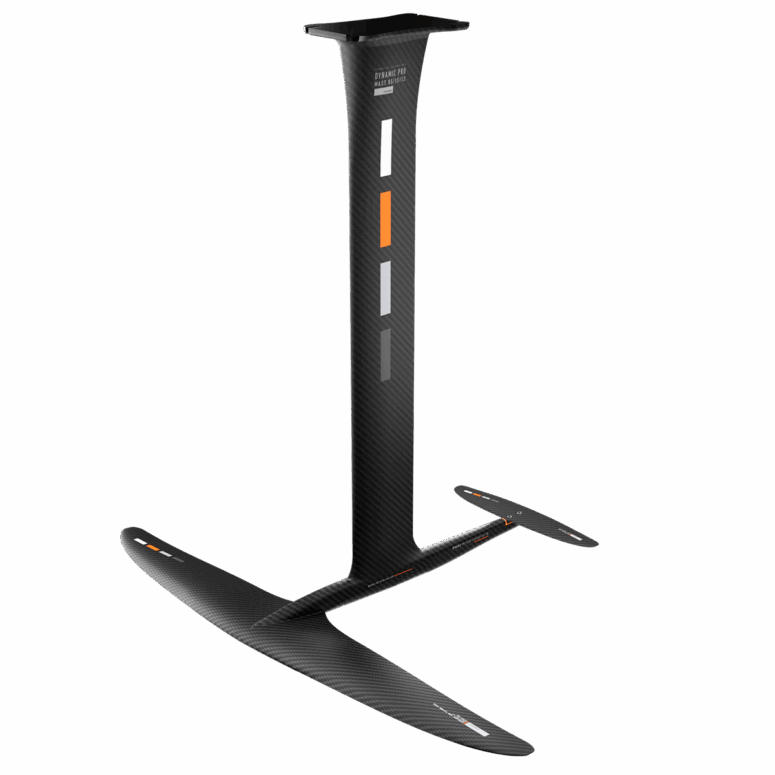
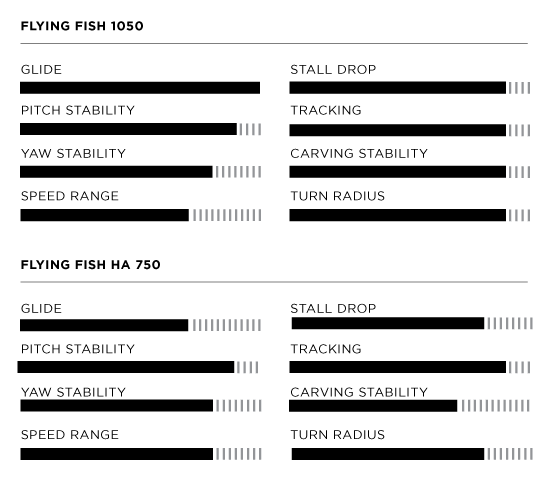
RRD has gone in two very different directions with the Flying Fish range. On one side, you have the Flying Fish 1050, a relatively moderate 9.3 AR wing designed to combine glide, low-end performance and carving. On the other, the Flying Fish HA 750 pushes the concept much further, with a 14.7 AR and a clear focus on downwind speed and efficiency. I tested both back-to-back, and while they share the Flying Fish name, they are really two different tools.
Flying Fish 1050: The 1050 is probably the one that surprised me the most. With an AR of 9.3, it sits in that sweet spot that we are looking for more and more today: enough glide to connect waves and bumps, but still enough lift and maneuverability to be used for pretty much everything. For wingfoil, parawing and surf foil, this is exactly the kind of foil that makes sense if you want one setup that can do a bit of everything without having to compromise too much.
The low-end is excellent. The foil generates lift early and keeps flying at surprisingly low speeds, which is really useful when connecting waves or trying to keep gliding at the end of a wave. With a wing or parawing, you can also keep the foil flying through slower sections instead of constantly having to pump to stay on foil. But what I really like is that the glide doesn’t come at the expense of carving.
The foil still feels easy to turn and has a nice, predictable roll. You can carve properly, change your line and play around in the wave without feeling like you are riding a pure downwind foil. It has enough stability to make the glide easy, but enough response to keep the riding fun. For me, this is the big strength of the 1050. It doesn’t feel like a specialist foil. It is fast enough, glides extremely well, gets going early and still lets you carve. If you are looking for one foil for wing, parawing, surf foil and general freeride, this is the one I would look at first.
Flying Fish HA 750: The HA 750 is – in short – a completely different foil! With an aspect ratio of 14.7 and a 105cm span, this is clearly designed around one objective: getting you from point A to point B as efficiently and quickly as possible.
RRD positions it as a high-performance downwind foil, and that’s exactly how it feels on the water. Compared to the 1050, you lose some low-end lift, but as soon as you have enough speed, the HA starts to make sense. The projection forward is excellent. Once you are on foil, the wing wants to keep accelerating and moving forward rather than turning or climbing aggressively.
It has a very efficient, fast feeling and the glide between bumps is seriously impressive. One thing I really appreciated is the stability at speed. High-aspect foils can sometimes feel nervous when you start pushing the pace, but the HA 750 gives you a lot of confidence once you are up to speed.
The high-modulus carbon construction also keeps the wing very stiff and direct. The take-off on a paddle is also better than I expected for a 750. You obviously need more speed than with the 1050, but it doesn’t require 30 knots and massive open-ocean bumps to work. The HA 750 also pumps surprisingly well. It generates forward momentum quickly and each pump can be converted into a lot of distance. This makes it very effective when you are trying to connect bumps or keep the foil flying through flatter sections. Carving is where you clearly feel the difference compared to the 1050. This is not a carving foil. You can absolutely have fun carving bumps on a downwind run, and the speed makes those turns really enjoyable, but the roll is much more pronounced. Overall, this is one of the most fun and ‘tuned in’ HA foils I have tested.