
When you purchase gear through links on our site, we may earn a small commission. Here’s why you can trust our tests and our affiliate partner.
Adam Bennets is the enigmatic Australian poster boy of prone. As he rose to insta-fame he flipped between brands shamelessly, subscribing to none permanently whilst hacking turns at G forces which would normally be reserved for fighter pilots. It’s fair to say he’s had a significant influence on prone foiling as the sport has progressed, and it was interesting to see him stop playing the field and settle down to the Flite brand with his own AB signature range initially centering around three front wings, the FLUX 707, 808 and 1010. Three UHM mast lengths are available (77, 82 and 87cm) along with three stabilizers and four fuselage lengths allowing plenty of flexibility in the geometry across disciplines and rider weights, although the FLUX Range is squarely pitched as a surf foil.
Their extended development time and cheeky Instagram teasers gave the foil an almost mythical status pre-release, so it was good to finally get my filthy hands on it in some realistic UK conditions to objectively scythe through the hype machine. We tested the 808 and 1010 with the 82cm UHM mast and the 125 tail in the searing 2026 UK heatwave. We made a point of taking it into a variety of foil situations outside of its remit, including some parawing and wingfoiling. Keep it on the downlow, but we even stuck a foil assist on it whilst no one was watching, which probably breaches several international treaties. Yes, we were thorough with this one.
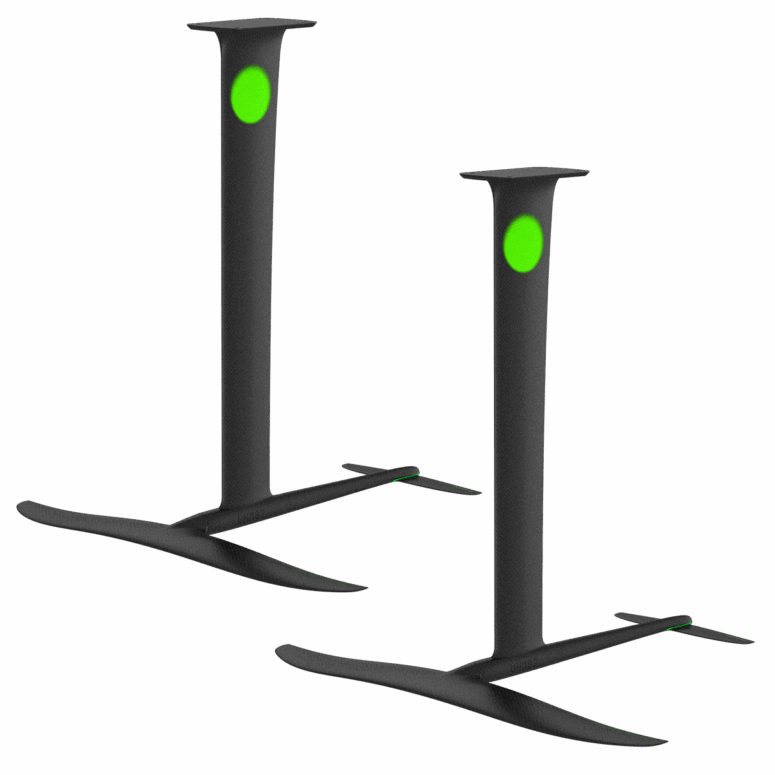
The FLUX Range is pitched as a balls-out, mid-aspect surf foil and certainly looks the part. Looking from the front we’ve got some gentle moustache, and interestingly the trailing edge profile of the lower surface is almost flat, no concave is present here. There’s some twist hidden in the tips to aid flaring. Other than that, if you closed your eyes and visualized a common or garden surf foil, this is what would manifest.
Nuts and bolts of the system are minimal and a consistent Torx 30 size throughout, including the M8s. The T-handle Torx tool is a beautiful thing to behold, in fact, we’d say best in class of brand provided Torx tools. The front wing mounting interface is a conical taper with two stout M8 bolts pinning the front wing on with no play onto a titanium insert that protrudes from the mast. Interestingly for a tapered fitting, when you slide the front wing on it’s loose, with no mallet persuasion required to remove it, but as soon as the bolts are in its rock solid. The fuselage slides on the rear with another two stubby M6 bolts and is similarly sturdy making for a cohesive plane set. A comprehensive range of snazzy green shims are provided; these are a necessity to get the stabilizer to fit, and locate into two apertures in the rear of the fuselage. We ran it with the flat zero shim for wind sports, and then ramped it up to a plus one for prone and SUP.
The mast is slender and extremely stiff – although we couldn’t find any specs, our calipers came in at 13mm down near the fuselage. It has a subtle concave running up the trailing edge and 4 x countersunk M8 bolts (with Torx 30 heads) securing it to the board. The surface coating on the whole system is a matte finish giving it a premium feel, and a decent padded cover set sheathes your foil from potential danger whilst rattling around in the back of the van.
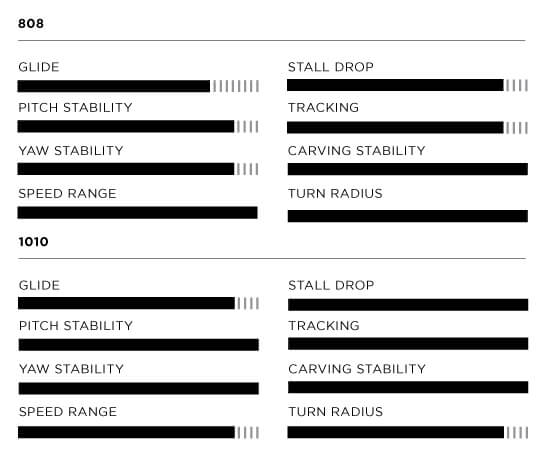
What’s essentially a Mr Bennets Pro model performs as you’d expect from a surf foil. The consistency in the turn is a standout factor, coupled with a great top end, and eager, consistent roll characteristics. It doesn’t lock out the roll in the top end. The pitch stability allows a narrow, non-defensive stance and minimizes the amount of correction you need to perform which is quite apparent in choppier water states and particularly at higher speed which it ploughs through unflustered. The confidence boost it provides allows you to ride in a more playful manner; it seemed to prefer a foot position very slightly ahead of the mast center for pumping and optimum control. Whilst the pitch stability over such a broad speed range makes it a relatively easy foil for a surf specific design, we’d say it’s intermediates upwards in terms of skill level due to its playful nature in all other directions.
At 90kgs, the 808 has a ridiculous top end and, unless you were towing it, would more than serve as our smallest foil. Sizing feels smack on where it should be. The 1010 is very easy to pump with a lazy cadence and eats up whereas 808 likes to be kept moving with a more jabby energetic approach. Glide and carry from swell feels efficient.
Although the FLUX is definitely surf focused from a marketing standpoint, a modern foil like this with a decent speed range crosses disciplines very elegantly, and with that very surefooted turning feeling particularly when under speed and pressure, and ridiculously solid pitch control, it’s definitely got a wider span of application than we anticipated. Swapping feet during jibes for instance is extremely easy when winging or parawinging as the board doesn’t mind being unweighted, the 1010 had great parawing application at my bodyweight. An extended top-end speed range is also a joy for any wind sport where foils are pushed fast the whole time.
The FLUX is legit and lives up to its hype. It balances the important characteristics well in terms of roll, glide and absurd level of pitch stability, which really shines in the top speed range. It’s most definitely a standout surf foil that swaggers into the party late and immediately establishes itself as a benchmark.