































When you purchase gear through links on our site, we may earn a small commission. Here’s why you can trust our tests and our affiliate partner.
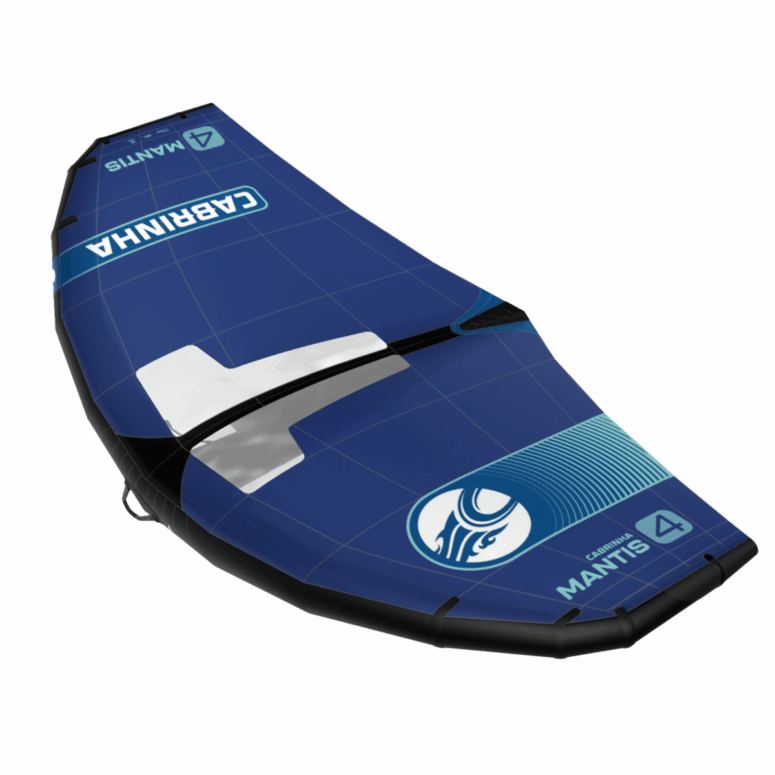
The Mantis has been around since the flappy dawn of wingfoil, and is now in its sixth version. It has seen a decent amount of change as wingfoiling has evolved and the last few incarnations have settled into a benchmark product. There’s a comprehensive range of sizes running from 2m through to 6m in half-meter increments.
First off, the twin handle option has been shelved, and a compact boom system is implemented – this saves weight on inserts and mounting points and offers a wider range of users a comfortable grip, as well as easy one-handed control. The self-indexing boom bases bolt onto the lightly curved strut and are very solid with no independent movement, and the rear of the boom has a raised ribbed finish which seem to give it a decent gecko-like grip across a range of weather conditions. The front end of the boom is deep enough to pistol grip if required. The front handle is solid and TPU clad, matching the boom and allows you to accurately direct the wing when flagged, not that it rocks around or requires much wrangling as the amount of dihedral and balance baked in keeps it innately stable. The boom and front handle bolt on and off with a Torx tool for easy travel and replacement.
The leading edge tube has a refined amount of segmentation, smoothing its aerodynamics elegantly; it maintains a decent structure even when heavily loaded. The canopy is well tailored and has some inbuilt tension, particularly in the front of the profile which you notice as soon as you pump up the wing. The canopy layout channels load down the seams to the strut tip, which is reinforced with some extra Dacron. Material choices this year are from Teijin, and they’ve gone for the classic, extremely well proven two-core canopy cloth which has high water-repellence characteristics and longevity in UV. We were impressed with the anti-scuff protection on the wingtips to cover the canopy segmentation which can be a vulnerable area if you inflate on an abrasive surface.
The inflation system has had an update, with the leading edge and strut both having familiar inflation ports, but they are also linked by a one pump tube with an isolator so you can trim pressures for more or less flex depending on your bodyweight or if you need a little suspension.
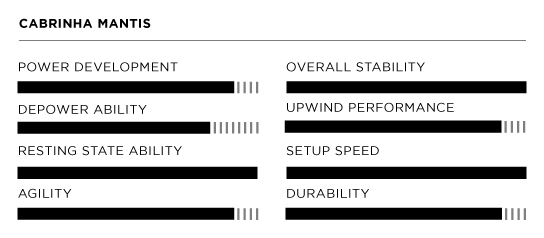
In the water, the Mantis feels immediately quite powerful for its size; the profile they’ve chosen pulls forward well, so isn’t too fatiguing when overpowered, and you don’t need to work very hard to get a decent upwind angle. In the top end, that well-controlled canopy tension extends its comfortable range, and the four trailing-edge battens reduce vibrations when things get tough. We’d say it has more of a freeride and wave bias rather than freestyle due to its smoother power delivery, where the more on-off throttling of the Apex series would perhaps be more appropriate.
The elegant boom interface, short span and aimable and balanced flight characteristics make for an extremely easy-to-use wing for a wide range of riders. Also it does this without heading into the exotic tube materials trap, therefore maintaining a favorable price point. In a wave scenario, the flagging ability coupled with the hard front handle make the Mantis extremely easy to flag, and its fore and aft strut balance allow it to follow along behind you on the wave like an immaculately trained spaniel. Now an extremely mature and well-thought-out product, it’s by far the smoothest Cabrinha wing we’ve used so far.