When you purchase gear through links on our site, we may earn a small commission. Here’s why you can trust our tests and our affiliate partner.
The Armstrong XPS range has been well received as far as all-round wings go and is now in its second generation. It has a huge, universal range of application for a standard Dacron wing. Armstrong decided it was time to step things up a bit and utilize some more advanced airframe materials to achieve increased weight saving and stiffness. We were fascinated to see what they could achieve here, and they’ve dutifully released the X-Wing Performance in a huge range of nine sizes, from 2.5m through to 6.5m in half meter increments.
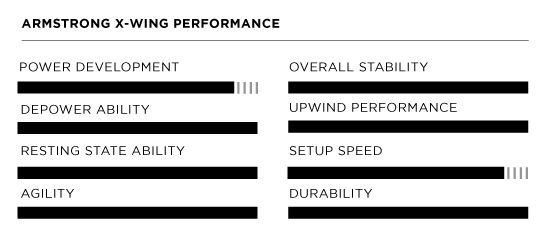
So the big news is the new airframe material which is coined as Ultra-PE X-PLY. This is a pliable four-layer laminate where the polyester sits on the outside, which is a sensible choice in terms of durability. The extra stiffness in the airframe has allowed Armstrong to minimize tube diameters and increase efficiency, building a slightly higher aspect wing than the XPS. Back-to-back testing with an equivalent sized XPS, you can definitely feel the X-Wing Performance wants to drive the foil forward more in terms of speed and upwind ability. It would be interesting to see how it does on the wing race circuit as it was definitely the foil holding up the top end rather than the wing. The top end and overall wind range is extremely impressive. The stiffer airframe with less reflex takes a little more technique to get on foil per size than an equivalent XPS perhaps, but the overall wind range is far broader.
As advanced air frame materials go, it remains very practical. You don’t need to be too conscious of folding it, and it’s worn extremely well in the long term with zero delamination or visible wear after several months. Anyone worried about staining a white leading-edge material shouldn’t be, as the external layer seems to be non-absorbent and has dealt with UK parking lot mud like a champ, remaining as white and virginal as a 1980s wedding dress.
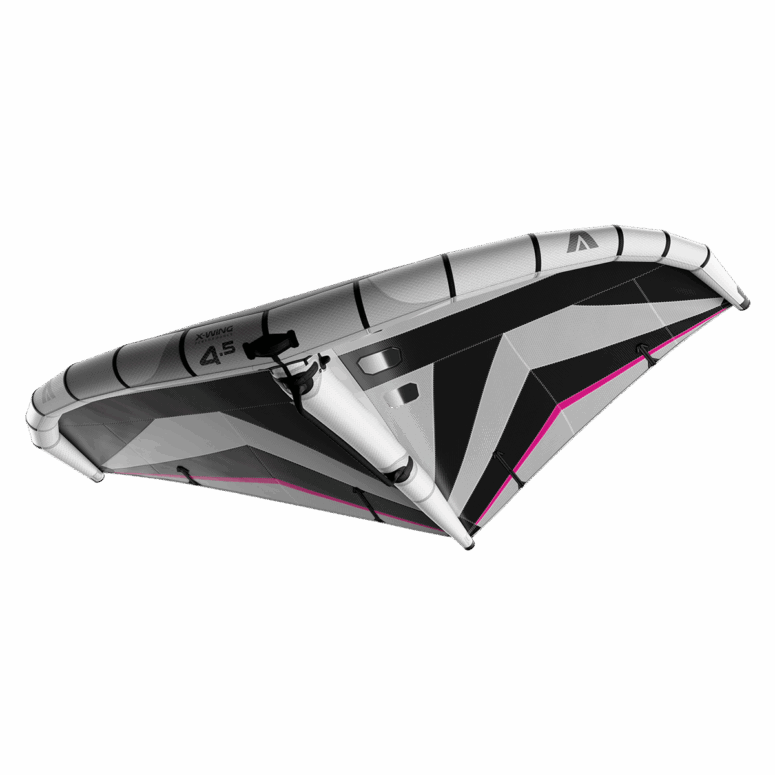
Canopy-wise the well proven D3 Teijin cloth carries over from the XPS range, and they have utilized seaming which channels load to the center of the trailing edge. It’s also worth noting due to the minimal screen printing and sewn-in design, if you do manage to damage the canopy it’s extremely easy to swap panels out individually and hide the repair. Two pairs of elegantly streamlined carbon battens sit in the trailing edge. These are easily removable for transport or if you want to tune for wind strength, where you’d insert them to prevent vibration in stronger wind, and a few spares come in a tube hidden in the bag. From a safety perspective, if things did go wonky out to sea, the black and white stripes already stand out from a search and rescue perspective, and they’ve included some pink accents to increase visibility further, which is becoming something of an Armstrong brand identity. Eight intelligently spaced porthole windows are purposefully minimal to save weight and offer excellent horizontal view of the action. They bead well and are nice and pliable; you’d barely notice they were there, and comply well with the high canopy tension.
Our test mule arrived in the shape of a 5m, which is at the larger end of what we usually use in local mid-sized wave conditions for a 90kg rider. Interestingly the 5m comes in at 2kg, 600g lighter than the equivalent in an XPS Mk2. This evens out to around 30% lighter across the range for equivalent sizes, and is worth taking into consideration when you’re traveling and close to the dreaded luggage limit.
Out of the bag you’ll notice the X-Wing Performance is boom only, rather than dual handles – this is most likely a weight-saving tactic as two joints to the strut and associated reinforcements required weigh half the amount of the four you’d need to accommodate handles. The booms (S, M and L) are cross compatible with the XPS Mk2 across the size ranges, so have a glance at the charts. The boom allows for some more advanced handling techniques and easy one-handed control. Connecting it to the wing is very simple, simply tuck it under two loops and inflate the strut, and it locks in securely. The boom interface is gently oval in profile and extremely comfortable with a premium feel to the grip, which has also proven very hard wearing.
As you inflate the wing, the pre-loaded canopy tension makes itself immediately evident with an extremely controlled and elegantly sculpted canopy shape which extends all the way to the trailing edge, a trait which has always stood the XPS range apart from the competition. Throwing the wing into tacks and other more technical flat-water shenanigans, it’s extremely clean with zero flutter, even in the upper reaches of the wind range where other wings start to falter and vibrate.
As a larger wing, we were extremely impressed with how well the X-Wing Performance performed in a wave scenario, with its flagging ability and stability definitely drawing DNA from the XPS. A 2kg 5m wing is delightful in this context, and made the innocuous lighter winds of the UK summer an absolute treat, with its mobility underpowered on a wave extremely impressive. It’s super easy to manage and rotate around flagged and behaves itself miraculously at all angles, particularly running into wind as previously discussed. It’s compliant with no death wobble or oscillation, and even sits well when flagged on the leash. It’s an extremely comfortable and balanced wing to use, with the boom enabling balanced front to back arm pressure, reducing fatigue.
Fixtures and fittings wise, the leash is a familiar, well-tested Armstrong bungee and solid Velcro wrist cuff with stainless swivel. The front flagging handle is a decent, comfortable size and stiff, giving you assertive and easy control over it in waves. It comes with a full-length boom-on bag so it’s easy enough to cart around, as well as a decent backpack.
The X-Wing Performance sits logically next to the existing XPS range as the premium high-performance option, we could see instances where a mixed quiver makes sense, utilizing the lightweight Performance models in the larger sizes, and then perhaps keeping a smaller Dacron XPS Mk2 for more hectic high-wind situations where a little give in the wing can be advantageous. Leaner, meaner but equally as compliant and easy to use as its stable mate, the X-Wing Performance ticks all the boxes of a premium lightweight airframe wing with a generous dose of practicality and ease of use thrown in.