
When you purchase gear through links on our site, we may earn a small commission. Here’s why you can trust our tests and our affiliate partner.
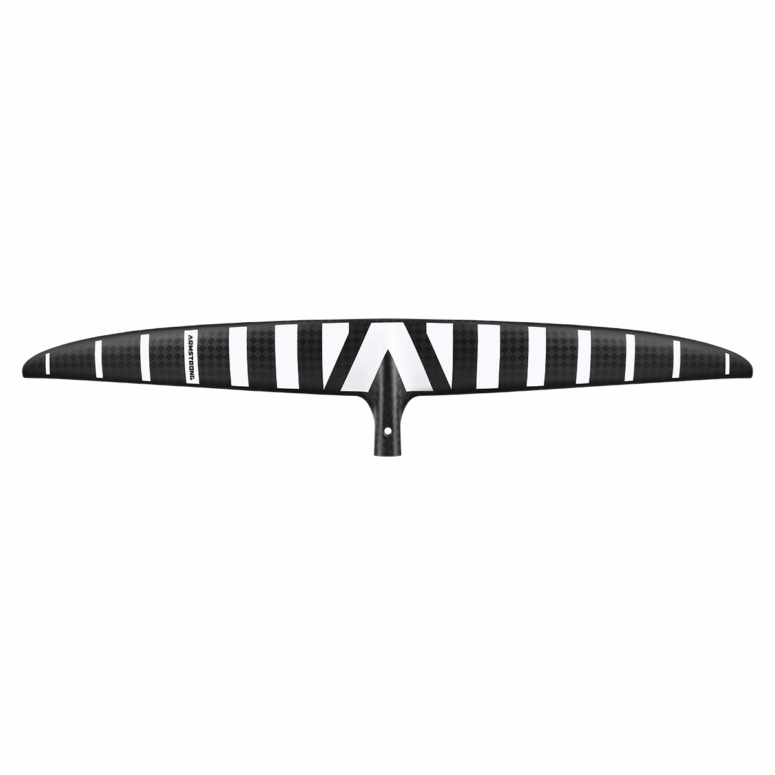
It’s been obvious of late that Armstrong UHA FRONT FOIL had a little gap in the product range, particularly where more purist downwinders were concerned, where glide, speed range and efficiency is everything. The existing (and brilliant) HA product line was a little too surf and wave biased. Armstrong have clearly been beavering away in the background to rectify this, and their answer has been the release of the all new UHA model, which times particularly well with the rise in popularity of parawing, bringing downwinding conditions far more within the reach of your average rider.
Shape-wise we’re looking at an aspect ratio of 12.8. Anyone familiar with the legacy and highly cambered DWP front wings will notice an enormous amount of difference both in riding characteristics and shape. It’s not an evolution of the DWP; it looks like markedly different. In basic terms think more of a HA that’s been stretched a little, and casting assumptions, this may have been the design basis.
Looking down its nose you’ve got a subtle moustache shape which flattens out into the extended tapered wingtips. The camber implementation is interesting, rather than the emphasized rear loaded lower trailing edge concaves we’ve seen widely across brands of late, this is a far more subtle affair; on our 870 UHA test wing for instance it has a hint of a dip across the majority of the span, which only flattens out in the extremity of the wingtip. The upper profile of a foil is an often overlooked feature, but the upper trailing edge has a little kick in the final 1/6. The nose shape seems close to the HA with a relatively rounded leading edge with bias towards the lower surface. All design roads lead to efficiency.
In the water, I think we’re all aware that the biggest proponent of lift in a foil is span, and the UHA has plenty of it per size. We’d fully concur with the brand’s advice to size down one size from the HA range to achieve equivalent lift, and the luxury of back to back testing with a Foil Drive more than confirmed this.
Discipline wise, it would be easy to pigeonhole it for DW or parawing biased bump-riding activities, but I think it’s got a far broader application than that. If you’re more of a carvey, glidey rider using any propulsion method it could be worth consideration. It was interesting watching my wife, who’s an intermediate wingfoiler, learn to dial her tacks with it. That extra bit of carry allowed her to maintain momentum and complete the maneuver, without stalling out, and as a lightweight rider she could still get the foil to roll adequately.
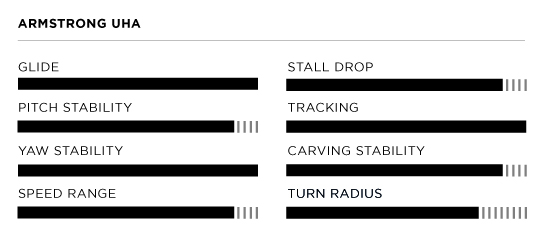
In the bumps, it likes to ride high on the mast and this has a noticeable effect on the glide. The stall characteristics are almost impossibly smooth and pitch stability is extremely high considering the market sector. The speed range is massive also, an important factor when you take it into faster open ocean swell. Pumping the 870 was an interesting experience, initially we were putting in the work, and perhaps pushing a little too hard. It seems to prefer a more subtle application of pressure at a more relaxed rate, less energy than you would imagine for the amount of projection it supplies. For a high-aspect foil it feels solid enough to stamp on.
For nuts and bolts, we’re on the A+ architecture as usual, it’s two 28mm bolts, one with a barrel nut as well as a 19mm golden bolt in the front, the same setup as the latest HA range. Tails-wise, we flipped between the 120, 140 Dart and 180 Speed for downwind and parawing applications. For DW and glidey work it made sense to use an efficient higher-aspect tail to the front wing, being mindful to match the sizing accordingly. The Surf Mk2 tails loosen up the roll and provide a more playful experience generally with the 130 and 170 pairing well with the UHA870. White water tolerance is impressive for a foil of its dimensions, and you can flair a tip with confidence. Whilst completely useable we noticed the largest 1270 UHA (with its mighty 126.65cm span) made a P865 mast flex slightly, so we would recommend going shorter with the P795, or who knows what might be in the pipeline from our Kiwi friends.
If glide is your number one priority, the UHA is the choice from the Armstrong range, and heralds a new standard in usability with regards to higher-aspect foils. Pump less, glide more, and retain more energy and momentum for longer runs. Retaining a playful turning ability gives it a far wider range of use across disciplines than other foils in its class, particularly when paired with the surf tails. Regardless of your propulsion method, this is a versatile foil and complements the existing Armstrong range perfectly.