
When you purchase gear through links on our site, we may earn a small commission. Here’s why you can trust our tests and our affiliate partner.
Armstrong’s original Midlength was a polarizing board – those with the ability to ride it loved the efficiency and early starting, but it was definitely on the narrower side for beginners, and required a level of talent in underpowered scenarios. Fast forward a couple of seasons and we’re faced with yet another new discipline in the form of parawing, with the savvy manufacturers creating boards which aid the transition across from wingfoil. I found myself in this position, having learned to parawing fairly early doors on a downwind board and first generation equipment, and then outgrowing the 8ft plus beast and requiring a more adaptable one-board quiver for switching between disciplines according to conditions.
Armstrong literally answered my prayers by sending over their 6’8 x 22” 100L Midlength Mk II for UK summer. I’m 92kgs and normally wing 70-80L in most conditions with smaller foils. Because of the X-Form construction, the 100L board is extremely light for its volume allowing you to carry a few more liters without feeling compromised. I’d normally completely discount a 100L wing board as too large, but with the forward box position and lack of weight it didn’t feel too oversized and performed well in flakey UK summer conditions where a little positive volume can make or break a session’s viability.
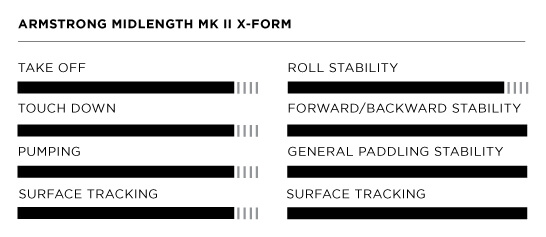
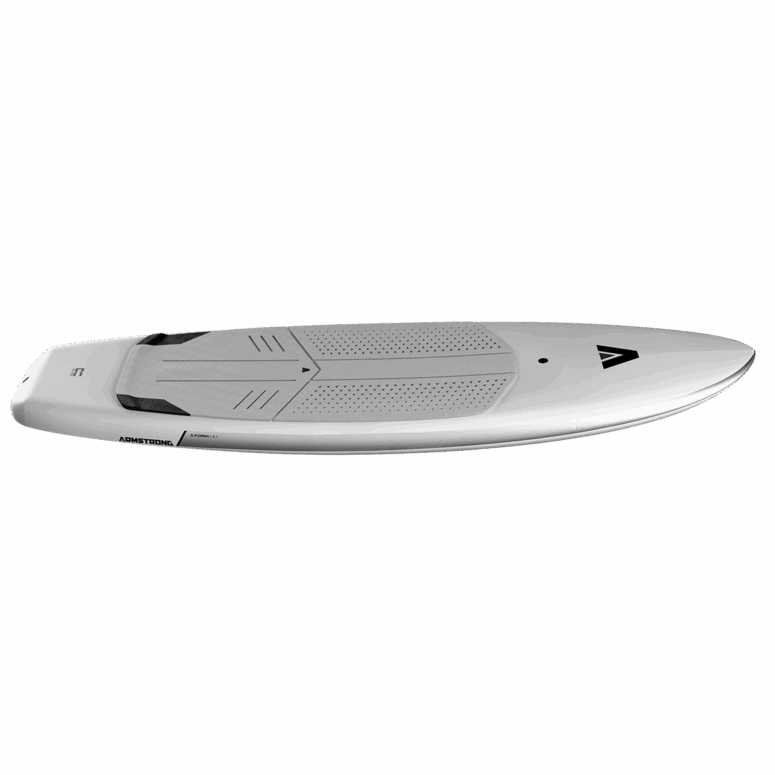
The Mk II is a completely revised shape and edged far more towards accessibility than the previous version, retaining more width and a more even volume distribution and extremely impressive surface stability. The X-Form construction means the board has a reduced thickness giving you better foil feedback. Hull contours have been toned downed and flattened slightly to improve efficiency, and yield easy tracking and a clean surface release.
The size range available is comprehensive and discipline spanning starting at 38L which would definitely prone and ranging all the way up to 130L for heavyweights, or even a friendly SUP foil board. The EVA deck pad is the usual bespoke Armstrong quality and has a little more thickness and comfort underfoot then previous, almost feeling like memory foam. The clearly demarked foil box position remains, which is great to glance down to check your foot position on a longer board.
The new X-Form construction is a precision molded affair, with a full carbon outer shell, PVC rails and a lightweight EPS core. The signature I-beam system connecting the deck to the foil box remains as does the further-forward-than-average elongated foil box. We’re sold on the X-Form construction, after being initially skeptical of such an eerily lightweight board – after several months in the field it’s held up well, and the matte white surface finish is hard-wearing to any scratches. It’s also foil assist compatible with decent signal straight out of the box.
In practice the Mk II is extremely stable for its size and reacts positively to leg pumping, bouncing your front foot out of the water like an eager labrador. These attributes lend themselves well to parawing, where some solid volume under the front foot is key when your bag of wind decides to be uncooperative. Crossing back over into wing use, the lack of mass and connected feeling allow you to chuck it around and the nose shape glances off the water well. You only really notice the drag from extra windage in offshore wave riding conditions. That little bit of extra width is in the right place and works wonders, and in terms of getting planing efficiency there’s very little compromise.
The Midlength Mk II is the most straightforward and least technical mid-length board to ride we’ve tested. It’s literally easy street. It’s a safer ML shape, far more accessible than the previous version, allowing you to get on foil and concentrate on the job in hand, maximizing your progression.