

When you purchase gear through links on our site, we may earn a small commission. Here’s why you can trust our tests and our affiliate partner.
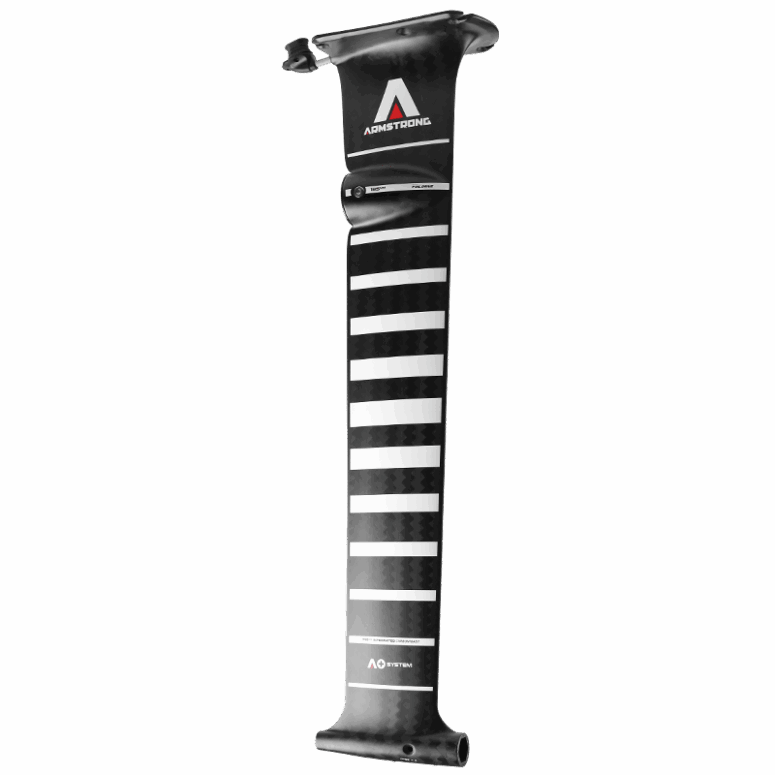
With Armstrong’s A+ foil system extremely popular globally and the meteoric rise of Foil Drive essentially creating a new discipline with the highest uptake we’ve seen in the last two years, it makes perfect sense for Armstrong to produce an integrated mast to (quite literally) streamline their integration with the system.
What we’ve learned from testing trench boards, is that even what may seem like an insignificant change with a product physically makes a marked difference both in hydrodynamic terms and with riding sensation. With the mast being such a critical component of a foil system, this is all the more relevant.
With a standard Foil Drive system with the bolt-on pod design, once up on foil, if you misjudge your height and dip the pod into the water, it’s normally game over and one of the inevitable limits to the design of the system. The drag from the pod will put the brakes on, and you either have to put in a significant pitch correction which interrupts your flow or eat the proverbial.
Armstrong have elegantly molded in carbon, what’s usually the plastic motor pod, into the mast, minimizing the frontal and side area of the motor pod, drastically reducing drag. The architecture is based around a 795mm Performance mast with the motor pod set at 185mm. A second 795mm eFoil-focused mast is also available with the motor set at 650mm for straight eFoil work.
Armstrong being Armstrong, they ran it through CFD to work out the most advantageous position, and you’ll notice an elegant concave in the trailing edge of the mast where the pod sits to mitigate any air creep and prop cavitation. Building the pod in that smoothly and hiding the cable inside is a great example of what’s achievable with modern composites.
The countersunk open-toe design of the mast feet have the same M7 hardware carried over from the standard Performance mast. What’s been added to the mast foot is two new countersunk M8 apertures for bolting the mast directly to the top of the Gen 2 MAX, Slim or new Fusion system. Armstrong kindly provide these two bolts as part of the package, so there’s no scrabbling around in the bolts box required.
From a practical perspective an integrated mast simplifies the setup process enormously. Hidden in the pod, an integrated motor puck locks the power cable to the motor with four dome head bolts, much like the usual puck with the red O ring keeping it all watertight, and the cables neatly tucked away internally. A sturdy split bolt slides all the way through the pod and clamps the motor in place with absolutely zero play as you would expect. The tolerances are impressively tight. On the Gen 2 Slim and MAX system, the cable tail is exactly the right length to clip into the unit as normal. It’s worth noting that with the Fusion system, you’ll need to open up the mast foot and extend the cable length a few centimeters, so you won’t require the Barnacle adapter. This process takes two minutes, and the correct length is neatly marked with a black line on the cable.
Out testing rig for a 90kg rider was a 33l Appletree Zapple S trench board; we tried it in 1ft onshore to well-overhead waves with the MA Mk2 690 and 990, and Surf 130 Mk2 tail. We also tested with the Fusion system with a 46l Midlength trench board, for a more hybrid eFoil based experience.
In practice, having used the Armstrong system extensively for Foil Drive, and being super tuned into it without the integrated mast, you’ll notice you can move your weight back a little bit for take-off as the more centralized motor position means you are not fighting the lift on acceleration (or pitching moment) in the front of the board so much. Takeoff is a smoother experience, and the mast connection gently resonates a quiet, futuristic sound.
Initially with the geometry set at 185mm, we were worried it would be set a little too far down the mast, as we normally use 15cm to cope with the inevitable UK surface chop. But measuring the systems side by side, due to the way the cable orientates, it was set only 8mm lower than our standard mast rig and took very little adjustment in technique to ride. Once you feel how ghost-like the pod is when you touch down, this information is almost irrelevant any way as the minimized drag means you can now confidently dip that pod in and get away with it. As we used the mast more, we quickly realized it massively improved your flow in the waves, as you could ride less defensively in your pitch, and really dive a bottom turn, much like you would winging or prone.
This delightful piece of carbon sculpture from Armstrong further enhances the Foil Drive experience to a point where it’s dangerously comparable in feel to non-propelled disciplines, particularly when paired with a decent trench board. Even the most lithium-averse riders are going to find this setup difficult to complain about.
Chances are if you have a Foil Drive system you have already set aside a mast specifically for it to avoid the constant disassembly and reassembly, so for someone starting afresh with it the integrated mast is a no brainer. Not having that feeling of being tripped over at critical moments is worth the investment alone, but it also comes with the benefit of a more efficient takeoff, improved weight placement of the motor, and less pitching moment. For the committed Foil Drive addict on the Armstrong system, Foil Drive’s unique ability to collaborate with more or less any foil manufacturer without stepping on toes plays out beautifully in this case and also reinforces the acceptance of Foil Drive both as a brand and a discipline.