

When you purchase gear through links on our site, we may earn a small commission. Here’s why you can trust our tests and our affiliate partner.
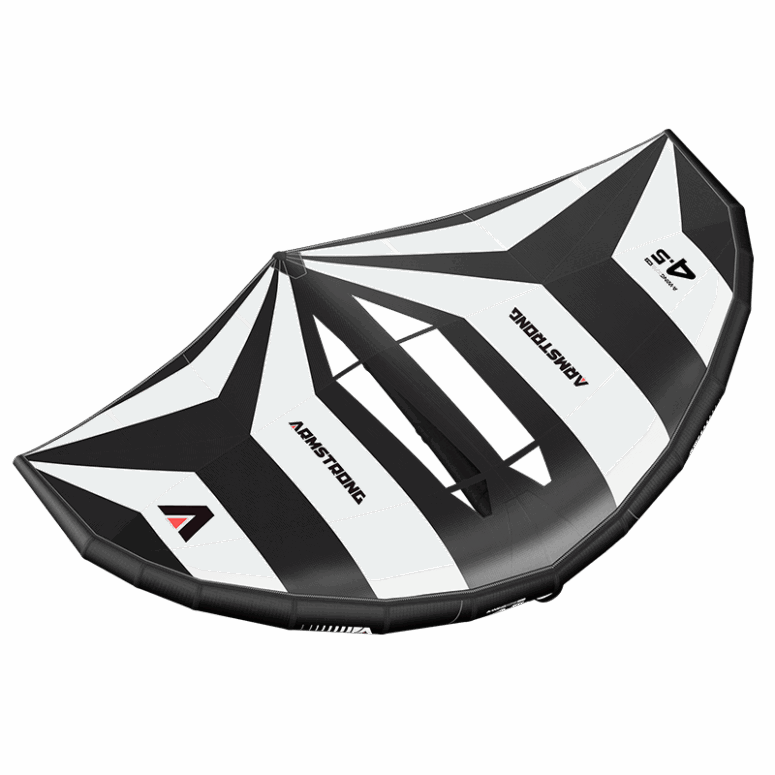
Two years ago, it’s fair to say, Armstrong’s original A-Wing XPS wing sparked a market-wide revolution in canopy tension. You pumped it up and it was preloaded drum-tight. The cut of the canopy was immaculate, and in practice this gave the wing a super wide wind range and very smooth and stable characteristics. Cash Berzolla took it to Jeffreys Bay and filmed an incredible video that also shook the whole industry. Its stripey cut-in pattern makes it instantly recognizable and its solid performance, particularly into wind and in waves, made it an instantly popular choice across rider levels.
MkII is here, and at surface level you’d be forgiven for thinking that not much has changed. Aesthetically, a familiar cross panel sail pattern is comprised of triangles of three-core ripstop which focus power into the tip of the strut and provide extra rigidity over the rear third of the sail. We think the spans have been reduced a little per size. There’s a comprehensive range of 10 sizes available this year, starting at a tiny 2m and running all the way to 6.5m in half-meter increments. Materials also carry across from the previous version with DLE 160 and 130 for the airframe and Teijin D3 canopy cloth. It comes as standard with an elasticated webbing style leash and Velcro wrist cuff – this is a solid design and reduces any tangling annoyance you might experience with a bare Dyneema leash. Lightweight and removable carbon trailing-edge battens carry over from the previous model, eliminating vibration in the top end, spares are also provided in a handy tube tucked in the bag. Supple TPU windows sit in a practical position and bead well, giving some awareness of any traffic downwind and upwind.
The most immediate difference you’re going to notice is the handles, which Armstrong have made an excellent job of implementing with the new Dyna-Link system. A slight oval shape to the grip and embossed grip pattern makes them feel both solid and elegant to hold, and gives the XPS MkII a more premium-feeling interface than the previous version. The front handle is large enough to pistol grip which is handy in some onshore situations. The handle connection system works with some bands of webbing sewn across the diameter of the struts. You slide the foot of the handle under the Dyneema-reinforced webbing at both ends, and once you inflate the strut it locks in place with no heavy inserts or fixings. Genius. The feet of the handles spread the load well into the strut forming an ultra-stiff connection which becomes part of the strut and doesn’t twist. This tool-less system makes for easy travel, and we found no issue getting the wing in the bag with both handles attached. It comes with twin carbon handles as standard, and a carbon boom is also available as an extra for the more freestyle inclined. This spans the entire strut and hooks into the outer webbing loops, giving huge adjustability. Three boom sizes are available which are wing-size specific.
In the water, there’s an overarching feeling of solidity in handling characteristics, which carries over and extrapolates from the former XPS. If you’ve spent time on the previous XPS it will feel familiar in a very good way, but the handle interface crisps things up and the subtle shape tweaks give more control and stability, particularly noticeable in the top end of the wind range where things are smoothed out beautifully – it takes a gust like an absolute champ. The XPS has a progressive power delivery over a relatively short span of sheeting. There’s a very balanced, even arm pressure making it comfortable to ride for a long session, and you creep upwind with little effort. The reduction in span means the wingtips rarely catch, and the wing feels a little more compact across sizes.
Armstrong have again achieved a product that’s comparable to brands using exotic (and therefore expensive) tube materials. The XPS MkII is comfortable to ride and extremely stable particularly when flagged, and has one of the widest, smoothest sweet spots of any wing we’ve tested. It’s a wing you dial into really quickly, and becomes an extension of your body rather than some apparatus. It’s an extremely versatile piece of equipment made all the more impressive by the keen price point and yields as much usable performance as you could ever require from a hand wing.