

When you purchase gear through links on our site, we may earn a small commission. Here’s why you can trust our tests and our affiliate partner.
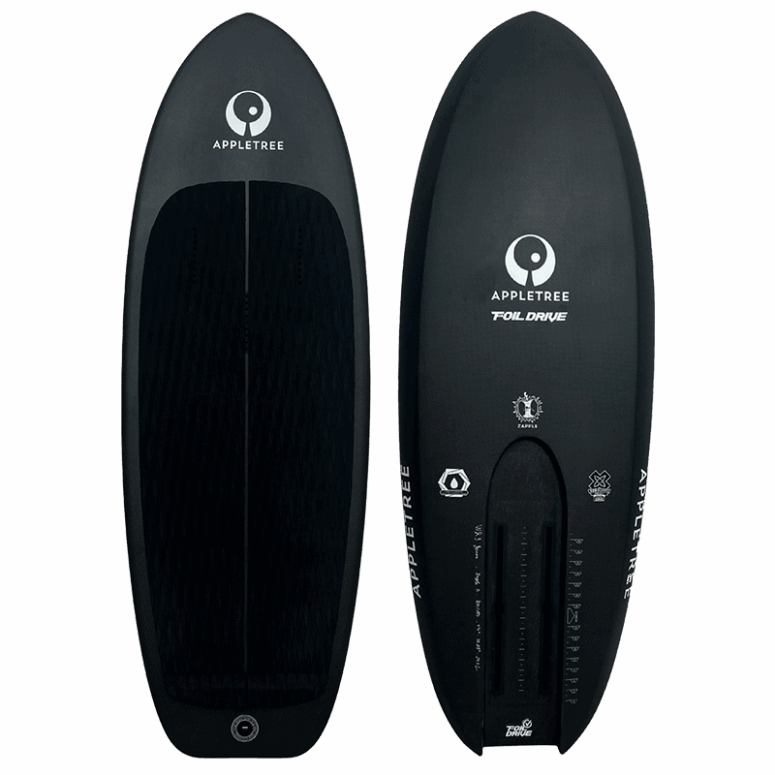
Since the launch of the Gen 2, Foil Drive are an unstoppable juggernaut, and we’re probably seeing the most uptake of any discipline currently with foil assist. Trench boards came to the market around a year ago and Appletree’s production facility was quick off the mark and nimble enough to produce an excellent mid-length shape, in the aptly named Zapple, to meet the consumer demand, cementing themselves as a benchmark platform in the process. Nine months later, and with the release of the High Power motor and battery from Foil Drive, as well as skill levels of the end user ramping up, demand for a smaller Zapple was obvious. Three stock sizes are available in 4’4, 4’6 and 4’8, ranging between a diminutive 29.6L to 33.3L.
With a focus on prone-style performance wave riding, it made sense to shift from mid-length to a more pure, prone-board shape, minimizing volume, drag and swing weight. Compared to the standard Zapple, you need a more snappy pop up and good technique to benefit from the more compact dimensions.
They’ve geared this for as efficient takeoff as possible in a compact shape, retaining quite flat subtle continuous rocker through the majority of the board with a quick kick in the nose and with a gentle V entry to let it bounce well off the water. The lower rails are chamfered at a generous angle to prevent any catchy behavior on the water. This harsher rail shape is smoothed out into the nose section, which retains quite a lot of width and volume, and planing ability under your chest area. The deck standing area is very lightly concaved giving you that planted feeling on the board and a little awareness of where your feet are relative to the rail. The kick pad is well placed and we found our back foot planted on it with a comfortable stance width as soon as we were transitioning from motor to wave power.
Signal issues are a distant memory with these boards; the whole nose is an S-glass signal window, and transmission is, in our experience, absolutely flawless. With a board aimed for more consequential wave conditions this is massively important, as your duck dive needs to be on point. With this lower volume board a powered duck dive will pull you quite a way underwater and avoid any potential thrashings. Inserts are also built in with a Y configuration on self-tapping inserts if you want to use foot straps.
Appletree advise a chip in for this board for your average sized rider, but this depends very much on your weight, skill level and foil size and of course whether or not you’ve got the High Power upgrades. Here’s our benchmark with the 33L 4’8 board, currently sitting at a robust 92kgs – we could flat-water start the 33L Zapple S with an Armstrong MAv2 990 with little effort with a standard taped mast and HP hardware. Weave an integrated mast into the mix (thanks Armstrong) and this became easily achievable. Chip ins with the MAv2 690 meant we could tackle overhead-high waves without feeling remotely over foiled.
What most people are chasing with foil assist is a feeling closer to prone foiling as possible, and the Zapple S reduces the distance from your feet to the mass of the battery unit to an absolute minimum, sharpening up turning inputs. Its compact dimensions allow you to be more risky in steeper waves and go for that bounce off white water you previously definitely wouldn’t have made. The notable stiffness of a vacuum-infused board means it’s a super connected feel when you put in a turning input, and further disguises the battery weight. For the more progressive, wave-focused Foil Drive enthusiast, this Zapple S further refines the assisted experience, and is going to skyrocket your progression when it comes to tighter, more critical turns.