
When you purchase gear through links on our site, we may earn a small commission. Here’s why you can trust our tests and our affiliate partner.
It’s fair to say the Appleslice has historically been one of the Appletree brand’s most successful models, keeping ahead of the game and adapting well as wingfoiling has evolved from its ungainly flappy infancy to now one of the widest adopted and dynamic foiling sports. 2026 sees the launch of the fourth version which is testament to the board’s heritage in a relatively short space of time. No sooner had the test board arrived from Portugal, it was tucked straight into a board bag, smuggled to Cape Town and thrown into a multitude of situations, from intermediate winging with a 60kg rider, to beginner parawing and advanced wingfoiling with a 90kg rider, even teaching a 45kg grommet.
Seven factory sizes in 10L increments are available. There’s a split in the range where 50-60-70 have a slightly longer width to length ratio for progressive and freestyle riding, the 80-90-100-115 sizes start to get a little wider comparatively to give more surface stability. A completely new material called Coat 25 is used for the hot coat instead of traditional epoxy; this saves around 8% of weight, making the board lighter without sacrificing durability, which on the larger volumes can mean a not insignificant 500-600g. A set of V strap inserts are present, and they’ve added more options forwards and backwards here – they come with a sturdy Torx T30 head on them, and self-tap into the board.
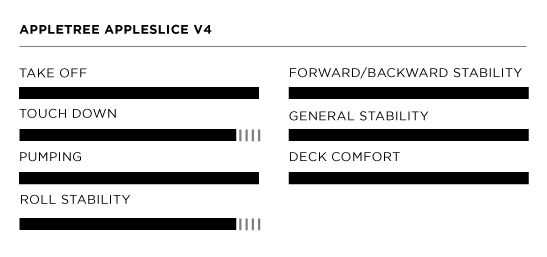
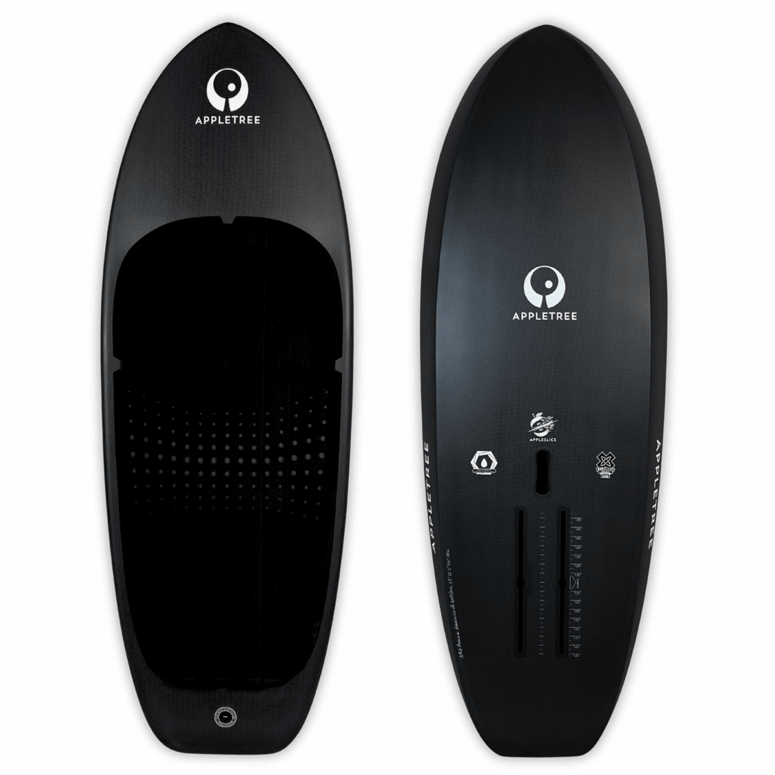
Out of the box, the board appears quite visibly different to the V3, as if many of the design features have been amplified. Our 90L test board at 5’7 and 24” wide you’d expect would take some persuasion to release compared to an equivalent mid length, but considering the enhanced levels of surface stability you’re treated to with those dimensions, the release is extremely smooth and achieved with less power than you’d expect. There’s a little extra kick of rocker in the nose to help it plough through choppier conditions more gracefully and a very subtle double concave through the first quarter of the board, which runs into a purposefully flat section to promote early planing and release. Per size, the outline is narrower overall, promoting more surface acceleration, and the widest point of the outline has been moved forward slightly pushing more volume under the front foot. The beveled rails extend further into the front of the board and provide a narrower, more efficient bottom surface heading up to a wider, more stable deck. The tail has had a serious rework, and is longer and more elegant than previous. The slope at the rear of the board near the kick pad is emphasized, and makes sliding on and off extremely easy. An NFC tag hides in the tail which allows you to register your board to a database, in case it goes missing or is stolen. The foil track has been budged forward quite a bit compared to the V3, which offers decent weight distribution and lets the board balance a little better during foot swaps. For reference our Code foil setup sat exactly in the middle of the box comfortably, and the Armstrong rig sat about 3/4cm forward.
A subtle, but significant practical improvement over the previous Appletree boards is an updated EVA deck grip which treads the line of comfort, grip and board feeling perfectly. The innate stiffness of a full carbon, vacuum-infused board translates the foil feeling immaculately, and the deck pad doesn’t dull this. The ribbed texture runs in a nose to tail corduroy direction giving a luxurious feeling underfoot, and allows you to shuffle forward and backwards. In the center of the pad, quite a bit of material has been removed in circles to increase grip and traction. The deck concave has also been amplified a little, meaning the front standing area is more recessed. This significantly enhances the feeling of being part of the board rather than on top of it. The nose on the top of the deck is little more domey and seems more dent resistant than previous in this vulnerable area, the front of the pad has a nice little slope which helps place your front foot.
Four generations in, thoughtful and incremental improvements build on an already solid platform and Appletree continue to innovate and keep up with modern discipline developments in their usual agile style. More volume under the front foot not only enhances the board’s suitability for parawing which has more of a flat forward pull than wing, but also improves surface balance for wingfoiling and makes a friendlier and more accessible board than the V3 in equivalent volumes. Whilst the new Slice is both longer and narrower than previous, that volume placement means it still offers similar levels of stability as the previous generation, perhaps even more, but still differentiates itself from a mid-length shape to more than justify its existence, particularly in the roll axis.
Whilst the board’s focus is undeniably wingfoiling, there’s definite potential for crossover into the dark and emerging art of parawing; whilst a pure mid length is always going to plane a little quicker and with less power required, we were impressed how well the new Slice worked for your formative stages, particularly if you want a little more surface stability whilst you learn to wrestle the angry binbag. On the flipside, if you ride somewhere with ideal conditions and want a shorter sinker parawing board, the lower volume will do this with ease. Strong, practical design choices make for a significant update for the Slice range.