Wing Commander: Noah Hoffman & Andrew Gibbons
When it comes to the big hitters in the wind and water sport realm, few can claim a heritage like Naish can. The brand has been at the forefront of the industry for many years, consistently bringing out well-received and commercially popular products. Continuing that tradition are designers Noah Hoffman, who joined the brand four years ago, and Andrew Gibbons, who came onboard last year, who are helping shape the brand’s next chapter.
First a little about yourselves. Andrew, you grew up near Naish HQ on Maui. Noah, you came into the brand after shaping boards. Did joining Naish feel like quite a natural destination for both of you?
NH: Getting the position at Naish felt like a very full circle moment for me. Growing up in Kailua watching my dad windsurf, Naish was a brand that I grew up around. Throughout university I really enjoyed the design and development side of engineering but jobs where you actually get to do hands-on development are very hard to find. I was in the process of onboarding with the Navy for Nuclear Engineering, so when my family friend and now coworker Des Walsh told my dad about a potential opportunity doing design for Naish I knew it was an opportunity that I couldn't pass up. It's truly a dream job for me combining my passion for design and love for water sports; and doing it for the brand that I grew up with is just the icing on the cake!
AG: It certainly was not expected. I grew up around Naish – always sailed Naish windsurf gear and flew Naish kites growing up – but as my foiling career progressed, Naish was not on my radar. I had been a team rider for Lift and hoped that I would be able to roll my sponsorship into a job designing with them after I graduated from school, but it didn’t materialize. A few months before I graduated, I saw Noah’s dad in the lineup and he said he might know of a job for me on the R&D team at Naish. Next thing I knew, he put me in touch with Noah for an interview with Naish and I got the job. It has felt like a perfect fit ever since.
default
A lot of riders imagine foil design as some mysterious dark art. Tell us what the reality looks like at Naish.
NH: It usually starts out as a conversation in the lineup that goes like “wouldn't it be sick if we had foil that did ‘x’?”. And then it's a lot of talking with the team about the market and making sure our goals are aligned with what will make other riders happy and being that we are consumers just as much as everyone else it always is. Once we have a goal, it's a lot of time in the computer designing sections and planforms, running simulations up until receiving the first prototype. Then test and refine, tweaking lay-ups and geometry and getting the foils out in as many different conditions, riding styles and under peoples’ feet as possible, until we are satisfied with the result and can sign the wing off for production.
AG: Yeah it is and it isn’t. Once you figure out the kinds of numbers necessary, what a lift distribution should look like, and how the way a foil looks affects how it rides, it can be very clear and easy to design a foil. I think the harder part is figuring out what the market actually wants and what user feedback means. As designers, we hear a lot of feedback: some technical, some non-technical, and some seemingly based on fairy tales – all are equally valuable. I think the real dark art is learning to understand the feedback you receive and then use it correctly to improve your designs.
Between the two of you, how do the roles divide up? Are there clear lanes, or is it more of a constant back-and-forth of ideas, testing, and refining?
NH: Before Andrew started we had a few other engineers come and go to help with foil design and other projects within the team. So when they left I became solely responsible for taking care of everything in the Wing and Foil range. While we were interviewing Andrew for the job it was clear to me that he was the right person to lead the development on foils. So after a short onboarding period we have a good split of workload where he leads foil design and consults with me when there are new ideas and I do the same with boards and wings.
AG: When I started working for Naish in June of 2025, Noah was doing all of the design on the wings, foils and boards while I got caught up to speed. After a few months, it became clear that I would start to take on more of the foil design responsibilities, and he the wings and boards. Today, these design tasks are almost completely separated, but we still collaborate extensively on ideation, range development, and testing.
Hawaii is one of the world’s great testing grounds. How valuable is it having access to real wind, swell, chop, and open-ocean conditions on your doorstep?
AG: It's invaluable. With access to both Oahu, Maui and Hood River, we have the ability to test in almost every condition imaginable throughout all months of the year. This means that we can design and test products suitable for all riding styles and conditions to deliver a more well-rounded product to the end user.
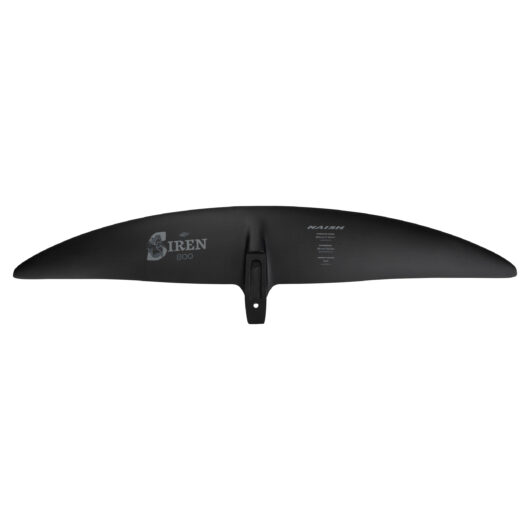
Moving onto some of your latest work, the Siren is positioned as the foil that can do a bit of everything – clean power, glide, carving and progression. Was that versatility the brief?
NH: A big part of the design prompt for both of our new foils was versatility. We wanted to create two lines that would sit at the core of our lineup. The Siren we wanted to place more on the wing/windpower side of foiling. Focusing more on the stability and speed range of the foil while putting it into that mid aspect outline that allows for real controllable turns. The section we came up with is a moderately high camber, sitting at around 4.5%. Its design was to get you up early by providing lots of low-end lift but still have a good drag curve so that it is easy to push hard and get going quite fast. Another big focus was the glide, a lot of our testing revolves around waves, so we made sure that the Siren had enough carry to connect waves surf foiling.
It’s a stable platform for beginners and is a fun foil for advanced riders. How do you design a foil that doesn’t get “outgrown” too quickly?
NH: In my opinion a lot of what makes a foil good for beginners is also what helps advanced riders progress. Having stability, control and glide gives less room for errors when you are learning and more consistency session after session when you get better. Obviously at both ends of the spectrum there are needs that cannot be met by a single versatile foil. But for 90% of the people looking for this style of foil there is a size that can meet their demands.
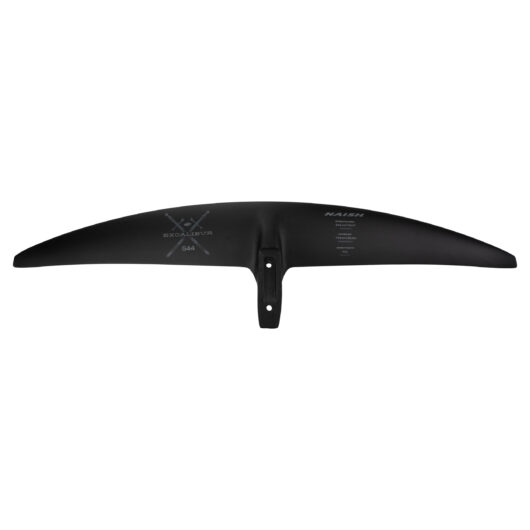
The Excalibur is your new fast, high aspect option. Who did you have in mind when shaping that line?
NH: I selfishly made the Excalibur for myself. I almost exclusively was riding our old 640HA for both wing and prone and wanted to make a foil to replace it for me. When coming up with the design prompt for the Excalibur we tried lots of different HA’s, ultimately our goal was to create an efficient and fast foil but still retain good low end and maneuverability. The Excalibur has lots of small details that help to achieve this goal. The upturned wingtips help with flow attachment on tip breaches and help liven up the turns. The 10.2 aspect ratio gives a good combination of glide, while the straighter leading edge through the center and more swept tips help with pitch stability for winging. The High 5.5% camber section gives good low-end and pump feel.
You mention working heavily on the drag curve to improve mid-range acceleration and top-end speed. For riders who aren’t engineers, what does that actually feel like underfoot?
NH: What this feels like when you are on foil is instant feedback of speed. It allows you to be riding around without much pressure in the feet and then whenever you want to go, pull more power into the wing and off you go. For example when riding waves, that mid-range acceleration allows you to stay up at the top of the wave till you are ready to drop down the face and all you need to do is put a bit of pressure on to your front foot and the foil shoots forward into the wave and projects into the flats for your bottom turn.
When you’re both out riding, what are you each reaching for right now – Siren or Excalibur? I’m guessing it’s primarily the Excalibur for you Noah?!
NH: Well it really depends on the discipline for me. Lucky enough for us we get to have every size of foil so we can tailor exactly to the condition if needed. These days though my go to foils are the 744 Excalibur paired with the 140S Series tail to liven it up for surf foiling and winging in small waves and swell. And the 600 Siren with the 135 E Series to add a bit more glide for powered winging and riding in overhead breaking waves.
AG: I am primarily reaching for my 744 Excalibur. I do a lot of downwinding and like to connect four or five for ones when I am surfing so the Excalibur is my foil of choice when I am not doing dedicated testing. I will switch it up to the Siren 800 though when the surf gets a little more critical or the downwind bumps are steeper and slower for a more carvey and maneuverable sensation.
Foil design is moving quickly, but riders still want a degree of simplicity. How do you balance innovation with keeping a range intuitive and not overcomplicated?
AG: Firstly, Naish makes it easy with our Semi-Complete kits. When new customers buy into the system, it is recommended that they buy a semi-complete set as it will include a front wing, fuselage, tailored stabilizer, and tool kit with all of the required mounting hardware. This makes it really easy for the customer to assemble a plane without guessing what fuselage or stabilizer they need to buy. After the customer gets comfortable with the system, it is very modular and cost effective for people to adjust their setup to their riding style.
Secondly, these two models are the core of our range that are meant to cover the majority of riding styles, conditions and skill levels from people learning their first jibes on the lake to parawingers doing laps and everything in between. There will be a few more specialty foils added to the range in the future with clear performance characteristics, but for the core market we would rather continuously improve these two models with marked performance differences to cover their respective niche’s better, than introduce more foils which more or less cover the same area as the Siren and Excalibur.
Final one: when riders jump on these two new foils for the first time, what’s the one thing you hope they notice immediately?
AG: Exceptional low end and ease of use.
NH: Agreed. We designed the foils to be comfortable. One thing to note is that we designed our system with a neutral fuselage. This provides a very balanced foot pressure and smooth feel in the water. Allowing you to really tune the foot pressure of your foil with mast position. For us this gave us the best glide performance without having to use any shims, however if you are coming off of a brand with a little angle in the fuselage, you will have to run your foil a bit further forward than usual to achieve that same front footed feeling.