The Innovators – THE RADIX SINGLE TRACK STANDARD
If you’ve jumped into our recent AWSI coverage on YouTube, you might well have seen a little something about the new RADIX concept, a single-track prototype system that’s been developed in a joint collab between CORE and Appletree Surfboards, and will likely enter the production phase in the near future. Our interest piqued, we went looking for more knowledge from the team at CORE…
First, a bit of an overview – how does RADIX differ from the conventional dual-track box system that most riders are familiar with?
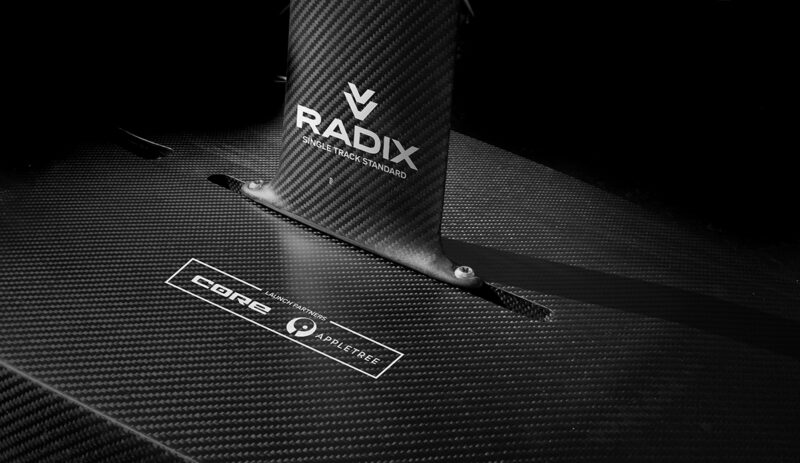
RADIX is a completely new foil interface based on a single-track concept. Unlike conventional dual-track boxes, RADIX moves the connection point from the surface into the core of the board using a conical geometry. This results in a stiffer, more direct load transfer and eliminates unnecessary drag on the bottom of the board. It’s significantly lighter, simpler, and hydrodynamically much cleaner.
What problem were you trying to solve when you first started developing RADIX?
We were looking to address several issues at once. First and foremost, we wanted to reduce drag and improve water flow around the mount area. The hull of the board is where turbulence and resistance can really affect performance. Secondly, we obviously aimed to create a much lighter system that is more efficient to manufacture at the same time. It should simplify the mounting process, and create a more compact system that’s easier to travel with, assemble, and maintain.
How did the collaboration between CORE and Appletree first come about?
We’ve been working with Appletree for years in the board-building space. Their deep experience in advanced board construction and in-house production made them the perfect partner for this kind of R&D-driven innovation. It was a very natural extension of our partnership and the perfect combination of niche expertise.
What kind of performance gains can riders expect to feel on the water?
You’ll notice earlier lift and a better low-end, especially at lower speeds (gaining higher taxiing speeds, faster) and a smoother hydrodynamic profile overall. Without the mast base and box creating drag, the board releases faster and touches down more cleanly.
Another beneficial effect of the base-less mast construction is the fully straight carbon fiber alignment, resulting in a significantly better stiffness to weight ratio. The stiffness of the conical connection also improves feedback and control during turns and pumping – it feels more locked in, but also more efficient. It’s subtle, but once you ride it, it’s hard to go back.
So do you think RADIX could eventually replace dual-track boxes, or will they continue side by side?
We don’t see RADIX replacing dual-track systems across the board in the short term. But it clearly offers a high-end, performance-oriented alternative. Our goal is for RADIX to establish itself as a performance option and as an open standard. Where it goes from there – the market will decide. Given the multiple benefits over a classic US box, we definitely see a bright future ahead.
How have other foil and board brands responded to the concept?
We had a lot of promising conversations at AWSI with other foil and board brands. There’s strong interest in a cleaner, lighter, single-track solution – especially one developed openly. We’re now working on a rollout timeline so that brands can start building prototypes in the near future.
Were there any big challenges you encountered during the design and testing process?
Definitely – as with any system that touches the core of both foil and board design, there are a lot of variables to align: geometry, tolerances, materials, load paths, even tooling. We’re still refining key details, and it’s been a lot of back and forth between lab and water. But that’s part of what makes it exciting.
We’re speaking with you in late September ‘25. Where do things sit with the system right now, and what’s your intention with it as we push into 2026?
We’re still in the early prototyping phase, but the foundation is solid. Our clear intention is to bring a fully tested, production-ready system to market – and that takes time. We’re committed to ironing out every last detail and avoiding the “version one regrets” that often come with innovation. 2026 will be about building confidence – with partners, riders, and eventually the entire market.