The Innovators: APPLETREE COAT 25
Although we didn’t quite find out what happened to the 24 other coats, Appletree have landed on something which really fits this slot: an innovative, ultra-lightweight, and significantly more scratch-resistant finish that’s now become the Appletree standard. We went to Appletree to find out the whats and whys…
Two years of secret development is quite the serious commitment! What was it about the traditional hot coat that you felt you needed to solve?
Actually, it didn’t stem from a problem, but from a constant drive for improvement. We are always searching for new ways to do things. Since the early days, our mission has been to build boards that are both lighter and more durable, and we are constantly looking for ways to push those boundaries further.
Our previous coat was good, but we felt there was still a way to shed more weight using materials that weren’t yet standard in the industry. We reached out to our specialized supplier and collaborated closely to develop this proprietary material. The goal was to push the quality even further, making it lighter and more scratch-resistant. It turned out to be a double win, it improved the board's performance and made the production process much more efficient and precise due to the faster curing time.
For anyone not deep into board construction, can you explain what a hot coat does – and why replacing it is actually quite a big deal?
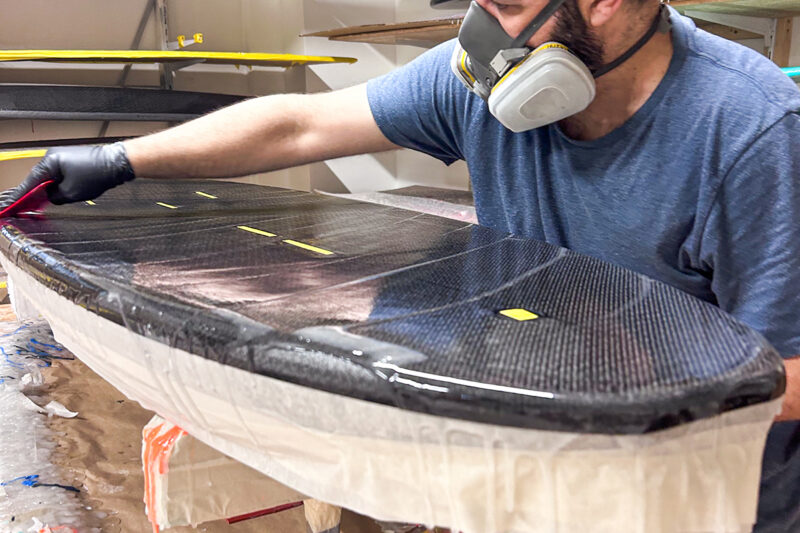
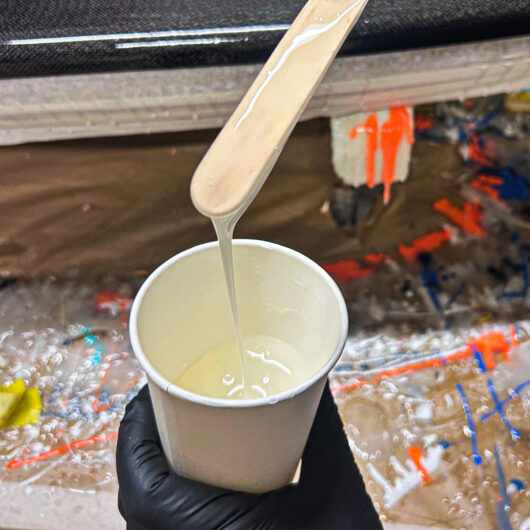
Think of the hot coat as the final ‘skin' that seals the structural composite. It provides a high-quality and smooth finish, making the board glossy and scratch-resistant while adding a crucial layer of protection. It’s also where the artwork and color are applied.
Replacing it was a huge deal, first and foremost, because it meant working with a completely new material for the industry. Coat 25 fundamentally changes how the coat is applied compared to the epoxy we used to use. Because the chemical behavior is so different (Coat 25 cures much faster and should be applied with a different tool) it has completely changed our flow. While it speeds up production, it demands more precision.
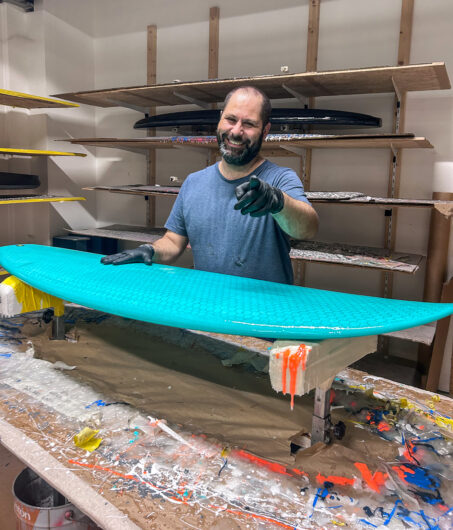
You have to master the material quickly before it sets, which is why we had to retrain our entire team and rethink our artistic techniques to maintain that clean, sharp Appletree look.

What does two years of development actually look like day to day?
Most of the two years are soaked up by long term testing. Saltwater is incredibly aggressive to any material. Just look at anything plastic that got washed up on the beach, (and while you’re at it, please throw it in the trash!). It starts to deteriorate almost immediately. The same happens to our foiling gear. We know almost no one actually does the recommended freshwater rinse, so gear is stored in wet bags full of salt. So, long-term testing was crucial to ensure the Coat 25 could handle that reality.
Parallel to testing, the challenge was pioneering the production process. Since there is no existing information on how to work with these materials, we had to develop our own methods from scratch and, as previously mentioned, train our entire staff to master them.
Weight reduction without losing strength is easier said than done. How did you actually prove to yourselves that you've achieved that?
This is exactly why the implementation took so long. Achieving that balance between weight and strength involves many factors. On one hand, there’s the immediate, visible side: the board must be hard, scratch-resistant, and completely waterproof against salt water and the everyday use conditions. On the other hand, there’s long-term structural integrity and durability.
This is a big part of our commitment to sustainability. We don’t want to build products that need constant replacement; we build boards that are meant to last. To prove Coat 25 met these standards, we conducted extensive ‘high-stress' testing with our riders in the most demanding conditions. We put a lot of boards through the wringer to ensure that by shedding weight, we weren't losing the durability Appletree is known for.
There's an interesting detail in here about the material flowing better and curing faster, which lets the shape come through more clearly. Is that an aesthetic bonus or was it always part of the plan?
A lot of board builders hate hot coats, especially in epoxy. Where polyester cures fast, so it’s hard before the resin can start dripping, epoxy cures slow, so you apply the coat, everything looks perfect and then you come back in an hour and the epoxy has flowed off the board or is full of little pin holes and uneven finish, yet not fully cured. Coat 25 cures even faster than polyester, so it's amazing that way.
This new tech meant retraining an entire department and rethinking your finishing process. What was the hardest part of that transition on the factory floor?
The biggest challenge was maintaining our production flow while simultaneously dedicating time to R&D. We had to keep up with current orders while carving out space to test this new material. Our process starts by deeply understanding how the new product behaves, and once we are confident, we run workshops to train the rest of the team.
There is always a learning curve, and many improvements happen at the time as we gain experience. We have a work philosophy where we test and pivot very quickly. While this agility is our greatest strength, it can also be incredibly demanding on the factory floor. Balancing that restless drive for innovation with the precision required for daily production was definitely the hardest part of the transition.
In terms of the aesthetic and look of the boards, has moving to Coat 25 changed the way you approach that side of things at all?
Absolutely. We have two incredibly talented artists in our Hot Coat department, and since the chemical behavior of Coat 25 is so different from epoxy, the way of applying paint had to evolve.
First, we had to explore how to maintain the classic Appletree style using these new application techniques. But that challenge actually opened the door to new artistic possibilities. Because the material behaves differently, it sparked a period of creative exploration.
In fact, we just launched a new art style called “Multicolour Tail Dip” with a fresh palette of colors, something that came directly out of experimenting with this new finish.
Coat 25 has been running in production quietly for a while already. What have riders been feeding back when they get their hands on the new boards?
The feedback has been very positive. Riders immediately noticed how much lighter the boards felt, along with their increased resistance and overall durability. It’s because of this real-world validation that we made the decision to incorporate Coat 25 as the new standard for every Appletree board.
We made sure our factory process was razor-sharp and that our team had complete mastery of the technique before rolling it out fully. At Appletree, every new shape, model, or version is born from the direct feedback of experienced riders testing in diverse styles and conditions.
At what point did you know you were ready to go public with it?
We waited until we were absolutely certain that this material was superior in every way, lighter, resistant, and more durable, and that our production workflow was fully integrated. In fact, all the boards leaving the factory have been made with Coat 25 for a while now, but we intentionally held back on the announcement. We didn't want to go public until we were 100% sure that the real-world feedback was consistently positive.
Now that we’ve seen the results and the riders reactions, we’re ready to officially make it the new Appletree standard.
Durability and sustainability are clearly connected in the way you think about this – a board that lasts is a board that doesn't get thrown away. Is that pretty consistent Appletree philosophy toward sustainability driving where the materials research goes next?
At Appletree, we believe the most sustainable product is the one you don’t have to replace. That’s why we don’t constantly swap out our lineup every year just for the sake of it; we only launch products when we truly have a significant improvement to offer.
For us, sustainability isn’t just a buzzword. Every step we take is aimed at using sustainable and local materials. Expanding our factory in Portugal has allowed us to go even further, like improving our foam recycling system and investing time in finding the right local suppliers who share our vision.
This commitment runs through everything we do, from the factory floor and our drive for structural durability, down to the smallest details like ensuring our apparel is made from sustainable materials. If a board stays out of the landfill and remains high-performance for years instead of months, that is the biggest environmental win we can achieve. By combining our signature 50K waterproof foam with the new Coat 25, we are creating equipment that can take a beating and stay fresh for the long haul.