PROfiles: ROMAIN GHIO
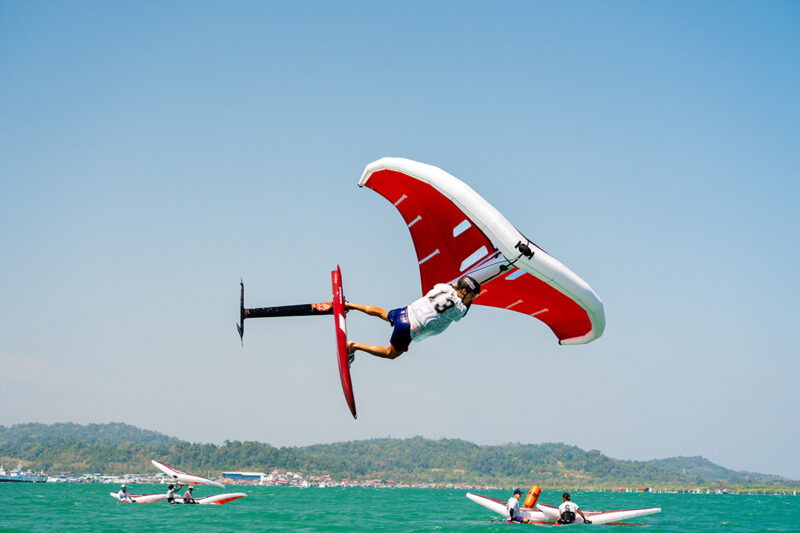
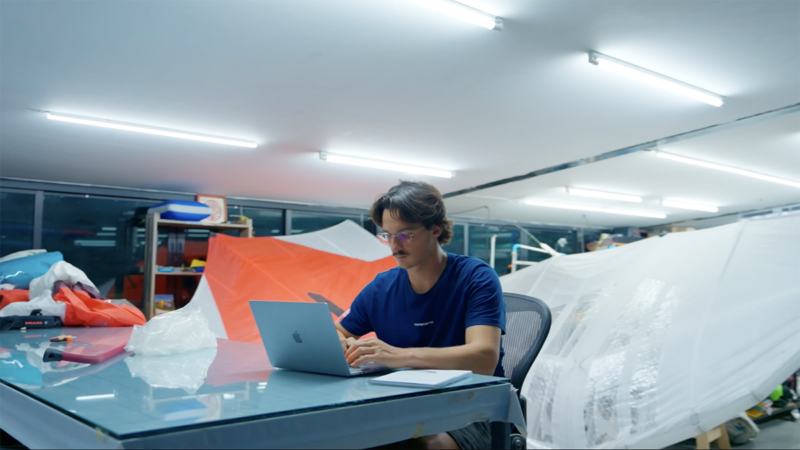
27-year-old French racer Romain Ghio has already claimed standout results on the IWSA and GWA tours. Now, alongside his racing career, he’s also helping shape the future of performance equipment as Starboard’s race wing designer, currently working on their next generation “Bowstring” design.
RIDER STATS
Age: 27
Height: 182cm
Weight: 81kg
Nationality: french
Sponsors: Starboard & Precilens
Competitive foil disciplines: Racing (X-15, IWSA and GWA)
Hey Romain. First let’s start with your competitive career. You race X-15 class right? For those not in the know, please tell us all about that.
Yeah, since the beginning of this year I’ve been racing on the X-15 Tour. The X-15 is a one-design racing class, which means every rider competes on the same equipment, similar to Olympic classes like iQFOiL. The goal is to remove the equipment advantage, so the racing is really about athletic performance, strategy, and technique.
How did you first get into it? Were you racing wings prior to this?
I’ve been racing since I was 12 years old. I first came from the Olympic side of windsurfing and windfoil, and then for the last four years I’ve been part of the French Wingfoil Team. Because of that background, I’ve known the one-design mentality for a long time. When I joined the X-15 Tour, I rediscovered what I truly love about racing: competition where the athlete makes the difference more than the budget or the equipment.
What have been the major standout moments and highlights so far in your racing career?
In windsurfing, I achieved several youth podiums during my early career. In wingfoil, I’ve had a few IWSA top 10 finishes and last year I achieved a Top 4 on the GWA Tour, which was actually my first season competing on that circuit. Those moments definitely stand out because they showed me I could compete at a high international level in different disciplines.
A big development for you recently is that you’ve now joined Starboard as their race wing designer. How did that come about, and what experience in design are you bringing to the role?
Honestly, it’s something I never could have imagined four years ago. Alongside my sporting career, I’ve been studying material engineering at university, specializing in material behavior and design. At the same time, my Olympic racing background has taught me how to truly feel what makes equipment accelerate and perform on the water. Combining that athlete experience with engineering studies allows me to be extremely precise in R&D and product development.
You’re primarily focused on their “Bowstring” wing design. Talk us through that.
The Bowstring is what we could call a next-generation wing. Today, most wing designs continue to improve, but fundamentally they still follow the same concepts. With Starboard, we want to push the discipline further and create something significantly more efficient. The biggest innovation is the leading edge, which is almost 50% thinner than on a traditional wing, making it much more aerodynamic and reducing drag significantly. The challenge with thinner structures is keeping enough rigidity for racing performance, so inside the double-surface profile we use a second internal leading edge called the “Spar.” This internal structure helps maintain stiffness and stability while still benefiting from the aerodynamic gains of a thinner profile.
For the non-racers amongst us, what is the secret sauce that makes up a fast race wing?
The “secret sauce” of a fast race wing is really all about compromises. There are dozens of parameters you can adjust: stiffness, control, stability, power delivery, drag, handling, and many others. But in my opinion, the biggest weakness of current wing designs is drag. The more you reduce drag, the more aerodynamic and efficient the wing becomes, which directly translates into higher performance and speed.
What kind of speeds are you hitting in the race class?
We can reach around 32 knots in top speed conditions. But racing is not only about going as fast as possible in a straight line. In upwind and downwind racing, angles, tactics, positioning, and consistency are just as important as raw speed. Sometimes the fastest rider is not actually the one sailing at the highest top speed.
How do you manage to balance what I imagine is a pretty heavy work schedule alongside your racing career?
Balancing design work with my racing career has honestly been a huge adaptation. For the last nine years, I learned how to manage studies, training, and competitions together, but now things are completely different. Designing wings at this level requires an enormous amount of work and long-term planning and to be efficient under pressure.
At the beginning of this year, I actually had to sacrifice some training time to learn how to use Starboard’s design software and workflows. People often don’t realize how much work goes into developing a wing from scratch. Every detail matters, and every prototype takes time. Now, whenever I’m not on the water or in the gym, I’m usually working on the Bowstring project, slalom wings, or parawing developments for Starboard. It’s a demanding schedule, but I really enjoy combining performance sport and engineering together, keeping in mind that the faster I develop the Bowstring, the better chance I have of reaching the podiums.
Finally, for anyone looking to get into X-15 or racing in general, where would you suggest they start?
The most important thing is simply spending time on the water and training consistently. Equipment obviously plays a role, but the beauty of X-15 is that it removes the budget advantage because everyone races on the same gear.
My biggest advice would be to find two or three friends with the same motivation level and push each other every session. That’s one of the biggest strengths we have within the French Team environment. Racing and training together creates progression much faster than training alone. Also, spend time observing what the best riders are doing and focus on refining the smallest details of your technique. At the highest level, those little details are often what make the difference in competition.