INBOUND – RRD FLYING FISH
A new high aspect offering covering multiple disciplines arrives from the energetic Italian brand, with a new rear wing to pair it up with too. We went fishing for the details…
When you first hit the drawing board, what was the main design goal for the Flying Fish, and what are people going to love about it?
When we first started designing the Flying Fish, the goal was to create a foil that blends high performance with true accessibility. Fast, reactive, and fun, yet easy for a wide range of riders to enjoy. Its high aspect ratio delivers impressive glide and speed, while remaining surprisingly maneuverable and intuitive to ride. Riders will love how instantly stable and fluid it feels on the water, turning every carve or transition into something effortless and natural.
High-aspect foils can sometimes be intimidating for fresh-to-the-game riders – how did you balance performance with accessibility in the Flying Fish?
High-aspect foils can be intimidating at first, but with the Flying Fish we worked specifically to make that experience accessible to everyone. We carefully refined the profile and lift distribution, so the foil stays stable and predictable even during the first take-offs, without losing the glide and speed you expect from a high-aspect design. It has a wide performance range, so that you can ride it slow and easy, or push it hard when you’re ready.
The Flying Fish is positioned as a multi-discipline foil, with surf, wing, and downwind in its repertoire. How do you adapt a foil to excel across all three disciplines?
For designing a truly multi-discipline foil like the Flying Fish we worked on three key elements: the wing profile, the aspect ratio, and the lift distribution. The profile was optimized to minimize drag and maximize glide, while maintaining enough stability for carving and control in surf. The mast and fuselage setup were fine-tuned to balance the center of lift, giving the foil smooth handling in winging and steady glide in downwind conditions. Thanks to its strong low-end and efficient lift, you can ride it in light wind or small waves, but it also accelerates effortlessly when you push between bumps or drop into faster sections. The result is a foil that adapts naturally to surf, wing, and downwind, without compromise.
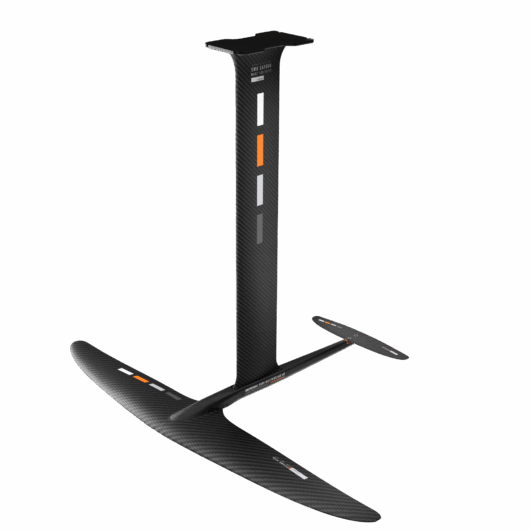
Could you talk us through the role of the new carbon ADJ Flowarch rear wing and how it contributes to control and maneuverability?
The new carbon ADJ Flowarch rear wing sits at the core of the Flying Fish’s control and maneuverability. Its refined shape optimizes lift distribution and directional stability, giving the foil a smooth and predictable feel. With three interchangeable shims – Black (0°) for a balanced, confidence-building setup, Orange (0.75°) for extra lift and control in turns, and White (1.5°) for fast take-offs – riders can precisely tune their foil to match their style and conditions. This versatility ensures the same setup performs effortlessly across a wide range of speeds, disciplines, and rider levels.
Where has the Flying Fish found most of its “on water” testing happening, and who’s been key in giving feedback?
Most of the Flying Fish testing took place between South Africa and Mediterranean spots in France and Italy, helping us refine its performance across both strong and lighter wind conditions. Key feedback came from Aaron Fryer and the Bouyer brothers, Camille and Julien, whose insights were crucial in perfecting the foil’s balance, control, and versatility.
We know things are always pretty productive at RRD HQ… can you tell our readers about other incoming products?
Yes, we’re working on a new front wing specifically designed for freestyle. The goal is to create something even more reactive and playful, with faster lift and tighter turning. It’s still in testing, but the first prototypes are showing great potential!