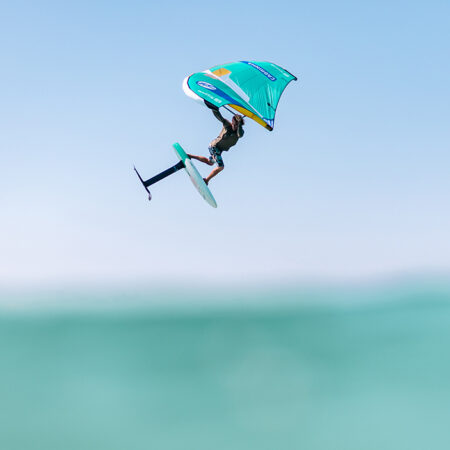
Inbound: OMEN EMISSARY BOARDS
Omen aren’t a brand that flood the market with constant releases. Their products are well thought through, and when something new lands, it’s usually for good reason. So with the arrival of the Emissary board range, we caught up with founder Greg Falck to dig into the thinking and intent behind them.
So let’s go from the start… what was the original driver that kicked off the Emissary project?
We’d just launched the Flux and I was at a bit of a loss on what direction to head for a “V2”. Discussing some concepts I wanted to explore with Tucker at MacKite, he encouraged me to split off a second line of boards dedicated to the direction my own riding was heading rather than compromising with the features that were building a following around the Flux.
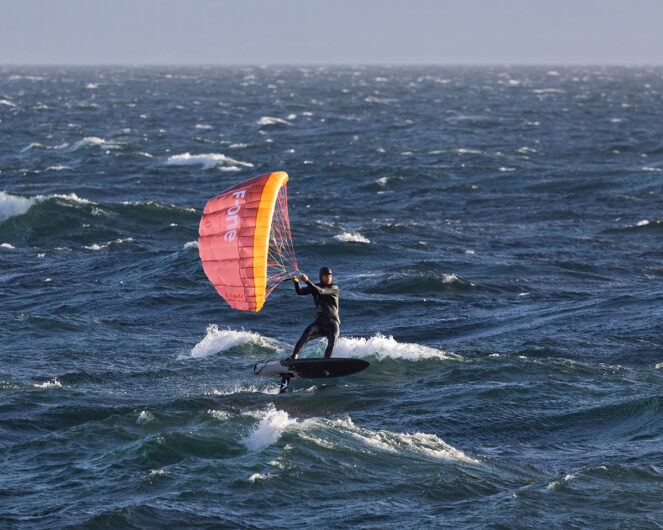
Splitting my winging evenly between my 40L and 60L, I wanted more sessions on my “sinker board”. With the right hull design and a bit more volume I was convinced we could achieve similar low end to the 60L Flux. My “second board” therefore needed to fill a new niche for even lighter days and I was willing to really stretch the dimensions to achieve it. Sam White and I were also playing with drop anchors at the time and really enjoyed the first 66L prototype. The range enabled use of smaller gear and made paddling back to an errant wing less frantic! Right around this time I saw Sam Reynolds with the pocket wing and immediately started obsessing over optimizing the 66L for what would become parawinging.
One of the limitations of longer boards is the tail. Aggressive tail rocker to optimize for “release” makes a board inefficient at building straight line speed, whereas leaving the tail flatter creates drag as soon as the board’s angle of attack increases for take-off. I developed a few hull concepts to address this by minimizing drag through a large angle-of-attack range. We tested these head-to-head, including numerous combinations of tapering the outline and rocker of each concept with CFD. From there we took the best performing concepts, made more variations and ran another series of competitions. One more cycle of this and we had arrived at the design of the 44L and 66L Emissary.
By the time the new samples arrived I had a BRM parawing and immediately knew our work had paid off. An unanticipated but major benefit of minimizing drag across a wide AoA was a big increase to glide/projection when on the curved surface of a wave. Being able to use a bump to get on foil with minimal power in the sail was a major boost in the otherwise limited parawing wind range.
And please walk us through the range. What are your size options, and how come you felt that the larger sizes needed their own sub range?
Longer boards require a different way of thinking about moving through water to minimize drag. With the smaller sizes, getting up on foil is about creating lift efficiently and building speed with the hull approximately parallel to the surface. At speed, the short tail and planing dynamics make it easy to do a quick ollie/pump onto foil. The design (especially rearwards) really changes with the larger boards to take advantage of the longer hull delaying the transition from displacement to planing and the increased interaction with the tail at takeoff.
What marks this range out from the Flux? Please tell us about the differences there.
The new Flux V2 uses the same CFD derived hull design as the Emissary, as well as the new rail geometry which gave the Emissary better touchdown recovery than the Flux V1. Although similar, each favor a different set of rider preferences. In general, the Emissary is for riders who prefer the absolute smallest volume board with the most possible low end. This results in a longer, narrower shape, as well as a volume distribution weighted more centrally within the board.
The Flux has a dropped deck, more volume in the nose and tail, and is a bit shorter and wider. It’s more user-friendly during water starts, has an edge in “slashy” style turns, and keeps the rider closer to the foil which provides a confidence inspiring, locked in feel.
You specifically call out parawinging as a discipline that benefits from this design. What is it about the Emissary that makes it particularly effective at using small bumps for takeoff?
The ability of the hull design to move through the water with low drag through both a wide speed and angle of attack range. Pushing a hull through the curved surface of a wave face is very different than optimizing for straight line acceleration. This was a happy accident discovery, as the original intention was to minimize drag when pumping the board onto foil, but it was quickly apparent in testing that the changing angles of attack of a wave face interact with the hull in a similar way which compounded with the improved pumping dynamics.
CFD simulation played a big role in the design process. What did the data reveal that surprised you most?
There weren’t any major surprises as we started with an already quite low drag hull and worked out a few quirks with initial prototypes prior to the CFD optimization. Our work was focused on refining how the nose and tail rocker progress, how much and at what rate the nose and tail taper, and how these two variables interact with each other. I came up with a few concepts to reduce drag at higher take off angles of attack, and while the winner wasn’t all that surprising, CFD allowed us to squeeze way more out of the concept than intuition alone.
Despite the longer lengths, you’ve managed to significantly reduce swing weight. How did minimizing nose and tail volume change the way the board feels once you’re up and foiling?
The thinned-out nose has a couple big advantages as well as some tradeoffs that can be significant depending on rider skill. For one, it allows a relatively long board to maximize low end, with minimal compromise to turning and pumping performance since there is very little mass at the ends. Reducing volume in the nose also doesn’t have any negative impact to low-end for a skilled rider. This is contrary to what people think. Volume above the waterline does not provide flotation and with good technique the nose is above the waterline in the most critical phase of light wind take offs.
The thinned-out nose also generates more lift in high-speed touchdowns. This seems counterintuitive as one would think more volume in the nose improves touchdown recovery, but in practice the angled upper surface of a bulbous nose actually drives the board down when submerged at speed.
The downside of a thin nose and narrower tail is the lack of fore and aft stability during water starts. This is where a board with more moderate dimensions like the Flux really shines. The wider tail also helps drive the board to the surface when underpowered, whereas the Emissary takes more skill and balance to get to the surface when really underpowered.
Finally, Omen seems very focused with its product range, bringing products to market that seem very well considered. Tell us a bit about the Omen brand ethos.
Thanks! I think of Omen as fluid dynamics research applied to boards and foils rather than a water sports brand. We’re still a very small company and most of what we develop is selfishly focused on what I want to ride. We’re all engineering minds and focused on making better gear for advanced intermediate wave foilers.
I’d define our approach as obsession with removing the superflous rather than adding features. For most foilers in the intermediate-advanced category, less is more, and having equipment with a larger usable range leads to faster development of skills and more fun in naturally varying conditions. I’ve always been attracted to the idea of having less equipment with a broader range, both in making the decision of what to rig easy, and having the ability to adapt to changing ocean conditions while still getting the best possible performance from my gear.