INBOUND: Lift Foils – COLLABORATION SERIES
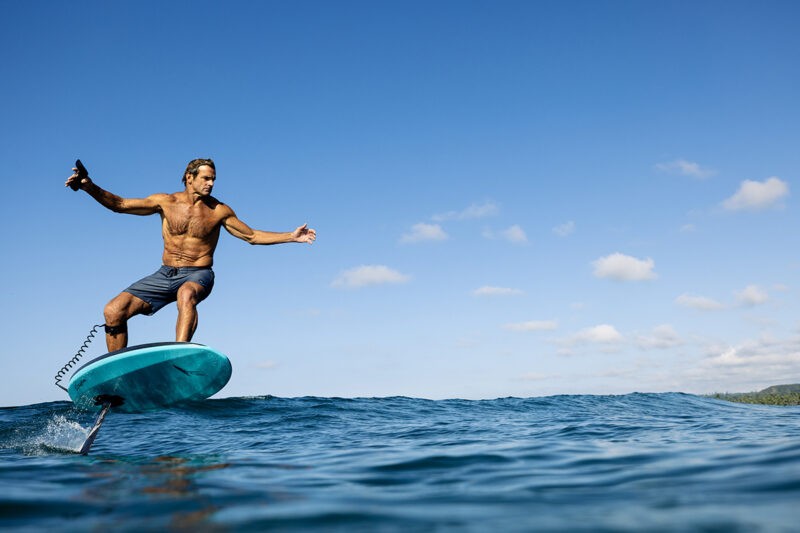
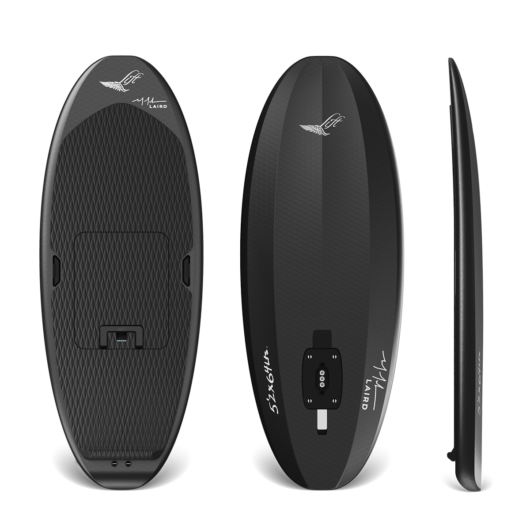
Two very high-profile collaborations appeared from Lift Foils recently – the Laird (Hamilton) 5’2 LIFT5 and the (John and Nathan) Florence 4’7 LIFTX. To get the background to the setups and how it is working with some of the biggest names in surfing, we went to Lift’s Co-Founder and CEO, Nick Leason.
Hi Nick. Firstly, collaborations like this, with such recognizable names, are obviously quite high profile. What were the parameters of these collabs?
We’ve been working with Laird and the Florence brothers for years in a supporting role. Getting them equipment that interested them, listening to their inputs, building around their desires for new product.
The foundation for a collaboration like this is respect. Good human beings, champions of the water sports world. Our job is to listen, respect what they want to do, respect how they present themselves in the industry, and not capitalize on that. For these three athletes, this isn’t a financial play. They have their own careers. They want to ride new, exciting product and push the boundaries. My job and the team’s job is to facilitate that and put in the work to get them product they’re proud of.
Both of these boards come from very specific rider briefs. How early do Laird Hamilton and John & Nathan Florence get involved in the process, and how much influence do they have over the final product?
These are two separate collaborations.
Laird has been active with me for years and has strong opinions on what the product should do. Sizing, rigidities, components, speed, carry. All from a feel perspective. What he wants out of the water, what boundaries he wants to push.
John and Nathan are a different category. Nathan is very feel-oriented. Accurate feedback, good read on architecture and balance, low end versus high end, speed. You get an accurate report. John is the more technical of the three. He’s coming up with new ideas, looking at different industries, looking at what’s been working on the Moth sailboats. He’s a thinker, and patient. I’ve been learning from him, the ways of a champion. Their input has been valuable, and it has taken time.
The Laird 5’2 is 64L but pulled into a narrower 23.5” width. What were the key performance gains you saw from redistributing the volume in the Laird 5’2, rather than simply scaling up an existing shape?
For Laird, the 5’2 is actually a small board. He’s a big guy with a wide stance, so when you watch him on it, the board looks small. 5’2 isn’t that long. But he doesn’t need the typical width we’d run for a more user-friendly setup. He’s going to be sportier. We worked the rocker and the positioning of the weights and the mast.
It’s a good size for him, and a good size for a rider 40 pounds lighter and four inches shorter. What’s sporty for Laird is an all-around sporty board for the average rider.
We paired it with the big battery because he wants to run on flat water, fast, with the larger propulsion. When there’s surf, swap to the battery adapter, drop in the LIFTX propulsion, smaller motor, less drag. One product in your quiver to do it all. And that’s Laird. He wants to do it all.
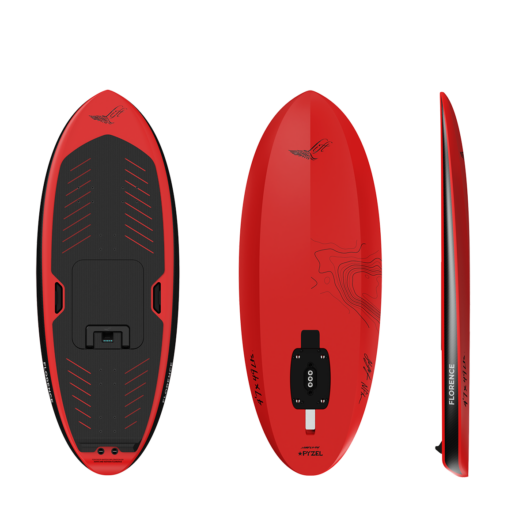
The Florence 4’7 feels like it’s targeting that “in-between” size category a lot of riders are gravitating toward. Was that something you’d had your eye on for a while, or did that come from the direction of the Florences and Jon Pyzel?
John and Nathan wanted a bigger board. Inclusive enough to get their friends out downwinding who hadn’t practiced. They mentioned wanting to get their mom out there with them. I’m sure she’s a badass. She raised those guys.
We looked at bigger sizes. The 4’7 was already a big size for us, and that one worked. The larger sizes felt clunky, and I hesitated to put their name on a board like that. So we rode the larger ones, and the 4’7 ended up feeling right. You need a little practice to get into it, but it’s worth it.
The shape wasn’t mine. Jon Pyzel designed it with John and Nathan. Jon called it “the badass”. I tweaked it for the electrical and mechanical installations and tuned the volumes we needed. Back and forth between all parties.
Jon’s a pretty legendary board shaper. How was it working with him?
Jon Pyzel is easy to work with. Grounded, down to earth. Meticulous about the quality of his product and where his name goes. He’s been working with John and Nathan for years, so the transition was easy. Looking forward to doing more with him.
There’s a clear emphasis on reducing swing weight across both boards. How important is reducing swing weight in modern eFoil design, especially as more riders are pushing into surf-style riding?
The technical term is inertia. The distribution of mass about the center of gravity. The heavier the mass, or the further it sits from the center of gravity, the larger the inertia, and the slower things rotate. That can be a stabilizing factor.
As you get into surfing, you want lower inertia. Bring the mass in, reduce the swing weight, rotate into a turn faster. There are boundaries on both sides. Too light, it feels unstable. Too heavy, it feels overly stable. There’s a magic inertia for each rider and each rig. Both these designs land in a good balance.
The Laird model runs the LIFT5 category, while the Florence runs the lighter LIFTX setup. Talk to us about the intention behind these different setups.
Everything is interchangeable. We also promote the Laird with the LIFTX setup: a smaller battery via the battery adapter, paired with the LIFTX propulsion. That turns it into a complete surfing rig. Same with the Florence. One of our top racers is running the Florence board with LIFT5 propulsion and winning some of the larger international eFoil events. The boards are versatile and can use all of our components.