Inbound: ARMSTRONG UHA FRONT FOIL RANGE
With the new UHA Front Foil range, Armstrong set out to unlock a whole lot of glide with a foil that’s also built to broaden the range of “good” conditions. We spoke to the team about all the thinking behind it.
What was the riding experience you ultimately aimed to unlock with this design?
We aimed to make the UHA stand out by achieving glide without compromise. We had a vision to create a foil that would enable people to complete technical downwind runs without needing to pump, leaving room for flow and style. The key design objectives for us were the ability to link waves through endless glide, harness energy from the smallest of bumps, and, importantly, to maintain high turning potential in a large-span foil.
One design feature of the UHA Front Foil is its incredibly low stall speed. How does that change the way riders approach marginal conditions?
This is key to broadening the range of conditions that riders can get on the water. The extra time it gives you without the need for power means completing maneuvers, gliding through lulls, and connecting bumps when conditions are difficult becomes easier. In combination with the early take-off speed, this foil unlocks a new “good condition” band, meaning less time spent waiting for perfect conditions.
How does the UHA differentiate itself from the HA range, and who should choose which foil?
The UHA was built to complement the HA range rather than replace it. On a sliding scale, the UHA maximizes glide, projection, stall speed, and efficiency, whereas the HA is higher performing in turning, top speed, and acceleration. There’s room for both in the quiver to let you make the most of the conditions you find yourself in.
The foil seems purpose-built for transitions. Was that connection aspect a core design priority?
Much of the design revolved around creating a foil that gave consistent pressure and delivered quality glide and projection. This combination was chosen to make the UHA excel at carrying energy from one bump to the next, with minimal force input needed from the rider. We created a foil that makes acing downwind runs as intuitive as possible.
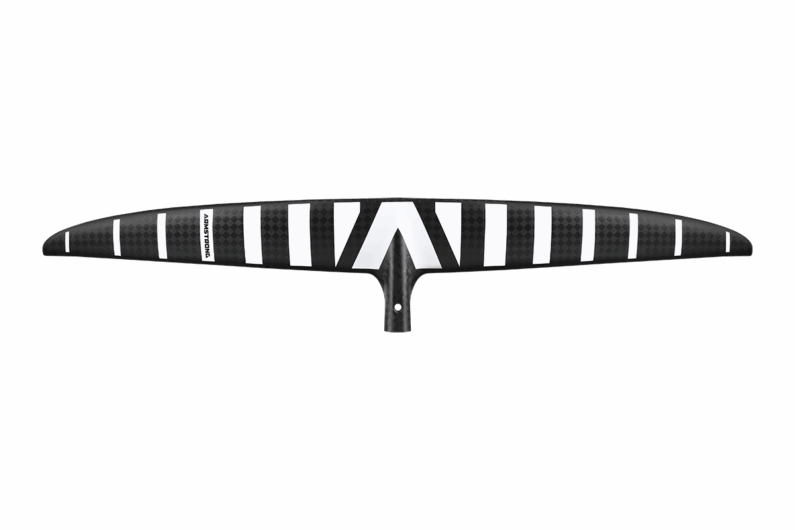
The size range is pretty broad. How should riders think about sizing depending on whether they’re downwinding, parawinging, or light-wind winging?
When comparing to the HA series, it is important to consider the increase in span alongside the intended use of the foil. The constant 12.6 AR across the range means each size has its own place in the lineup and maintains consistent characteristics. When choosing a size, it is important that riders picture where they want it to fit in the quiver and the conditions, they aspire to use it in. Our rule of thumb is to move down a size from the HA range to achieve a similar lift feel. The larger sizes make paddling up, getting on foil in light wind, and pumping as easy as possible, whereas the smaller sizes unlock great turning potential, fast runs, and ultimate efficiency.
Parawing is still a relatively new discipline for many riders. What makes the UHA particularly well-suited to making parawinging more accessible?
The UHA was designed at the same time parawinging became popular, so it was a major consideration in our design targets. Aside from the endless glide and flow, making it so parawing only has to be deployed once, the stability and ability to keep mast height provides more than enough time for stowing, and the performance in turns means riders can transition straight into surf style on bumps.
Construction-wise, you’ve gone with premium pre-preg Toray high modulus carbon. In real-world terms, what does that stiffness and strength translate to?
The importance of achieving high stiffness and strength using the best-quality carbon, alongside extensive layup construction R&D, allows us to create a foil that is true to the design. Minimising deformation and movement mean that the riding experience matches the fluid simulations used in the development of the shape, meaning that the foil is true to its intended use and performing at the highest level possible.