Inbound: AFS SILK V2 & U-SURF
A double whammy release from AFS, with the evolution of their favorite foil wing and a new addition to their stab range. Designer Laurent Borgna filled us in…
The SILK V1 was your best-seller and known for its reassuring, intuitive feel. For the V2, what has remained and what has evolved?
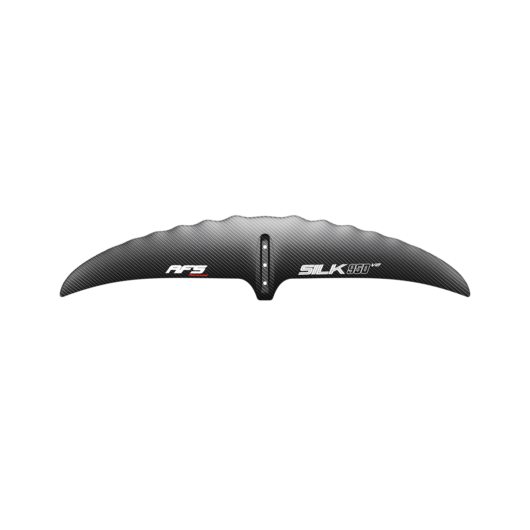
We’ve kept the reassuring and intuitive feel that made the SILK V1 so successful. The goal wasn’t to transform it, but to evolve it without losing that readability. We focused on surface behavior, low-end recovery, and the ability to switch between tight and long carves with even more engagement and stoke. The rail-to-rail feel remains very present, but with more precision and fluidity. We’ve also expanded the range to refine the options; there’s now a SILK V2 for every rider, depending on their weight, skill level, and conditions.
Increasing performance without losing that “SILK DNA” sounds like a delicate balance. How do you gain efficiency and glide without sacrificing that sense of trust riders loved in the V1?
That’s a great question, and I can’t answer it in just two lines! The winglets on the V1 played a huge role in that highly valued sense of control, but only when fully submerged. To maintain that capability while gaining efficiency, we had to work on every single parameter: the overall 3D shape of the wing (outline and dihedral), the profile choice (type and thickness), the twist value and distribution, the number, size, and positioning of the bumps, and the tuning and placement on the fuselage. Naturally, increasing the aspect ratio improves efficiency and glide, but it can make the foil more demanding. The whole challenge was to compensate intelligently to keep that immediate sense of control. Maybe we’ll dive deeper into that in a Tech Talk for AFS!
The V2 moves to a higher aspect ratio and reduced sweep. What do those geometry changes translate to on the water?
Indeed, the aspect ratio goes from 8 to 9 and the sweep has evolved slightly. This gain in AR reduces induced drag and improves overall efficiency. As a result, you get more lift at low speeds, which makes recovery and connecting waves much easier. It becomes simpler to play in the pocket without losing support. At the same time, the SILK V2 keeps its ability to draw long lines at higher speeds. We’ve worked hard to continue the quest I mentioned when the SILK V1 was released: the ability to “ride with your eyes closed.”
We understand that rider feedback drove a lot of the evolution. What were customers specifically asking for, and how did that shape the final design?
It would have been risky to launch a V2 without listening to the riders, especially the SILK aficionados! The feedback mainly concerned glide and the ability to connect waves more easily, as well as the need to refine the sizing. Some riders found themselves between two sizes and were looking for a more precise compromise, so we expanded the range for the V2. There was also a desire for better pumping recovery without making the foil more technical or exclusive. The idea wasn’t to make the SILK radical, but to better exploit its potential.
The SILK V2 was developed in parallel with the 2026 stabilizer range. How important was optimizing the front wing/stab interaction from the outset, rather than treating them as separate components?
It is naturally, and fortunately easier to prototype stabilizers in larger numbers than front wings. I say fortunately because their influence on the overall behavior is vital! From the start, we sought to optimize the front wing/stab interactions to achieve global consistency. This allows the entire foil to be adapted based on conditions, discipline, level, and rider preference. Today, the idea is no longer to pair a specific stab with a specific wing, but to allow the rider to choose a sensation. Depending on the model (U-CARVE, U-SURF, or U-GLIDE), you can add dynamism, mellow it out, gain low-end, increase V-max, or improve glide.
Yeah, you recently released the U-SURF. Tell us how these line up against the other stabs in the range.
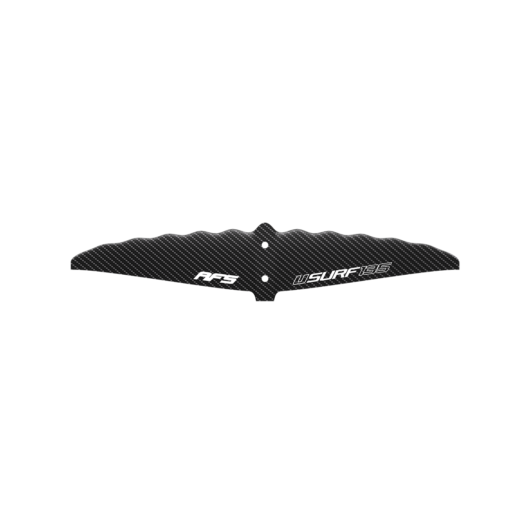
To summarize: the U-CARVE will energize the ride. It has an incisive feel and very appreciable glide. Turn initiation is sharp and precise, with great reach in the carves and excellent rail-to- rail pivot. The U-SURF is a “bump” stab with a profile that focuses less on pure glide and more on forgiveness. It offers a lot of control, the ability to push hard in turns, and controlled pitch. It’ll be more reassuring in heavy conditions. Then there’s the U-GLIDE, which is oriented toward pure efficiency. Its DNA is glide and pumping, especially for downwind. It remains more technical, but it unlocks the glide for riders comfortable with thin, high- performance setups. They can all share the same playground, but their temperaments will be different.
Tell us how the U-Surf has been optimized for surf foiling?
The U-SURF was optimized for surf foiling because it brings high-speed control, drive, and more committed carving. The bumps and the profile reinforce the grip during rail-to-rail phases and stabilize behavior in hollow waves. It increases grip without making the foil feel brutal, so you can engage more while keeping the pitch under control. But my view on surf foiling hasn't changed in years: if the technicality of the gear is too far ahead of the rider's actual level, it usually turns into a balancing act! Control builds confidence, and confidence brings the ease and pleasure of exploring new lines with more serenity.
When pairing the SILK V2 with the U-SURF, what kind of rider or conditions does that setup really come alive in?
I recommend this combo to those who love drawing beautiful, committed lines, whether in surf foil or heavy carving. it reveals its full potential in waves where you’re looking for grip and drive. With a wider range than the SILK V1, it’s also going to be easier to find the right surface area for your build and your conditions.