First-Ride Funnel
About a third of crewed charter yachts in the Caribbean and the Bahamas now carry a foil, and the crews put it under whoever is standing on the sugarscoops. Jason Acosta on the beginner program nobody designed.
Words: Jason Acosta / Photos: Knotworthy Films (unless specified)
Ask a first mate in the British Virgin Islands how many of the guests he puts on an eFoil have ridden one before. The answer comes back without hesitation.
“For me it has been 98% new riders,” Herman Bester told me, “with the 2% exemptions being guests that actually own some sort of foil at home.”
Sit with that for a second. Almost every person Herman taught last season arrived having never flown a foil, got handed a board off a swim platform, and rode one anyway. He is one first mate. There are hundreds of crew like him working the same cruising grounds, and between them they are running one of the largest first-ride operations in the sport.
Nobody planned it. It happened boat by boat.
The fleet nobody counted
I book crewed yachts for a living, which means I spend an unreasonable amount of time reading equipment lists written by brokers. Somewhere in the third year of that, the same word started turning up everywhere. Foil.
We track 633 active crewed charter yachts across the Caribbean and the Bahamas. Right now 203 of them carry a foil of some description, about a third of the boats. Narrow it to electric and it is 196 yachts, close to 31 percent of the fleet. We published the full breakdown by size, hull and brand in how the eFoil became standard kit on Caribbean charter yachts. The short version is that the foil is clearly becoming part of the charter experience.
Those boards are not sitting in a shop waiting for someone to walk in. Each one is on a vessel that sails most weeks of the season with eight to ten people aboard, almost none of whom chose the yacht for its foil, all of whom will be offered a go.
Why the Virgin Islands
I will put this plainly and expect an argument about it. Measured on instructors working daily and new riders per year, the British Virgin Islands has a claim to being the largest eFoil community anywhere on planet earth.
The reasoning is concentration. The fleet sits in a cruising ground you can cross in a morning. Almost every one of those crews teaches, because teaching foiling has become the job. The number of lessons can be described by the fact that each boat turns over an entirely new group of eight or ten every week, across a season that runs November to July. That is before you count a single land-based school.
Geography helped, and so did the law. Jet skis are prohibited for charter guests throughout BVI waters. If a yacht carries them they get declared to customs and they stay out of the water. The loudest, most obvious toy in the chest is simply unavailable across the busiest charter ground in the Caribbean, and something had to fill that gap.
In the Caribbean fleet we track, 36.7 percent of yachts carry an eFoil. In the Bahamas, where jet skis are legal and common, it is 17.5 percent. That’s more than double the rate.
That is not an accident of taste. On a Caribbean charter the toy chest and the cuisine are the centerpiece of the entire product. Take away the jet ski and the chest still has to justify itself.
Learning it the hard way, then teaching it
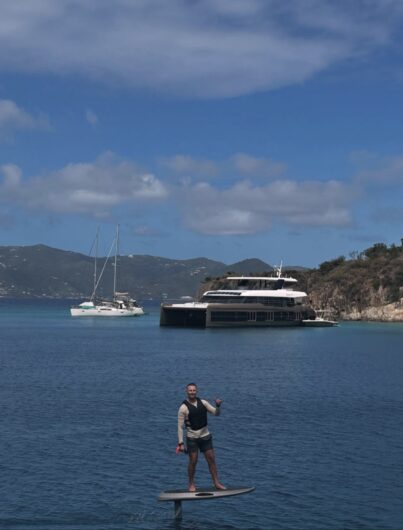
Herman Bester, who will be aboard ENCORE next season. Credit: Courtesy of Herman Bester.
Herman learned the way most crew do, which is to say nobody taught him.
“Most crew in the BVI probably learned through trial and error on their own during those in-between charter windows,” he said. “The best way to learn, in my opinion, will always be through physically doing the activity over and over again.”
He teaches off a Lift 5 paired with a Blowfish, the inflatable collar that wraps the board and turns it into something a nervous adult can climb onto without the whole thing squirting out from under them. “An awesome, low maintenance and clean looking setup,” is his verdict. For a program running back-to-back beginners all season, low maintenance is not a small virtue.
Where he takes them matters as much as the kit. Little Harbour. Brewers Bay. Privateer Bay. “The best for beginners will always be calm bays,” he said, and the list is a working first mate’s list, not a brochure’s: flat water, room to fall, close enough to get someone back aboard quickly.
Ask him who picks it up fastest and he does not say the athletes.
“New riders that want to have an advantage above their family or friends should try any board riding sport. The guests that have had the fastest learning experience are those that either snowboard, surf or even skateboard. This is one of those activities where actually feeling your center of gravity and then adjusting from there is the best way forward.”
And the number every reader of this magazine actually wants: how long until it clicks?
“On average we see guests getting comfortable after about 2 hours of being on the foil.”
Two hours. Not two seasons, not two weeks. One afternoon in a flat bay with a first mate who has done it several hundred times.
Learn to fall
Tyler Boruff has captained more than 100 charters, most recently aboard Ohana, an 80-foot Sunreef catamaran working the same islands, and his first-timers look a lot like Herman’s. “Most people have never experienced riding an eFoil,” he told me. “Many may have board sport experience, which is helpful, but for the majority it’s their first time.”
Herman talks about the kit and the bay. Tyler talks about the rider’s head. Ask him what he tells a first-timer and the first word is the one nobody wants to hear.
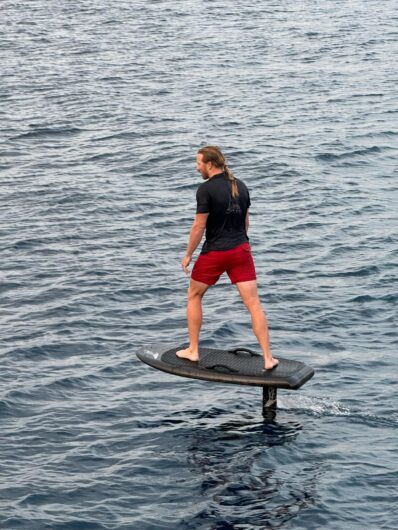
Captain Tyler Boruff on the foil. Photo courtesy of OHANA.
“Fall,” he said. “You have to commit. I’m there to help, but once you get going, it’s you, your body and the board. You have to be calm, trust yourself and get out of your head.”
A surfer, a gymnast or a dancer has a head start, he said, but none of it is beginner’s luck. “You have to be willing to fail and learn to fall. You have to trust yourself. Those who trust and fully send it will make it. If you are scared or hesitant then you may be on your knees the whole time.”
What holds people back, in his experience, is giving up, or never really playing. “Shifting your weight, changing the timing, it’s all a feeling and you have to be willing to throw yourself around and have some fun with it. First couple times it’s a lot of water to the face.”
The ride he remembers best was a guest’s first time up, in a small harbor. “We got into a school of fish and as he was foiling, his first time out of the water, fish were just jumping and following his wake,” Tyler said. “It was such a magical moment and the guest was absolutely thrilled.”
He is careful about what counts as getting it. “For one person, just going on their knees might be enough and something that they are truly proud of. For others, it might be soaring through the sky on foil for a long period of time. It’s hard to measure success whenever a lot of these people have never tried it before. Sometimes just getting out there and trying is the reward.”
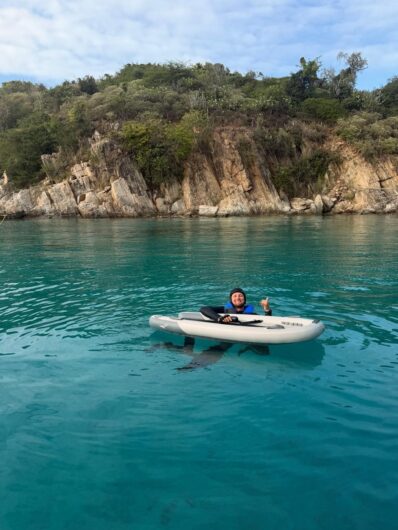
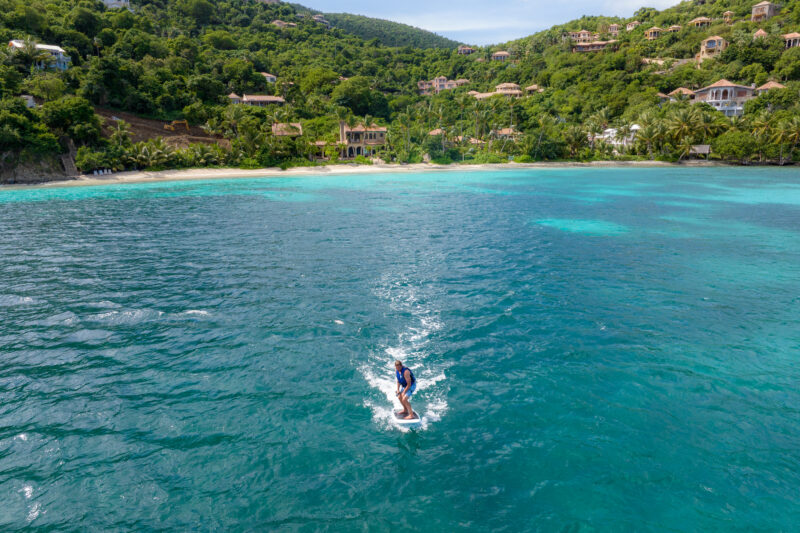
Flat water and an inflatable collar on the board, which is how most first goes start.
What people write down afterward
We see guest feedback from multiple charters across the Caribbean. The eFoil turned up in 120 of those reviews, across 57 different yachts, but what is actually said is the most interesting part of the dataset.
Guests write about being taught as often as they call it a highlight of the week.
They almost never write about the gear. They write about the person who taught them.
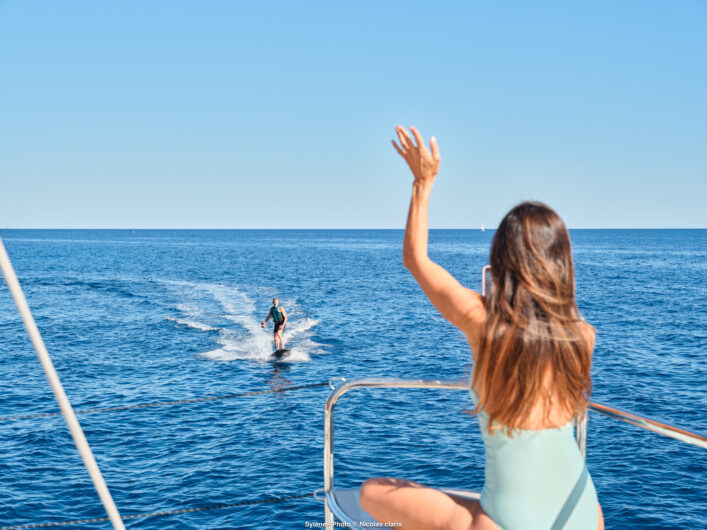
Back to the boat, SYLÈNE. Photo © Nicolas Claris.
“The kids all enjoyed learning, and mastering, the e-foil.”
“We lived in luxury, ate like kings, drank works of art, and learned that laughter on the water was the perfect way to spend days, much of that laughter was watching each other try to master the e-foil.”
“I never dreamt I would learn to foil out here so thank you for your help and letting me borrow the foil boards.”
“The tandem eFoil moment between brother and sister will go down as one of the most talked-about highlights of the entire trip.”
And my favorite, the entire funnel compressed into six words at the end of a thank-you note:
“Oh, and we are buying an efoil.”
That is the conversion event, and it’s written on a form that was asking about the food.
The arms race
Herman is clear-eyed about why every boat now has one.
“I think the conditions in the BVI allow for so much great watersports activities that you almost have to foil,” he said. “More and more charter boats are trying to compete and having great water toys, like e-foils, onboard really can make a program stand out.”
I asked how much the toy chest drives the booking. He said, “More and more boats make it harder to spot the difference between what is actually going to make your vacation fun. For some people that means having the most toys.”
From where I sit, the threshold has already moved. The foil now looks less like a differentiator and more like the price of entry. Boats are not winning charters by having one. They are losing charters by not having one.
The demand side has moved with it. Forty-seven percent of the charter inquiries that came across my desk this year named a foil specifically. Guests are no longer being surprised by the board on the back step. They are asking whether it is there before they ask about the itinerary.
You can watch the supply side move in near real time. Since late August the share of active yachts listing an eFoil in their equipment has gone from 27.2 to 29.7 percent. The direction agrees with what the listings say out loud. Boats are advertising new boards for the winter ahead. One inventory I read lists, in plain text, “Efoil (new for 2026/2027 season).”
Half of the boats that state a count carry two boards rather than one, which tells you something about how fast a single board becomes a bottleneck with ten people aboard. Herman has only ever run one foil at a time. Asked what changes with more, his answer was the least scientific and probably most accurate thing he said.
“More foils probably means more fun.”
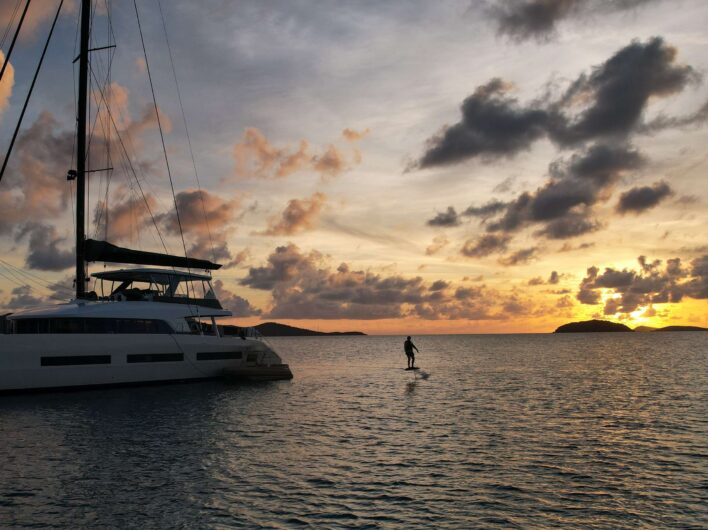
Last light off AEOLUS 77. Photo: Aeolus and Michael Wilson.
Jason Acosta is a licensed crewed yacht charter broker for Vital Charters and runs a research desk that maintains structured data on the Caribbean and Bahamas charter fleet. Fleet figures in this piece are current as of October 26, 2026, and describe 633 active crewed yachts working the Caribbean and the Bahamas.