Dynamics – THE CEDRUS STORY
From its origins as a one-man engineering experiment to a globally respected mast manufacturer, Cedrus founder Kyle Lobisser certainly has a story to tell about his journey to date. Using a precision-driven, data-led approach to mast making, and with sustainability high on the brand’s agenda, Cedrus is proving that the mast can be as performance-defining as the foil itself…
Hi Kyle. So for the benefit of anyone who has not yet encountered Cedrus, could you please give us an overview of what exactly Cedrus is, and the products in the range?
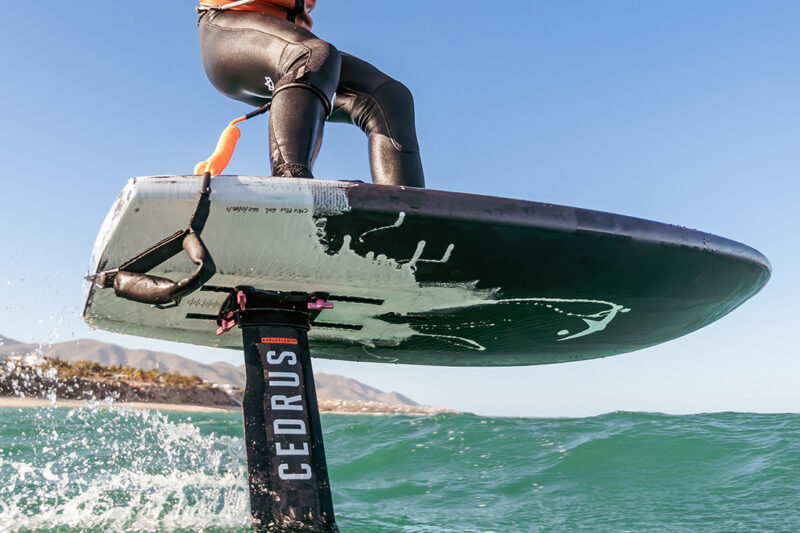
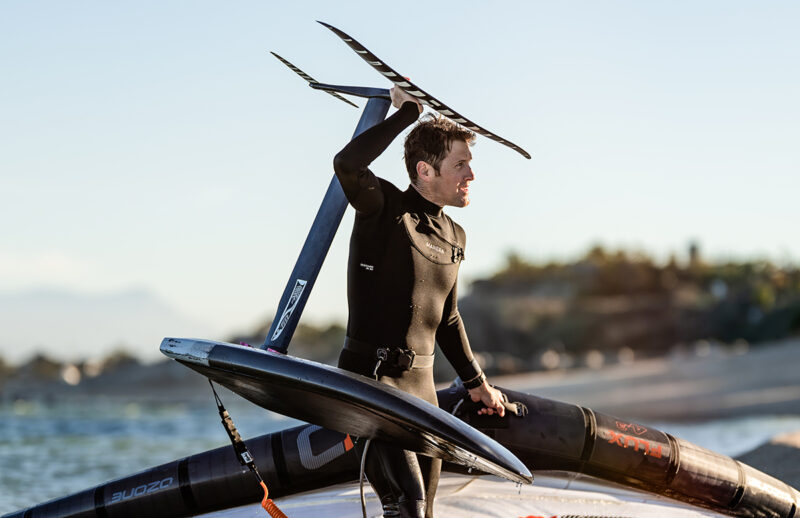
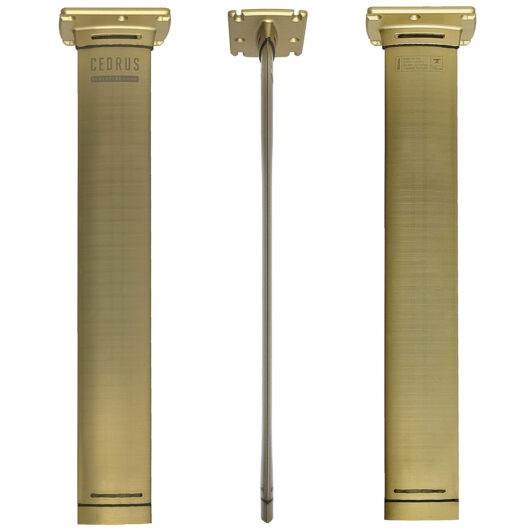
Cedrus is focused on designing and building high performance hydrofoil masts. Our fleet is discipline-specific, and compatible with all foil brands. Evolution Surf is our prone and DW oriented, high performance carbon mast available in a UHM layup. Evolution Wind targets the needs of more powered riders foiling at higher speeds using wings, kites, or towing into high energy waves. Our new aluminum mast combines the best of both into a more affordable, well-rounded offering for beginners to experts desiring a multi-length mast quiver.
Rolling back to the beginning, and Cedrus started as an engineering project rather than a typical foil brand. Can you tell us about the original inspiration behind “Project Cedrus”?
I started kitefoiling in 2013. An entire kit (board and foil!) was actually cheaper than the 16m kites that were otherwise required to ride in light winds. When carbon masts became more common, foil prices quickly rose. Early carbon masts were heavier, more expensive, not as stiff as their aluminum counterparts, and had a tendency to break. I had spent my entire career up to that point devoted to making stiff, strong, lightweight composite structures, and felt that I could make a better mast than I could buy. I wasn’t interested in making just one though, because the tooling is the most expensive part of the whole process. I figured if I could make 20 and sell them to fellow foilers through the local forum, it would justify the investment. So that’s how it started, in 2017 about 20 people gave me $1,500 to build them a foil kit featuring my mast concept compatible with Liquid Force foils. It was basically a self-managed kickstarter, and in hindsight kind of a crazy way to start a business. My sincerest thanks to the trust and faith of all those early “backers!”
You’ve often highlighted that Cedrus makes its masts in-house, in the USA. Why was local manufacturing an important choice, and what advantages does it offer in terms of quality and innovation?
Having direct control of our manufacturing has many benefits related to quality and innovation. The biggest benefit of small batch, in-house manufacturing is the opportunity for continuous improvement. If we find a way to make something better, we can implement it. We’re not waiting to move an entire shipping container of product before we can make changes we want to see to the product or process. Everyone involved in Cedrus genuinely loves making things with their hands (and foiling) and it’s really important to me that these jobs exist. Finally, having seen mass manufacturing firsthand with the biggest companies in the world, it can be extremely damaging to the planet. Our unique processes, both from an R&D and manufacturing standpoint, minimize waste and environmental impact. These processes coupled with innovative design result in a product that lasts, which is arguably the best thing you can do to minimize impact. We can say with confidence that we could not be any more environmentally responsible.
Well you’ve definitely been working hard so far! From stiff carbon and universal masts, to discipline-specific designs, to forged aluminum. Which breakthrough are you most proud of so far?
Honestly, I’m mostly proud of the fact that we’re still here in 2025! Not only that, but it feels like we’re just getting started. Between the pace of development in this industry, new forms of foiling popping up every few months, brands coming and going, COVID-19, and tariffs to name a few of the challenges, I would be lying if I said it hasn’t been hard. I am very excited about our new aluminum mast though, as it truly brings affordable performance to every rider whether you’re a beginner on a budget or an expert wanting three different lengths. It’s not just a new mast, but it’s an entirely new way to make a mast.
A lot of engineering has gone into solving challenges like ventilation, stiffness, and water ingress. Could you walk us through some of the unique design solutions Cedrus has introduced?
Our thousands of customers riding a diverse range of foils and conditions gives us the biggest data set in the industry. We had an early focus on stiffness using higher modulus carbon, but also design. While stiff even by today’s standards, these first generation masts suffered from ventilation as foils got faster and riders became more aggressive. After years of research and analysis, I set out to design Evolution Wind, which is the first mast truly engineered to be ventilation resistant thanks to a longer chord length in the piercing region. This unique design keeps flow attached, dramatically improves stability, and actually allows you to point higher upwind. It definitely looks different from any carbon mast on the market, but the science behind the shape is proven. At the same time, we launched Evolution Surf, which has a shorter chord length, and therefore much less wetted area, giving it exceptional glide for prone and downwind foiling. The two masts are the exact opposite of each other, a true testament to our belief that we are now at a point where the mast contributes as much to the ride characteristics as the foil. Our new aluminum mast leverages the best of wind and surf, for a more well-rounded design at an affordable price point. It also solves all of the complaints we’ve heard over the last 10 years about aluminum masts from sloppy fitting mounts to filling with water.
You’ve worked across industries such as aerospace and consumer electronics before moving into foiling. How has that background influenced the way you approach design and manufacturing in this sport?
The foil industry by nature evolving from the surf and kite industries operates under a “design, build, test” protocol. There are certainly some products that can’t be designed any other way, and I think foils, surfboards, and kites are great examples that are more “shaped” than engineered. This is not a bad thing, and I have immense respect for board shapers and foil designers! My background, and my genuine interest, is in multidisciplinary optimization. I see the mast as a product that can be highly engineered and honestly developed without any full-scale physical prototypes. We are balancing so many things in mast design, including stiffness, strength, desired speed range, weight, cost, drag, manufacturability, and then throw in the universal compatibility requirement. It’s not something that we can just prototype and test, the design space is too big and it would be way too expensive and time consuming. Instead, we spend years in CAD and running finite element analysis (FEA) and computational fluid dynamics (CFD) to come up with a design that we believe best balances these competing variables. All while listening to feedback from our direct customers. It may sound crazy, but we prototype and test a lot less than other brands. Our tools, molds, and dies cost tens of thousands of dollars and take months to make. We need to be confident when we kick them off that from an engineering standpoint, the design is sound. This is not atypical in industries like automotive or aerospace, as you can’t prototype an entire car or airplane. You engineer and build it, along with limited component level testing. We don’t release new models every year. Our four to five year product lifecycle allows more time for R&D, reduces waste, and results in masts that remain competitive and durable for years.
You recently released the new Evolution Aluminum mast, a one-for-all mast which you describe as offering carbon-like performance at a more accessible price point. What was the main design challenge in getting aluminum to perform at that level?
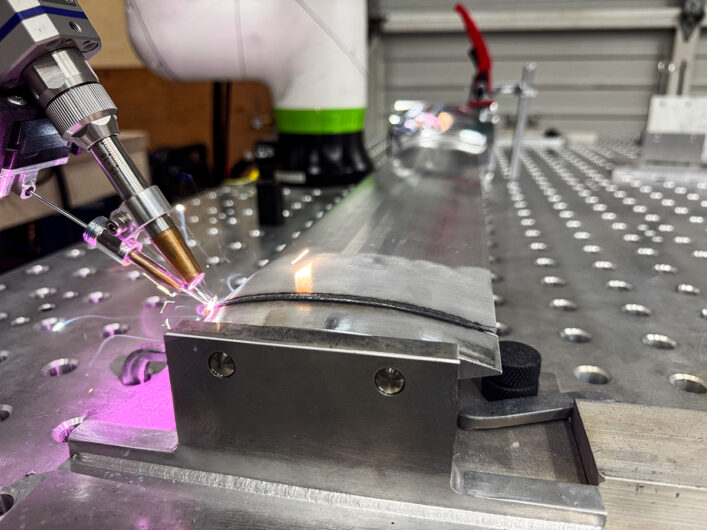
There are a lot of very high performance bikes, cars, and airplanes for example made out of aluminum. The problem in the foil industry is we’ve been confined to the same shape and process really since the beginning: a simple extrusion bolted together. This results in a mast that is either stiff and slow, or fast and flexible. The only way to get the best of both (stiff and fast) is to change the shape of the extrusion throughout the length like molded carbon masts. We explored a number of different processes that would allow this, all with varying costs and complexities. Ultimately we ended up forging a unique extrusion design, again developed through many months of FEA and simulation before any tooling. This allows the mast to have a thicker profile near the board mount with exceptional strength and stiffness, and thinner below the waterline for excellent glide and ventilation resistance. Coupling this unique shape with robotic welding results in an extremely stiff structure. In benchmark testing, our new aluminum mast exceeds the stiffness of a lot of HM carbon masts (ours included) with only a one-pound weight penalty and at a third of the price.
You’ve mentioned the desire to partner with brands rather than just compete with them. How do you see Cedrus fitting into the wider foiling industry over the next few years?
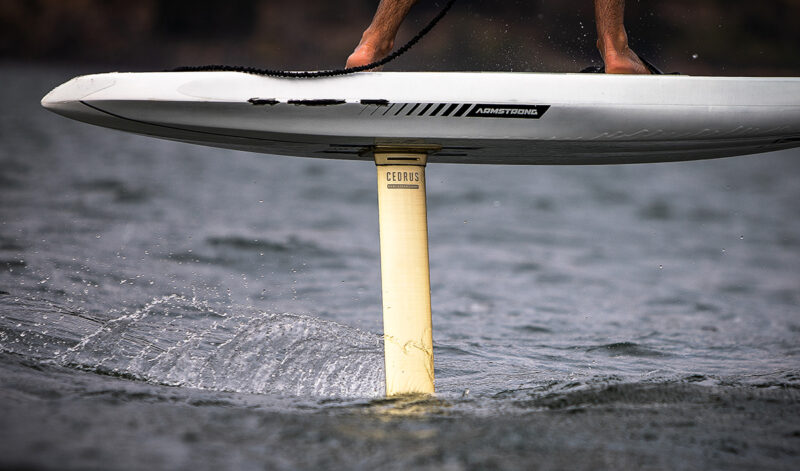
My initial goal after delivering the first 20 masts was to build more as an OEM for existing brands and let them manage the sales and marketing, so I could focus on the technical stuff. I don’t see these brands as competitors, I see them as partners. The more foil companies, the more value there is in a universal mast that works with all of them. I have talked to a number of new brands who are just getting started, and suggested they use our mast as a basis for their initial testing and design, as it can dramatically reduce development costs, and serve as a great platform for comparing different foils. Some have been more open to this than others. I’ve offered brands dealing with tariffs and import costs to the US to build their aluminum mast for them. I’m a huge believer in collaboration, given the industries and companies I come from. We were the first brand to work with Foil Drive on an integrated mast, for example. So I just want the industry to know that we are interested and open to help in any way. We know for a fact that many of the brands we are compatible with do sell more foils thanks to the thousands of Cedrus masts out on the water today, and we also know very well how hard it is to build a really good mast. So we see lots of opportunities to collaborate, and simply want to help grow the sport, improve the equipment, and reduce the environmental impact!