Dynamics: RIDE ENGINE PWC ACCESSORIES
With tow foiling becoming both increasingly accessible and popular, the Personal Water Craft (PWC) is becoming that big ticket Christmas gift that many foil obsessives need in their arsenal. Ride Engine have taken note, and have created their own range of PWC accessories. Ride Engine’s own Gary Siskar told us the what and why…
First up, can you give us an overview of some of the products Ride Engine now offers to complement PWC use?
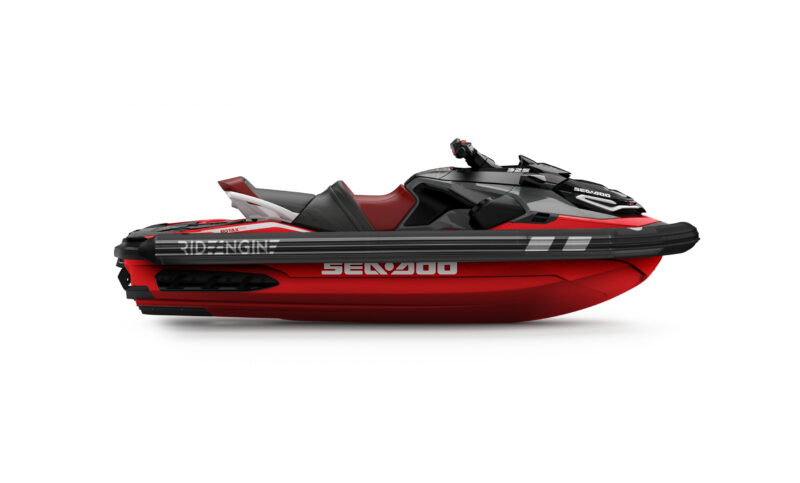
Ride Engine now offers a full range of PWC accessories designed specifically around modern tow sports, rescue applications, exploration, and daily watercraft use. Our main products are the PWC Inflatable Collars, performance deck sleds, and smaller useful utility accessories such as the Air Box Mini on-the-go e-inflation device and a specific PWC Collar Ready Cover.
The collars are available in different constructions depending on the user. We offer our standard Base Collar, the Pro Collar Plus, and commercial version of the Pro Collar Plus for fleets, rescue operators, and rental companies who need custom branding and heavy-duty durability. Our deck sled is designed for tow foiling, rider pickup, rescue agency and kite-wing schools.
What first sparked Ride Engine’s decision to move into the PWC world?
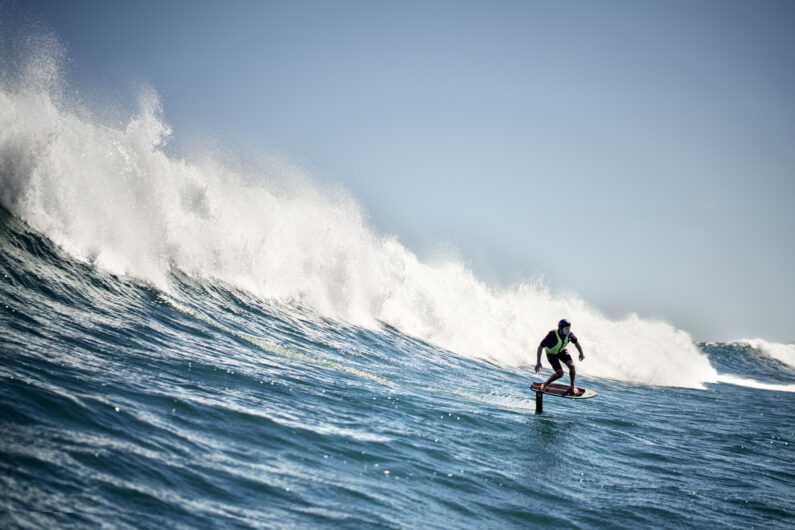
Ride Engine has always been deeply rooted in water sports progression, especially in disciplines that rely heavily on innovation. As tow foiling and surf foiling developed, PWCs naturally became a bigger and bigger part of the culture. At the same time, we felt there was a lack of truly premium, purpose-built PWC accessories designed from the perspective of people who actually spend serious time operating these machines in demanding conditions.
The move into the PWC world happened organically. Our designer Julien Fillion has been involved for 20 years in the tow surfing scene in Hawaii and had been a Sea-Doo Brand Ambassador for a few years. We were first exposed five years ago to the PWC collars. We soon realized how our quest for innovation could help this amazing product evolve, specifically using inhouse 3D scanning technology to bring a tailored-fit PWC Inflatable Collar for literally any personal watercraft ever produced.
How much of the thinking came from your own experience around towing and days spent on the water?
A huge amount of it. The products were not developed in an office environment disconnected from the sport. Most of the ideas came directly from real usage and countless hours spent on the water. When you spend enough time on a PWC in the lineup doing tow surf, tow foil and running safety, you start noticing patterns very quickly. You realize where the limitations of a stock PWC are, and you begin thinking about ways to improve comfort, stability, functionality, and rider interaction.
That hands-on experience shaped almost every aspect of the products. Even small details, like rider pickup ergonomics in the impact zones, spray deflection angles, handle placement, collar and sled geometry, all came from real testing rather than theory.
For readers unfamiliar with the product, what does a PWC collar fundamentally do, and why can it make such a noticeable difference to the ride?
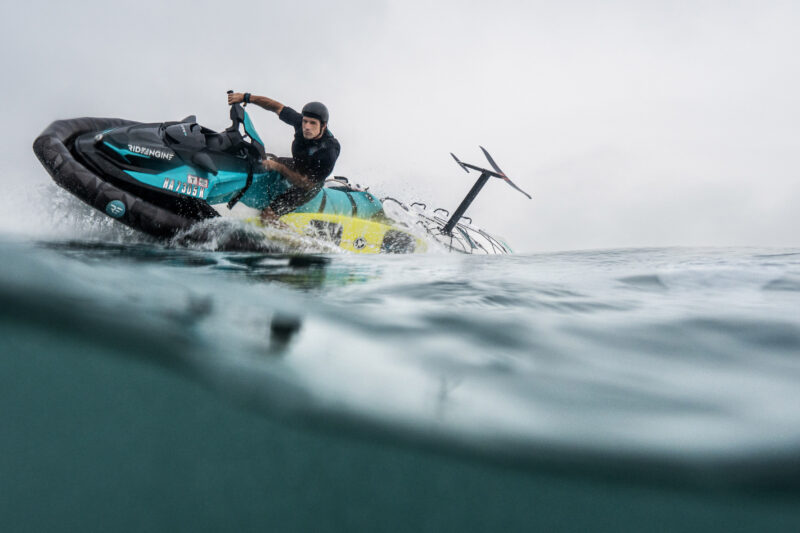
At its core, the collar adds flotation, stability, impact protection, and spray deflection around the perimeter of the watercraft. But the interesting thing is how dramatically that changes the feeling of the ski on the water. One of the first things riders notice is the reduction in bow spray and the smoother ride quality. The collar acts almost like a suspension system for the hull. It softens impacts, stabilizes the craft in side chop, and makes the ski feel more planted and predictable in rough conditions.
It also changes the interaction between the rider and the machine. During rider pickup, tow sessions, or rescue situations, the collar provides a soft protective perimeter around the craft, which is a huge advantage compared to hard fiberglass and plastic edges.
Another important aspect is safety and flotation redundancy. In severe hull damage scenarios, the added flotation can help keep the craft afloat even in situations where a traditional bilge system would struggle.
So how do you approach designing gear for a PWC? Particularly something like the collar or the sled.
The starting point is always real-world functionality. We are not trying to simply add accessories onto a ski. We are trying to complete the unit. Fitment is critical. Every Ride Engine collar is designed from dedicated 3D scans of the exact hull. That precision allows the collar to integrate tightly with the lines of the craft instead of feeling bulky or disconnected.
We spend a lot of time balancing durability, flexibility, weight distribution, rider interaction, and water flow. Material selection is also extremely important because these products live in harsh environments involving UV exposure, salt water, impacts, and constant friction.
With the sleds specifically, rider interaction becomes a major focus. The sled has to remain stable at speed, predictable in turns, comfortable for the rider being recovered, and since it's an inflatable product, durable enough for repeated heavy use.
A lot of riders will worry that adding anything to a craft might dull handling. How did you ensure the ski still feels agile and responsive?
That was one of the biggest design priorities from day one. A poorly designed collar can absolutely make a ski feel oversized or disconnected from the water. That is why precision fitment and overall profile shape matter so much. The goal was never to build something oversized and bulky. We wanted something that worked with the hull rather than against it, our collars are some of the more streamlined on the market.
Because the collars are specifically designed around each platform, the watercraft retains its natural handling characteristics surprisingly well. In many conditions, especially rough water, riders actually feel more confident pushing the ski harder because the craft becomes more stable and predictable.
The key is finding the balance where you gain stability, protection and suspension without sacrificing agility and maneuverability.
Tow foiling has become a huge part of modern foiling progression. In practical terms, how does a better-equipped ski improve the towing experience for both driver and rider?
Tow foiling depends heavily on efficiency, communication, and rider confidence. A properly equipped ski improves all three.
For the driver, added stability and reduced spray make long sessions less fatiguing and improve visibility. The ski becomes a more controlled and comfortable platform, especially during repeated pickups and tight maneuvering around riders.
For the rider, the experience becomes noticeably safer and smoother. The collar creates a more forgiving environment during pickups, water starts, and close interactions around the ski. The sled also improves recovery efficiency and comfort after falls.
Modern tow sports involve constant interaction between riders and PWCs. The more intuitive and rider-friendly the craft becomes, the more progression naturally follows.
As you’ve already mentioned, your designer Julien Fillion is deeply involved in the PWC world. How valuable is it having someone like Julien on board?
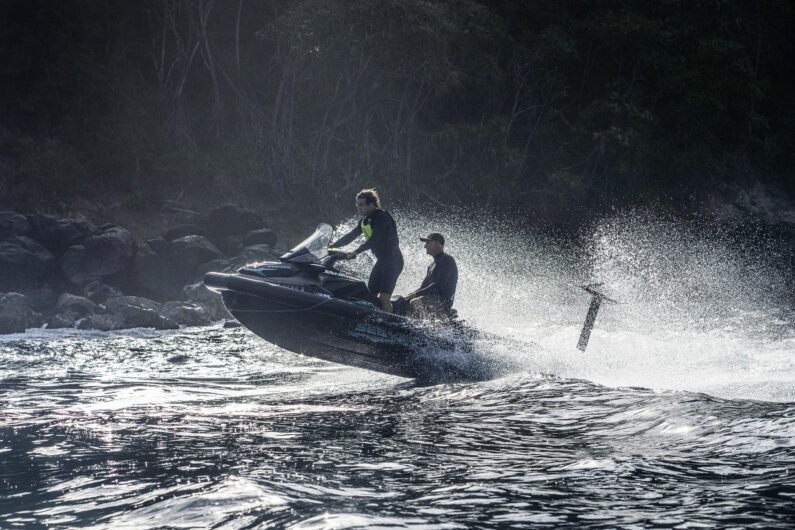
It is extremely valuable because the feedback comes from real-world high-level usage rather than controlled testing environments. Julien spends a massive amount of time operating PWCs in demanding ocean conditions while towing, filming, exploring, and producing content. That kind of usage exposes weaknesses very quickly and also highlights opportunities for improvement that might never appear during standard recreational riding.
Having someone deeply involved in both the technical side and the lifestyle side of the sport creates a strong feedback loop during development. Small refinements in rider interaction, durability, ergonomics, and water behavior often come directly from those experiences. At the same time, Julien’s connection with the broader water sports community helps ensure the products remain authentic to the actual needs of riders rather than becoming overly engineered for marketing purposes.
Ride Engine has always had quite a functional, problem-solving design ethos. Do you see PWC products becoming a bigger part of the brand moving forward?
Absolutely. The PWC category aligns very naturally with Ride Engine’s philosophy of functional design and progression-driven product development. PWCs are becoming increasingly integrated into modern water sports culture, not only for tow sports, but also for exploration, filming, rescue support, fishing, and offshore adventures. There is still a huge amount of innovation possible in that space.
For us, the exciting part is continuing to rethink how these machines can better support the people using them. We are still in the early stages of what is possible.
Then more broadly, do you think the crossover between foiling culture and PWC utility is only going to grow from here?
Without question. Foiling has pushed riders further offshore, into bigger conditions, and into entirely new styles of riding. PWCs naturally became part of that evolution because they expand access, improve safety, and support progression.
What is interesting now is that the relationship between foiling and PWCs is becoming much more integrated. The ski is no longer just a tow vehicle. It is becoming part of the overall experience and part of the equipment ecosystem and is simply super fun to interact with.
As riders continue exploring open ocean downwind runs, surf foiling, tow progression, filming, and adventure riding, the demand for purpose-built PWC functionality will only continue to grow.