Backstory: WAKA FOLDING FOIL BOARDS
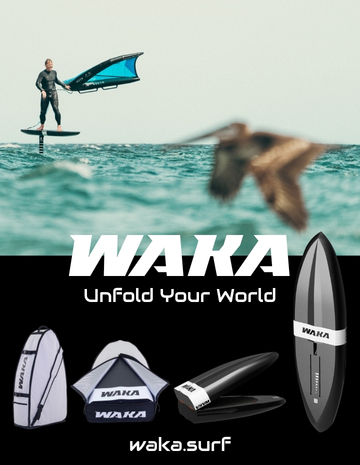
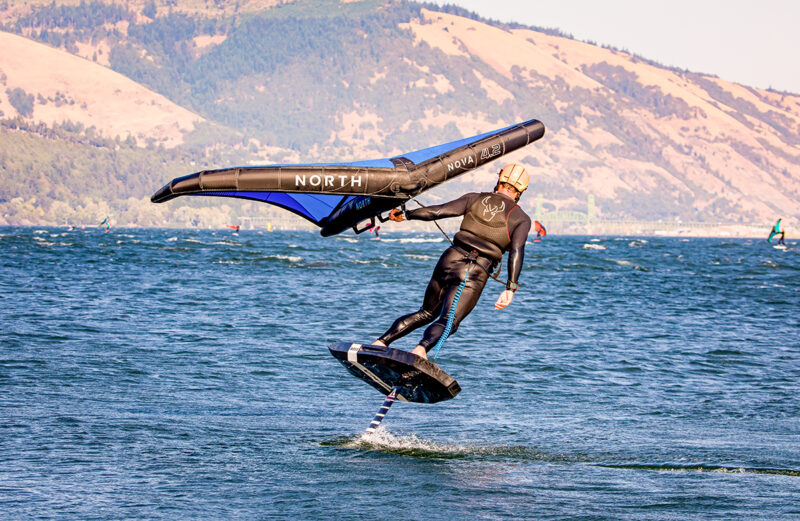
It’s the eternal nuisance. Boards, by their very nature, are chunky. They always will be. Volume, length… everything that’s gonna make your session a good one conspires against you when it comes to airline baggage fees or traveling to the beach on the bus. Thankfully, there are people like Nigel Thompson in the world. The Founder of WAKA – home of the folding foilboards – tells us all about how he came up with the concept, and why it’s now doing so well…
Before we get into the full story of the brand, tell us what got you into this sport in the first place?
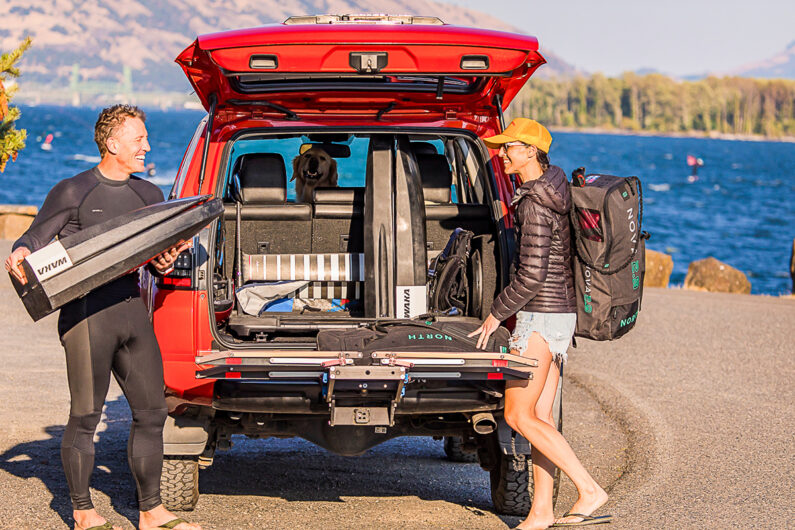
The camaraderie and the adventure. Foiling pulls you to new spots all over the world, where you meet people who share the same obsession. The highlight of my year was traveling with friends to wonderful locations such as the Turks and Caicos, New Zealand, La Ventana, Cape Hatteras and Hood River – completely different waters, different crews, the same magic every time. The not-so-good part was what it took to get there: hauling six- and seven-foot boards through airports, oversized baggage fees, rental SUVs I didn’t want. After getting hassled at an airline check-in desk one too many times with a board bag, I started asking a different question – there has to be a better way. That’s how WAKA started.
So was it pretty much just you at this point?
On the design and engineering side, yes – by choice. From early on it was clear WAKA needed to be lean by design rather than lean by accident. The early operation was deliberately small. The real work was figuring out who to bring in, who to partner with, and where the right tools could do the job of three people. What you see today is the result of that, and it doesn’t look like a typical board brand.
And did you have a background in board building at this point?
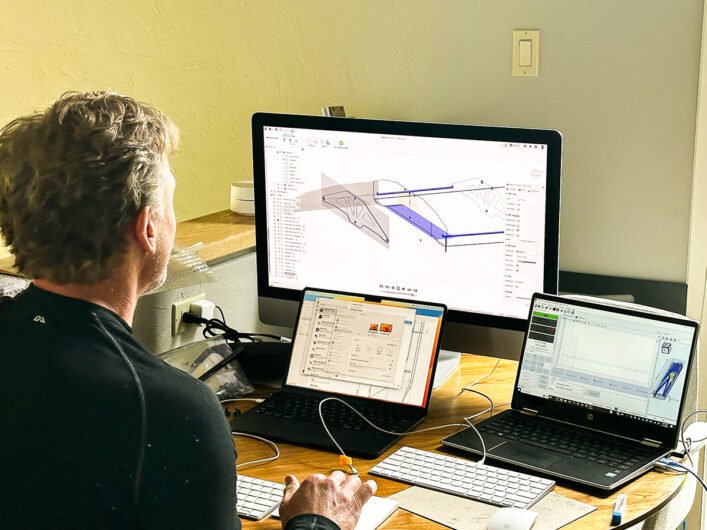
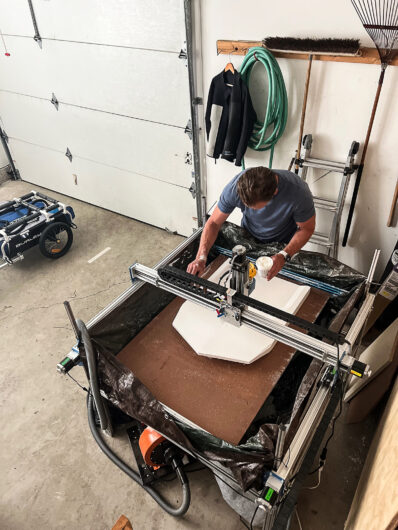
No, I wasn’t a board builder. But I am a product designer. My background is software, not composites, but the principles of design are universal: you approach a problem, strip away complexity until you land on an elegant solution. That’s what I knew I could bring. The composites side I had to learn from scratch – builders’ forums, master builders, a lot of CAD. Then I jumped in: bought our first CNC, set it up in the living room, and – with my wife Mattea’s amazing understanding – started cutting foam inside the house. There are things Mattea has put up with that would break most people, and foam dust in the living room is high on the list. But that’s where the first prototypes came from.
What did that first phase of prototyping teach you, and where did the folding idea come from?
I spent about six months trying to engineer previous sectional approaches into something that actually worked – two-piece boards with carbon rods through the joint, three-piece designs with removable deck pads, and a few other wild ideas I’d rather forget. Every one confirmed the same failure modes: complexity, weight, flex. I was almost ready to throw in the towel. Staring at yet another compromised sectional one day, I said out loud, I just wish the board could simply fold in half – and instantly dismissed it, because a conventional hinge causes every failure mode I’d been hitting. Then I caught myself: why not? What if the hinge wasn’t mechanical at all? That question led me down a new line of research, and it turned out the aerospace industry has been using composite living hinges for years – in drone control surfaces and ailerons. That was the moment I knew I had a real angle.
And how did that turn into the WAKA Glide?
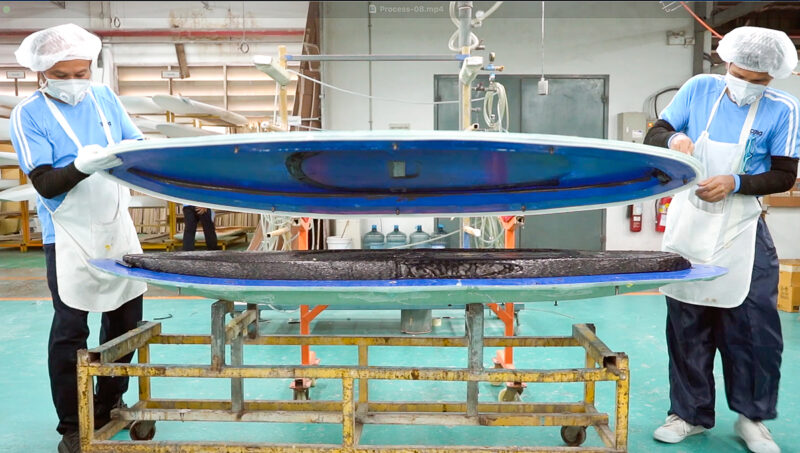
We cycled through folding prototypes fast and landed on a composite living hinge – no mechanical parts, nothing to wear out. I won’t get into the weeds on how it works; the short version is that the structural load and durability tests easily met our requirements, and industrial testing has since conducted over 1M folds without performance compromise. For our flagship product we could only launch with one style of board. We landed on a mid-length weapon – long, narrow, efficient, surprisingly playful – and that shape became the first WAKA Glide. A small group of early investors backed the idea when all we had was a sketch and a patent application – none of what came next happened without them. And once we had a design we believed in, we partnered with a world-class composites manufacturer in Thailand to build it at the tolerances the hinge demanded.
 We understand you got the board in front of a few people in the industry first. How did that go?
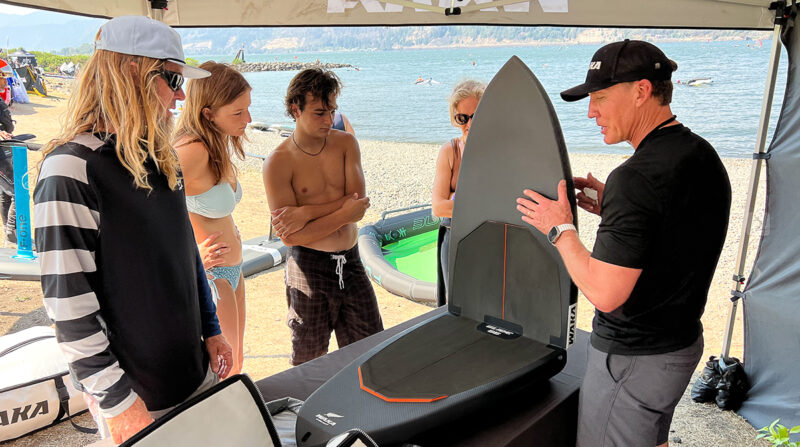
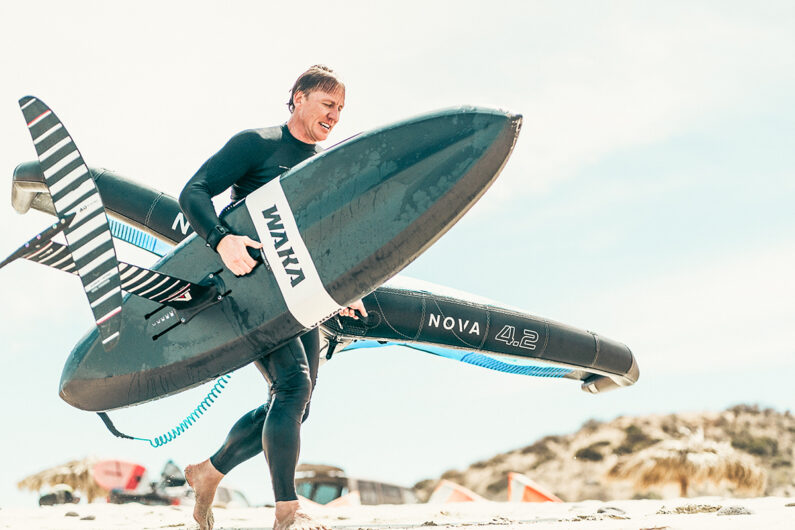
We wanted an honest read before going wide, so we got early boards to our partners at MACkite in Michigan – Jeff and Tucker – for a private review. Jeff’s first reaction, which he happily admits on camera now: “Another gimmicky idea. Probably heavy. The design probably sucks. Probably expensive. Probably a huge compromise.” Fair – that’s every reasonable person’s first response to a folding board. A few sessions in, the tone had changed: “This board is lighter than most boards in the market, even carbon boards.” With that behind us, we unveiled the WAKA Glide at AWSI in Hood River in September 2025 as the world’s first performance folding wing foil board. People picked it up, folded it, unfolded it, and kept looking at me like I was messing with them. The line I keep coming back to: the magic of the WAKA Glide is you don’t even know it can fold in half – it just looks like a sweet all-carbon board, with no compromise on performance.
So now you’re this far in, what would you say has been the biggest highlight for you?
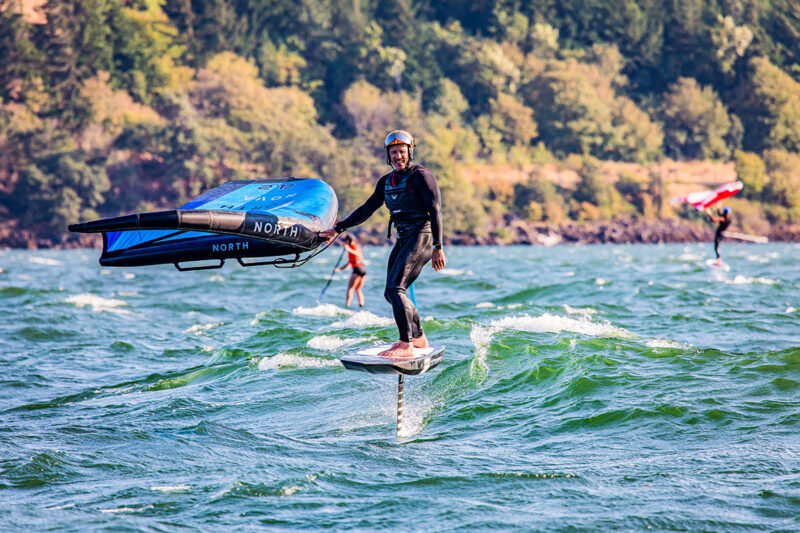
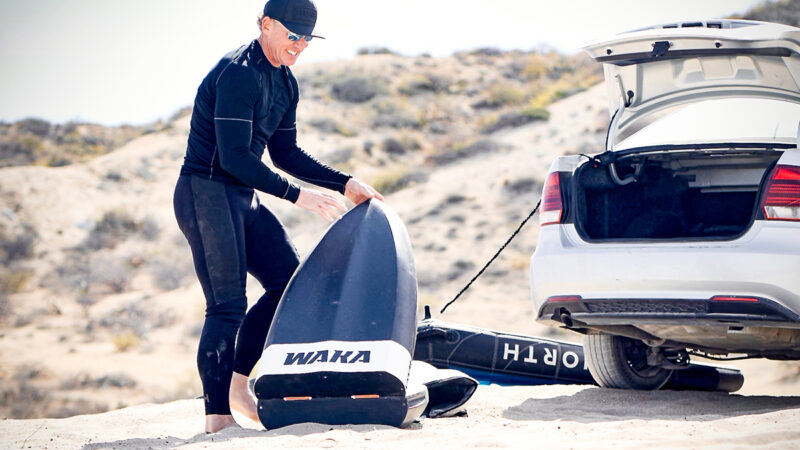
For me, it was flying to La Ventana, Mexico with the WAKA Glide. I’d been in Thailand in May 2025 watching the first production boards come off the line, and a few months later I landed in Baja with a full Rolling WAKA gear bag right at 50lbs, grabbed a compact sedan for half the price of the SUV upgrade, and drove straight to the water. I unfolded the WAKA Glide, assembled it in 30 seconds, and had an amazing session along the coastline – exactly the trip I’d imagined two years earlier. Around that time, Tucker at MACkite posted his full public review; his closing line – “I don’t want to change it. I just want to ride it” – was the moment I stopped worrying about whether the industry would believe us. Since then the photos and clips have been rolling in from across the globe – Mexico, Brazil, the Bahamas, Lake Garda – same story every time: “got off the plane, grabbed a car, was on the water.”
What I love most is watching riders reinvent what’s possible with the sport. Our friend Hydro Gav came up with what he calls the Uber Downwind – board folded into the boot of a regular Uber, ride up the coast, bolt the Glide back together at the top, and downwind the swell home. In his own words: “I didn’t even know I needed this, but now I’ve done it – there’s absolutely no going back.” And it’s not just riders. We’ve been approached by boaties who instantly get it – stowing boards on a boat or yacht has always been awkward and hazardous, and the WAKA Glide solves that elegantly. Use cases like this keep popping up, and honestly – this is exactly why we do what we do every day. Unlocking more adventures on the water – how cool is that.
So where are you based now, and talk to us a little more about the team behind the scenes at WAKA…
WAKA is headquartered in Snowmass, Colorado – a Rocky Mountain town, admittedly an unlikely address for a water sports brand. The year tends to follow the water, though: some of the summer we’re based in Hood River testing new prototypes, with winters split between La Ventana and New Zealand.
I’m the founder and chief designer. Beyond that, we deliberately don’t carry the layers most brands do – in-house factories, large product teams, marketing departments, multi-year cycles. WAKA is what happens when a small team uses the right tools and the right partners to do the work of a much bigger one. Cobra is the clearest example. We treat our manufacturing partner as an extension of the WAKA team, not a vendor. Their Chief Innovation Officer Paolo Cecchetti and his team bring decades of advanced composites and board-building expertise – and that partnership is what helped transform the WAKA Glide from a clever drawing into a real product. Technology is the other multiplier. We’ve built our own AI agentic app server – we call it Viento – integrated across logistics, warehousing, and our consumer and social touchpoints. It does the work that in a traditional brand sits across half a dozen departments. Our reseller partners are part of the team in the same way – not a sales channel but advocates, actively shaping the next generation of product based on what they’re seeing on the water.
In a lot of ways, WAKA represents the next generation of brands and micro-manufacturers: hyper-efficient, technology-leveraged, partnership-driven, and able to move at a pace incumbents simply can’t.
Commercially, where’s the brand at today, and what philosophy is shaping the drive forward?
The WAKA Glide is available at waka.surf and ships today in five sizes – 66, 77, 88, 99 and 111 liters – from warehouses in the US, New Zealand and Australia, with Canada and Europe coming this summer. But honestly – we’re not doing this to be another board manufacturer. We’re doing this because adventure travel is what makes this sport great. The trips, the new spots, the crews you meet along the way – that’s the whole point. If we can take the friction out of getting there, more people get to have those experiences. And watching that unfold is the biggest reward.